This article contains spoilers for Season 2, Episode 9 of “The Pitt.”
Midway through Season 2, “The Pitt” has taken on the perils of the digital age and given me a reason to love the show as much as everyone else does.
Don’t get me wrong — I understand perfectly why so many people, including recent Emmy and Golden Globe voters, have lost their minds over the HBO Max medical drama: The propulsive day-in-the-life of a Pittsburgh ER conceit, the dazzling ensemble cast, the writers’ heroic attempts to showcase our perilously broken healthcare system, the healing power of empathy and, of course, the Noah Wyle-ness of it all. His brilliant and gentle-voiced Dr. Michael “Robby” Robinavitch is as aspirational a character on television as we’ve ever seen.
But having recently spent almost six hours passing out and vomiting from pain in the waiting room of my local ER (which was empty except for one other man), while being told there was nothing anyone could do until the next shift arrived, I confess I have watched “The Pitt” with a jaundiced eye. The regular crowd shots of the waiting room too often reduce the afflicted into a zombie-like horde bent on making life more difficult for our beloved medical staff.
Sure it’s tough to work in an ER when you are worried about your mother’s expectations, grieving your dead mentor, struggling with addiction or worrying about your sister, but no doubt many of those in the waiting room are experiencing similar issues while also in terrifying and hideous pain.
I’m just saying.
In this second season, however, “The Pitt” gave me reason to cheer. It chronicles the day before Robby is set to leave on a three-month sabbatical, and in the early hours, we meet his temporary replacement, Dr. Baran Al-Hashimi (Sepideh Moafi). Having already attempted to force those suffering in waiting rooms to create their own “patient portals,” Dr. Al-Hashimi goes on to advocate for an AI-supported system to aid the doctors with pesky paper work.
Robby, of course, does not think any of this is a good idea and since he is always right (and no television writer is going to openly promote AI), her plan backfires almost immediately. First, with a medical notes transcription that gets Very Important words wrong and then after a complete digital blackout.
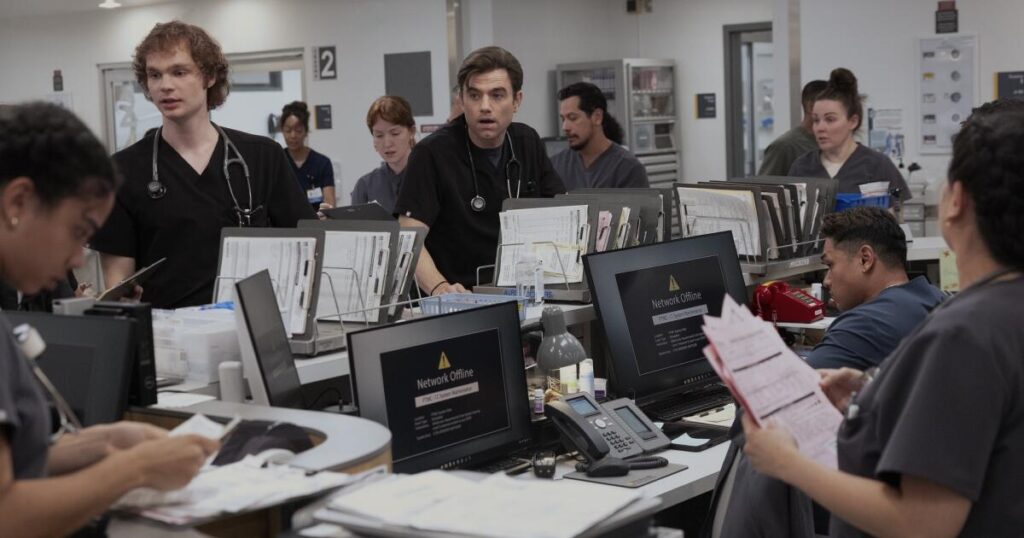
After a nearby hospital is hacked and ransomed, the higher-ups decide to defend its system by shutting it down, which means business must be conducted in the old-fashioned, paper-and-clipboards way.
The result is chaos, and a few too many jokes about young people not knowing how to work a fax machine or manage paper. Some of the more seasoned staff, including and especially the indefatigable charge nurse Dana Evans (Katherine LaNasa), remember the days before everyone carried an iPad well enough to keep things moving. Even so, Dana wisely calls upon the services of “retired” clerk Monica Peters (Rusty Schwimmer).
“Laid off by the digital revolution, not retired,” Monica corrects her. “And how’s all this digital s— working out for you now?”
This is where I cheered. I love the digital world as much as the next person currently typing on a computer to file a story that I have discussed with my editors on Slack and that I will not see in hard copy until it appears in the physical paper. But like pretty much everyone, I have suffered all manner of digital breakdowns and mix-ups, not to mention the inevitably increased workload that comes with the perception that I can do the work of previous multitudes with a few additional strokes of a keypad.
Except, of course, that’s a lie — a keypad is capable of nothing on its own. Neither are fingers, for that matter. They must be manipulated by someone whose brain has to figure out and execute whatever needs to be done. This requires an ability to navigate the ever-changing tech systems that store and distribute information (often in ways that are not at all intuitive) while also understanding the essentials of the actual work being done.
In “The Pitt,” that is the emergency medical treatment of human beings, which requires all manner of physical tasks. As this storyline makes clear, many of the medical staff do not quite understand how to order or handle these tasks without a screen to guide them.
Hence the need for Monica, representative of a large number of support workers who do understand because it was once their job to keep everything moving, to answer all manner of questions, prioritize what needs to be fast-tracked and make sure nothing falls through the cracks while also engaging with all and sundry on a human level.
The shutdown is obviously an attempt to underline the limits of AI but it also serves as a fine and necessary reminder of how readily we have surrendered people like Monica, with their knowledge and experience, to keyboards and touch pads (which, of course, don’t require salaries, benefits or lunch breaks).
But — and this is important — computers are tools not workers. Alas, that has not kept companies in virtually every industry from drastically cutting back on trained and experienced employees and handing large portions of their work (mental if not physical) to people, in this case doctors and nurses, who already have demanding jobs of their own.
But hey, you get a company iPad!
Often, including with those patient portals, what was once paid labor lands in the lap of the consumers, who in “The Pitt” are people sitting in an emergency room and likely not at the top of their game when it comes to filling out forms about their medical history or coming up with a unique password.
ER dramas, like the “The Pitt,” are inevitably fueled by the tension between the demands for speed and the need for humane care, something that is increasingly true, if not as intrinsically necessary, in all facets of our culture.
With computers in our pockets, we now expect everything to be available instantly. But when something in our online experience goes wrong, we need an actual human to help us fix it. Unfortunately, as the overwhelmed staff of the Pitt discover, those people are increasingly difficult to find because they have been laid off — even nurse Dana can’t do everything!
Dr. Al-Hashimi, like many, believes that patient portals and AI-assisted medical notes will save time, allowing the doctors and nurses to spend more of that precious commodity with their patients. But, as Dr. Robby and Dana repeatedly argue, what they really need is more staff.
There’s no point in saving a few minutes at the admittance window, or on an app, if you are then going to have to spend hours waiting for or trying to find someone who can actually help you when you need it.
That is certainly true in the medical sector, where digital technology has done little to eradicate long wait times for medical appointments or in emergency rooms. Being treated in a hospital hallway by people who can barely stop to talk to you is not an uncommon occurrence for many Americans. The U.S. is facing a critical shortage in hospital staff, with the ranks of registered nurses and other medical personnel having plummeted post-pandemic, often due to burn out.
The amount of time the staff of “The Pitt” spend with each patient, while dramatically satisfying, is almost as aspirational as the wisdom and goodness of Dr. Robby.
None of these problems is going to be solved by AI or any other “time-saving” device. We have not, as far as I know, figured out a way to extend an hour beyond 60 minutes or modified the human body so that it does not require seven to nine hours of sleep each night.
Medical institutions aside, I can’t think of any place I have visited lately that wouldn’t have benefited from more paid and experienced workers, especially those who know how to do things when computers glitch or fail.
The minute Monica sits down and starts barking orders in the ER, everyone feels much better. Here is someone who understands what needs to be done, why, and how to make it happen. Moreover, she has eyes, ears, hands and human experience enough to know that, in the end, people are less interested in saving time than getting the care they need.
In the ER and everywhere else.
The post As ‘The Pitt’ suffers a digital meltdown, a human with analog experience saves the day appeared first on Los Angeles Times.