For centuries, Chinese educators took their marching orders from Confucius, for whom the purpose of schooling was to instill moral virtue, filial piety and civic responsibility in the young, and to foster reverence for China’s literary classics. No-nonsense goals like these left little room for a playful children’s literature to gain a toehold. Taiwan published its first wholeheartedly child-centered picture books in the 1960s; mainland publishers made their own fledging effort a decade prior but did not fully commit to the genre until the early 2000s.
While English-language editions of Chinese children’s books remain a comparative rarity, the pace of imports has quickened in the last few years, opening the door a crack wider to a fascinating instance of cultural catch-up that often combines contemporary approaches to storytelling with Eastern visual narrative traditions that have a venerable history of their own.
Hsu-Kung Liu, the Taiwanese author-illustrator of the horizontally bound LITTLE MONK WRITES RAIN (Eerdmans, 48 pp., $18.99, ages 4 to 8), translated by Rachel Wang Yung-Hsin, paints with a light touch on double-page spreads meant to be read top to bottom, like a vertically formatted scroll, rather than as a Western-style left-to-right book. The story concerns the Buddhist monks of a remote mountaintop temple, among them a boy who is incapable of learning to read.
Every day after Little Monk completes his chores, he practices painting the only Chinese character he has succeeded in memorizing: the one for “rain.” Compulsive behavior or meditative act? Liu’s feathery fable accommodates both possibilities, even as the boy grows up to become Big Monk without altering his routine by a smidgen.
One day, when a drought grips the valley below, the monks trek down to pray for rain. Big Monk brings a basket filled with his drawings as an offering. A sudden wind catches hold of the papers, sending them skyward, and a cloudburst promptly ensues. But instead of playing up the heroic interpretation of Big Monk’s role, as a Western author might have done, Liu draws the tale to a close with a far-off glimpse of the monks walking side by side in loose-knit rows, a microcosm of the vast, invisible scheme of existence in which everyone has a place in the pattern and no one is irrelevant.
An otherworldly element also shapes the narrative of Cao Wenxuan’s YULU’S LINEN (Caitlyn Dlouhy/Atheneum, 48 pp., $19.99, ages 4 to 8), translated by Helen Wang, about a talented 8-year-old whose father buys her a linen canvas on which to paint her first self-portrait. The special cloth was initially earmarked for a famous artist, and it proves to have an impish life of its own. Out of resentment for having fallen into lesser hands, the canvas repeatedly sabotages the child’s efforts by causing her paints to run. A reader steeped in China’s spirit-rich mythology may be well prepared to savor the fun-house weirdness of this pivotal premise; for others, an explanatory note about the cultural context probably would have been helpful.
Cao is China’s most celebrated writer for children — the author of “Bronze and Sunflower,” a haunting middle grade novel set during the Cultural Revolution, and the picture book “Feather,” among other works available here in translation. Yet the Korean artist Suzy Lee, whose robust mixed-media drawings animate every page, may be better known to Western readers (for her agile Border Trilogy, comprising the picture books “Mirror,” “Wave” and “Shadow”).
Adding to the project’s luster, the story comes printed on extra-heavy textured paper meant to approximate the sumptuous feel of the linen cloth that Yulu ultimately makes her own.
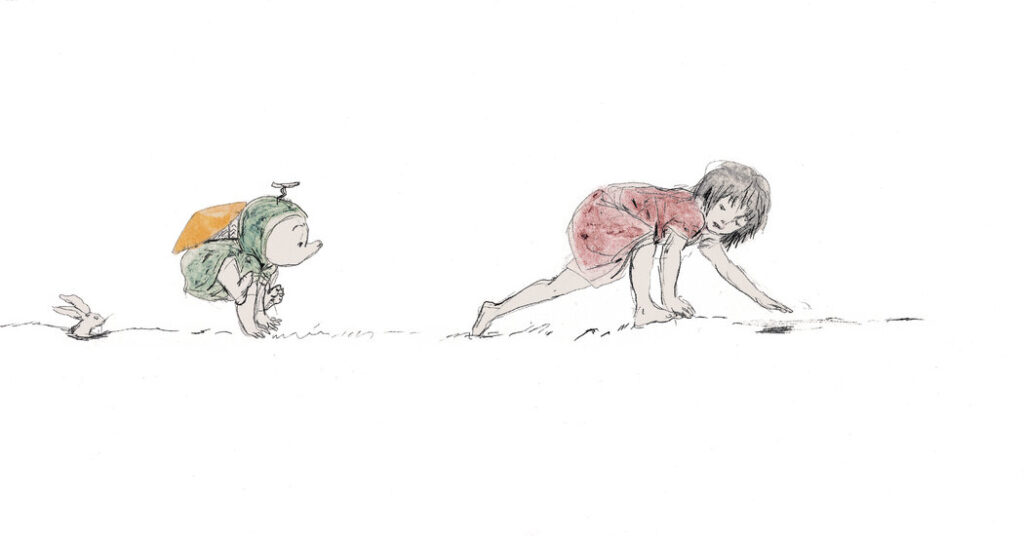
The Chinese author-illustrator Xiong Liang emerged from an intensive study of traditional Chinese ink wash painting soon after the turn of the millennium to become one of his country’s first internationally recognized children’s book creators. LOST IN PEACH BLOSSOM PARADISE (Elsewhere Editions, 86 pp., $24, ages 8 to 12), translated by Chloe Garcia Roberts, is the stand-alone first volume of a mirthful seven-part illustrated middle grade fantasy series featuring Little Yu, a fearless schoolgirl whose adventures begin, in archetypal fashion, when she wanders farther than planned into an old-growth forest.
Propelled by curiosity, she spies delicate out-of-season peach blossom petals floating in the river and decides to track them to their source. Then she meets (ever so briefly) a darting toylike creature called a Treeling, and resolves to track him down, too.
Xiong’s kinetic landscapes crackle with the mythic energy of superabundant spirit forms, including some disguised as beasts and berries. Will Little Yu survive the towering demonlike guardians who one by one block her way along the road to what turns out to be a hidden magical realm known as Peach Blossom Paradise? A supple fantasist and prankster, Xiong makes amiable bumblers of these half-baked gatekeepers.
Like Alice in Wonderland, Little Yu soon realizes that she has no reason to yield to the dubious authority figures in her midst. What would Confucius have said about that?
The post Art and the Otherworldly in Three New Chinese Picture Books appeared first on New York Times.