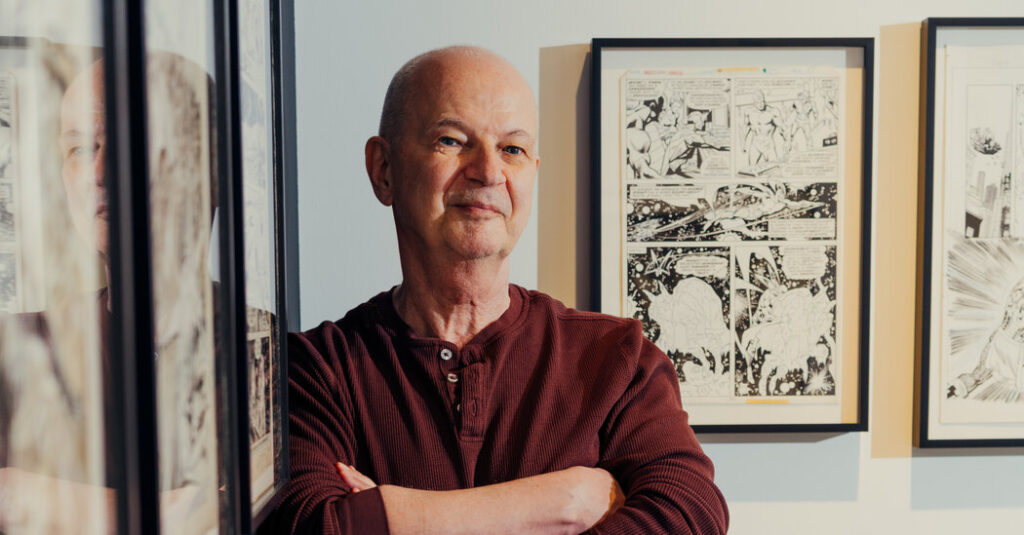
Klaus Janson, the veteran comic book artist, in his work with the writer-artist Frank Miller helped save Daredevil from cancellation and catapulted Batman to new heights. For his latest achievement, Janson is flying solo.
His pages and covers featuring Daredevil, Batman, Spider-Man, Superman and other characters will be on display in an exhibition of his work at the Philippe Labaune Gallery in Chelsea, running through April 11.
For Janson, 74, the show represents how far the appreciation for comic art has come. “Sequential narrative deserves recognition,” he said in an interview. “That’s part of my motivation for doing this exhibition and I hope that people walk away from the exhibit with a growing appreciation of what comics can do.”
Janson provided insight on some of the pieces.
Daredevil, interior page
“We did three years on Daredevil and we went through a personal evolution and an evolution as a team,” Janson said. Miller was the writer and penciler (who draws the initial images and lays out the page) and Janson was the inker (who gives proper weight to each line). “I distinctly remember how deeply he pressed the pencil to the page,” he said. The grooves were so deep that Janson joked that he could pour ink into them to get the job done. Later, Miller shifted to providing only layouts, including the dialogue, for Janson to pencil and ink. “It was perfect. There was no change in dialogue from what he gave me to what was eventually published.”
Jemm, Son of Saturn, cover
Original art — with its erasures, white out and ink smudges — can provide a view into the human labor behind each page. Coloring, a separate step, is not typically done on the original work. On the bottom of this page are Janson’s handwritten notes to the colorist. “I was feeling my oats at the time and starting to boss around the colorists and tell them what to do,” he admitted. “Whoever did that job, I apologize.”
Superman, cover
“Superman was the very first character that I read when I was 5 years old when I came over from the old country, meaning Germany,” he said. “I had discovered comics at a local, little store that basically sold cigars, comics and dust.” It had a profound impact. A Superman comic helped him learn “how to speak the language and read the language by putting the words together with the pictures.”
Batman and Spawn, cover
A meeting between characters from separate publishers is catnip for fans — and creators. When Janson was asked if he would draw Batman (DC) and Spawn (Image Comics), he thought, “Are you kidding me? I’ll drop everything.” A lot of the Image artwork from that period had a wild, kinetic energy, filled with billowing capes and inventive layouts. Janson tried to honor that aesthetic. “The page layouts were not necessarily vertical and horizontal. They were a little diagonal-ish.”
Batman and Robin, cover
Batman: The Dark Knight Returns, from 1986, was a runaway success and spawned sequels: The Dark Knight Strikes, in 2001, and Dark Knight III: Master Race, in 2015, which reunited Miller and Janson. The cover depicts Carrie Kelley, a female Robin introduced in 1986. She later becomes Catgirl and then Batwoman, when she graduates from apprentice to partner. “You could feel the air shift in the room,” Janson said about the popularity of the original series. “My career would not be the same without it.”
Jack Kirby
For an image honoring Jack Kirby, who with Stan Lee cocreated many of Marvel’s most popular characters, “it was one of those things that wasn’t a struggle,” Janson said. He kept him casual. “That’s the way I think of Kirby, just a genius without a lot of strain.” Janson occasionally saw the King, as he was known, at Marvel’s offices. “He literally was always encircled,” Janson recalled. “And the funny thing is when he would walk down the hallway, that circle would walk with him.” But he never approached Kirby: “What could he possibly be interested in that I would have to say?” He regrets that, but “even seeing him was a treat.”
Bullseye and Daredevil
This piece, which was used for a collected edition of Daredevil stories, “was done in a wash, meaning diluted ink,” Janson said. He showed it to his mentor, Dick Giordano, a comic book artist and editor, and gave it to him. “I treasure the memory I have of going to his house when I was 18 and showing him my pages and the counsel that he gave me and the insights he provided about the business.” After Giordano’s death in 2010, the artwork was returned to Janson.
George Gene Gustines has been writing about comic books for The Times for more than two decades.
The post An Artist of Caped Crusaders Emerges From the Shadows appeared first on New York Times.