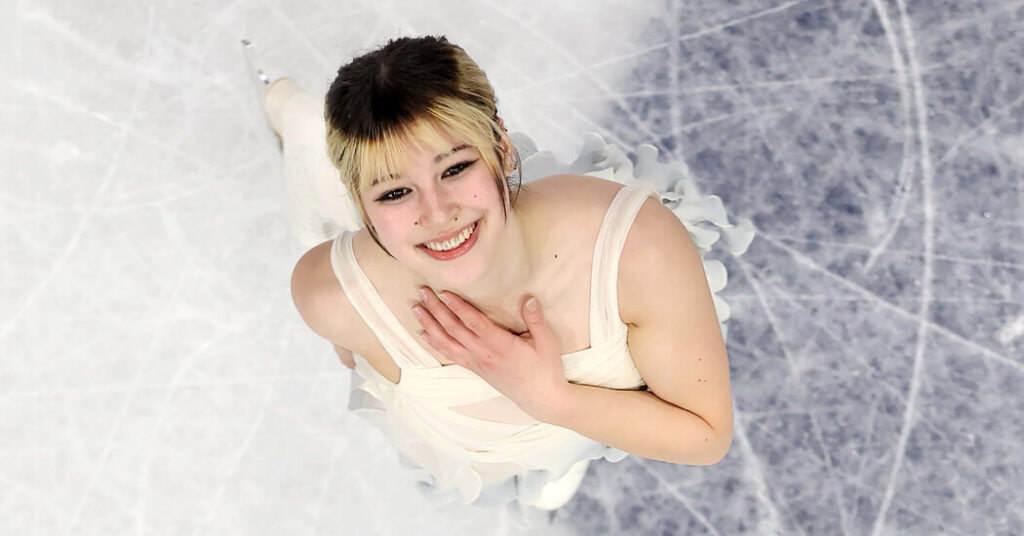
Alysa Liu, the effervescent figure skater who won gold at the 2026 Olympic Games, moves like a dancer. She’s studied many forms of dance over the years — flamenco, tutting, ballroom, contemporary, modern contemporary, ballet and, her favorite, hip-hop, for which she still takes classes at an Oakland studio with her friends. “Hip-hop style doesn’t really go on the ice, funny enough,” she said over breakfast at a New York City diner this week.
But Liu’s full-body approach to skating, rooted in a plush, pliant plié, isn’t such a stretch from that expressive, highly rhythmic dance form. While many skaters glide on top of the music, she lives inside of it, showing — in her spontaneous, joyful way — a deeper sense of inner life.
That much was clear during her performances at the Milan-Cortina Games. Liu, 20, who had retired at 16 before returning to the sport two years later, entered a flow state in her electrifying free skate set to the disco of Donna Summer; the audience was pin-drop silent during her soulfully quiet short program to Laufey’s pop-inflected jazz; and she leaned into the hyperpop of PinkPantheress and Zara Larsson in an exhibition performance. Liu becomes, for each, an extension of their voices.
“The music allows me to get there, which is why it’s so important I skate to music I like,” she said. “I know every beat, I know every lyric. My body feels it.”
She talked about her approach to performing, the role of music and modernizing the sport. Here are edited excerpts from the conversation.
What did you tell yourself before you started your free skate?
I visualize my entire program multiple times before I do it, but I also visualize the patterns of my breathing. I practice my breath while envisioning the program.
I can really sense that, especially in your jumps. I don’t see preparation, and I don’t get nervous watching you, which is one of my favorite things in life: not to be nervous watching a performer.
We really value musicality. We’ll edit the music to match the jump sometimes. If I don’t have enough time to get from point A to point B — to land a jump on the crash or something, we will add in more music just so that I can. I think all my jumps have a timing for all of it. I don’t miss a step. For me, the music carries my body. It tells me what to do. Even though it’s all planned, it’s just so natural. Like I wouldn’t be moving any other way.
Do you think of skating as dancing on the ice?
Yeah. Although, I will say figure skating does not artistically satisfy me. I’m really big into photography because that does satisfy my creative. And then I have to keep dancing off ice because there’s some things on ice you can’t do when you’re wearing your skates. So it’s not enough for me, artistically. Athletically, it is enough. Like I can really push myself. Dance, I can do anything and everything.
John Curry brought balletic artistry to the sport. He won the gold medal in 1976, and he felt he needed it to make himself and skating more popular in order to start his own company. Do you think about how you will influence skating?
You know, it’s actually been a really deep struggle in whether I want skating to be big or not.
Why?
I’m glad for it. I wouldn’t change my childhood at all. But I feel like no child should go through that. Figure skating can be so hard and the parents that put their kids into skating — sometimes they get so into it. Sometimes it’s not toxic, but it usually is — especially at the top. Most skaters have had bad experiences.
There’s so much discussion around body image in dance. How did you deal with yours as a skater?
Took a long time, actually. Years. I got a sports psychologist. I had it bad from when I was a little kid until when I quit skating — not even. It took another year. I would say 17 or 18.
It seems like when you felt comfortable with your body image, then your mind could be free. Is that right?
Yeah, it really sets you free. And the work culture, the training culture. It was crazy. I had not a day off. I would not want any kid to not have a day off. Coaches need better training.
I wonder about ways to modernize skating a little bit, to make it a little more experimental without cheesing it up. Because I love it like you do, but —
Things gotta change, 100 percent. I think the whole system’s got to scrap it and start over. The competition system and the setup just isn’t fit for consumption, honestly, because the competitions are too long, no one can sit through and watch all that. And people don’t understand the scoring. Sometimes I don’t either. And music is a big thing. Copyright.
Music rights were a mess this time.
Lucky for me, the artists really like when I skate to their music, but one day I might be unlucky.
What was it like to find yourself in the center of all this political discourse?
Ooh, am I?
I don’t know if you feel you are, but there is all of this discourse around you and Eileen Gu. China and America are viewing you as like a liability or a hero.
Yes, I’ve seen that. I’ve known Eileen since I was 13 or something. We’re from the Bay Area. She’s super nice, and her mom is from China. I think people are hypocritical for shaming her for representing China. So in my head it’s a bit hypocritical, because her mom is an immigrant. Y’all would have told her to go back to China. Now that they’re back in China, you’re mad. [Laughs] And it’s sport, it doesn’t matter what country we represent. Sport is sport, and she has a love for competition, she has love for the game. I think that’s all that matters. There’s no shame in going to where opportunity is.
You retired from skating at 16, and it was after a skiing trip — your first time — that you decided you wanted to return. Did you figure out that you missed the glide?
That’s what it was! It’s the glide. You can’t get that anywhere. Roller coasters, you go fast and they’re smooth, but that’s not glide. I love gliding. Ah! Even roller skating, it’s not as smooth. It’s because you’re on a blade that’s so thin. It feels so whimsical and ethereal. When I went skiing, I felt it. I glided for the first time since I quit, and I was like whoa.
In your announcement on social media that you were going to retire, you wrote, “For real, this skating thing taught me a lot.” What did it teach you then versus now?
Then, it taught me what I liked and what I didn’t like. I disliked a lot of things in my life, but that gave me clarity. I was grateful because I realized, well, I really don’t like this. I don’t like being away from my family for years. I hate feeling lonely, and I don’t like not being with my friends.
And now?
Now it’s teaching me there are so many new ways I can express myself. It taught me that I love to use my willpower. There’s this thing in our brain called the aMCC [anterior mid-cingulate cortex] and it’s basically where your willpower is stored. I really love the feeling of fight and I think for me, I don’t want life to be like this. [She moved her hand across in a flat line.] I want ups and downs. I want to experience all the emotions, and sport is so intense. You can feel such extreme emotions, and I think that’s beautiful. It’s hard to find that in your life.
Gia Kourlas is the dance critic for The Times. She writes reviews, essays and feature articles and works on a range of stories.
The post Alysa Liu on Dancing Her Way to Gold: ‘The Music Carries My Body’ appeared first on New York Times.