CAMBRIDGE, Mass. — It was just after 6 a.m. on Saturday when Soheil Fathi learned a wave of missiles were striking his hometown. As he scrolled through the news, his wife asleep beside him, he began to shake, his every thought on his parents in Tehran.
By then, Fathi’s father was attempting to get home through streets clogged with thousands of panicked drivers. The trip from his father’s factory, normally about 40 minutes, took nearly four hours.
Soon after, his mother and father managed to call from a landline. Since then, the one-way calls have been brief and unpredictable. His parents are safe, they think, after fleeing to a relative’s home east of Tehran. But Fathi also knows that nowhere is completely secure in a widening and volatile war.
For Fathi and many others in the Iranian American community — about 750,000 people — these are difficult and momentous days. The country they call home is attacking the country where their families live, provoking a complex array of emotions: fear and helplessness, sadness and dread, relief and hope.
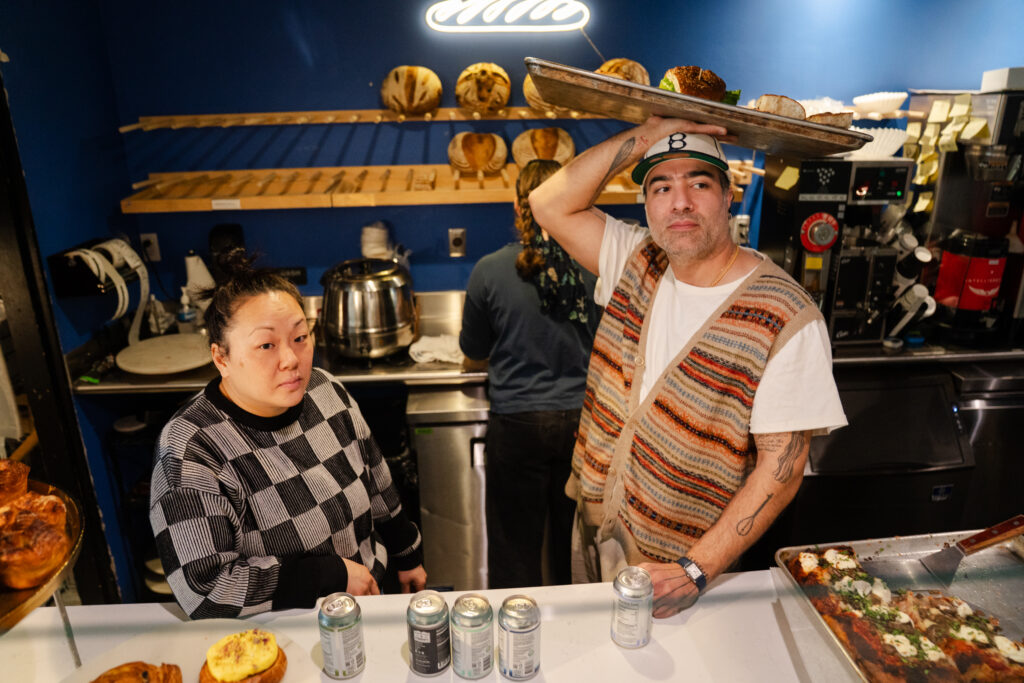
Fathi, 44, came to the United States in 2017 with his wife Sarah Moridpour and their young daughter, and the couple later opened two bakeries in the Boston area. Since the U.S. and Israel launched their assault on Saturday, Fathi and Moridpour have stumbled through their daily routines, Fathi said, the conflict always in the back of their minds.
On Wednesday, the fifth day of airstrikes, Fathi’s mother left a voicemail saying she and his father were all right and sending their love. Their updates generally have been terse: His parents have heard planes overhead and one explosion. They have enough supplies and are staying inside. His father’s business — a wholesale bakery and several cafes — is shuttered. One of their locations was damaged in last year’s 12-day attack by the U.S. and Israel.
When Fathi has spoken to his father, he detects a new looseness in his voice, a willingness to say things he wouldn’t have said before. Perhaps it’s frustration boiling over, Fathi thinks, or a decreased worry about surveillance.
Fathi doesn’t refer to Ayatollah Ali Khamenei, Iran’s supreme leader, by name, but he’s glad he’s gone. “They hit the guy, everybody was happy,” he says. Still, that satisfaction is tempered by a wave of dread about what will come next and how many innocent people will die.
His parents are alive, but each time he checks the news — dozens of times a day — it seems as though more places have been bombed. His daughter is in third grade, the same age as some of the scores of students killed in an airstrike on an elementary school for girls in the city of Minab.
Fathi thinks of his own childhood in 1980s Tehran during the grueling eight-year war between Iran and Iraq, hearing sirens and hiding under tables. The ensuing decades of striving for basic freedoms under a brutal dictatorship. The women’s rights movement violently suppressed in 2022. The thousands of protesters killed by the regime earlier this year. His eyes fill with tears.
“I’m a baker,” Fathi says, sitting next to a small counter as customers file in on a sunny morning to pick up bread and croissants. It feels futile for him to hold forth on politics. But he believes that Iranians had exhausted their options for bringing about change. “Someone has to come in from outside,” Fathi said.
He knows others may disagree, including an employee who is also from Iran. Her parents, too, are in Tehran. They were finally able to call on Tuesday, she said, three days after the war began. (She asked that her name not be used because of the sensitivity of the situation.)
The call lasted about a minute. In the background, she heard a boom and asked her mother if it was a bomb. It was, her mother said, but far away. After the call, the employee sank to the ground in the bakery’s parking lot, weeping. Now she falls asleep each night with her phone in her hand.
“No one from the outside can bring us democracy and freedom,” the employee said. She recognizes some of the places being struck with bombs and missiles: a major highway, a square near Tehran University. “It broke my heart, because this is my city,” she said.
Fathi’s youngest brother, a U.S. citizen, fled Iran for Boston days before the war began, fearing the worst. Since arriving, he wakes up to nightmares he can’t remember, seized with worry for his parents. He too asked that his name be withheld.
Fathi’s brother was in Tehran last year when the U.S. and Israel launched their first coordinated attack. When you’re there, he said, the only thing to do is survive, and information is scarce. In Boston, meanwhile, he’s grappling with a daily overload of news and reports circulating on social media, not knowing what to believe. Will the U.S. send in ground troops? Are insurgent militiasreadying their own attacks? Who will succeed Khamenei?
Almost a decade ago, Fathi and Moridpour arrived in the U.S. not knowing whether they would stay. Moridpour’s father was receiving treatment for stomach cancer in Boston and told them not to go back to Iran. It’s not a place to raise your daughter anymore, he said.
Fathi spent a year driving for Uber and Lyft, then got a job as a baker, a skill he first developed in Tehran. During the pandemic, he and Moridpour began eyeing a tiny retail space available in Cambridge. They opened La Saison bakery in November 2020, with Fathi in back and Moridpour up front. Moridpour’s father died four months later.
At La Saison, there are nods to Fathi and Moridpour’s heritage everywhere. Lattes flavored with rose, saffron or pistachio. A quote from the poet Rumi — “We are born of love; love is our mother” — in red block letters on a window. Small packages of traditional chickpea cookies ahead of the upcoming festival of Nowruz, the Persian new year.
On Wednesday, Moridpour juggled the lunchtime rush at the bakery’s second location along with a photo shoot for a line of sandwiches. It helps to be around people, she says, but she feels like there is always something in the back of her head, a voice shouting about what is happening in Iran.
She fears what conflict does to civilians. Growing up, she remembers always seeing refugees from neighboring war-torn Afghanistan. She finds herself struggling with despair that the violence will get worse while “still wanting to grip to hope underneath all of this.”
Meanwhile, Fathi and his brother watch their phones each day for a call from their parents. By nighttime Thursday in Iran, there was still no word from them.
Tomorrow, Fathi thought, maybe tomorrow.
The post A son waits for a daily call from Iran saying his parents are still safe appeared first on Washington Post.