When I was painfully single in my 20s and 30s and living in a converted garage in Chicago, I worried about the first impression a potential partner would get of me.
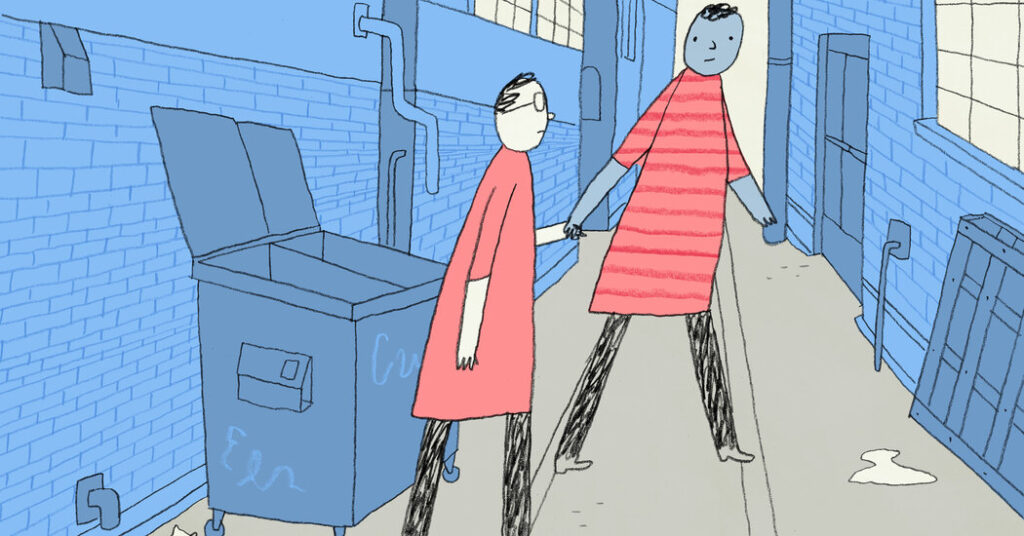
The back door of the garage was my front door, meaning I had to walk whoever I was seeing down the alley, past dumpsters and through the scent of rot to get to my place. In the summer, the smells would sometimes even follow us inside.
For a while after I moved in, people would knock at my door thinking I was the previous tenant, who apparently had been a local drug dealer. It wasn’t exactly the romantic, post-breakup fresh start I had imagined.
I’m an artist and a teacher, and the garage’s first room was my studio, filled with a range of works in progress — what I have come to think of as a different kind of garbage, a visual display of my insecurities and neurotic tendencies. A living metaphor for everything churning in my private world.
When I brought home a date, I would always rush through that first room to get to the second to avoid unnecessary questions or potential back-outs before disrobing and getting to business.
Kevin was one of the first men I allowed into my space. A well-meaning data analyst, he genuinely wanted to understand what I did for a living. As he looked around my studio, his brow furrowed. “Is this your work?” he asked. “Is this what you do all day when most people are working?”
I laughed it off but died a little inside.
For a long time, I struggled with the fear that if someone only saw the alley, the trash and the oddness of the space, he would assume I was a loser. A guy in his early 30s living in a converted garage behind a dumpster. I didn’t have an upwardly mobile job. I didn’t have a clean narrative.
I talk about this a lot with my students, how it may be cool to be an artist in your 20s, but as you get older, the charm wears off. People stop asking about your process and start wondering if you’ve failed. If you stick around long enough, they start giving you awards for endurance. For surviving the lifestyle. But still: Why would anyone pushing 50, as I am, choose to live in an alley?
It took years for me to understand what the impetus was for why I made art — and for whom. When I was a graduate student at the School of the Art Institute of Chicago, sitting in a first-day group introduction, everyone was giving their polished opening lines. “My work explores postmodern structures of feminist identity,” or “I’m interested in the implications of minimalist space in landscape.”
When it got to me, I blurted out, “I make art because I want people to like me.”
My instructor paused and said, “That’s the first honest answer to that question.”
That longing — to be liked, not necessarily understood — never fully left me. Especially when it came to dating. The longing for unconditional acceptance doesn’t fade on the personal level just because the professional starts to look better.
Over the years, through a string of missed connections and bad dates, a quieter fear took root — that I was simply too much. Too strange. Too intense. Too, well, me.
At different points, I tried to make sense of my craving for love and my creative need for solitude by looking to others.
I sought refuge in my Aunt Katie, my godmother and an Ursuline nun, who spoke of the empowerment and liberation found in celibacy. There was comfort in her devotion, in the sense that solitude could be sacred, not shameful. But we’re human; I was human. And also horny, though longing for more than just a quick connection.
At the same time, my therapist offered bits of wisdom that stayed with me as I navigated dating and long stretches of aloneness. One was: It doesn’t have to be perfect with the person you’re seeing. You can notice the imperfections. What we’re doing in relationships is practicing, rehearsing, even healing our previous disconnections.
And my favorite: Being in a relationship means two people keep showing up. When one person stops choosing to show up, that’s when it comes apart.
So I told myself: Just keep showing up.
By the time I met Ed, I genuinely wanted it to work. Which meant I dreaded taking him home even more. There was more to lose. If he read the cues too fast — trash alley, no furniture, colored pencil shavings under my fingernails — he might think I didn’t have my life together.
Ed was 10 years older than me. At first, I assumed it was a friend-zone situation. He was warm but measured. I put his name in my phone as “Ed the Banker.” The lack of a last name kept it casual. Low stakes made it easier to manage my heart.
The night I brought Ed home was his 50th birthday. I hadn’t planned to shoulder that kind of pressure so early, but it was close to Halloween, and I figured: Why not put on a costume and pretend like I was adult enough to sustain an adult relationship?
He suggested we get tacos at his favorite pork place in Pilsen. Apparently I gave him a spoken-word poem as a birthday gift; I cringe thinking about what I might have said.
As we approached my place, I gave him the usual spiel. The alley, the converted garage, the dumpster and the disclaimer: I’m an artist. These places are hard to find, you know? Because I really liked this guy. And I was waiting for the judgment.
But that night, there was an electrical outage across Chicago. I tried to use that as a way out — maybe we should just call it — but he said he didn’t care. We made our way through the alley in the dark, and he joked, “You’re not going to kill me, are you?”
In the darkness that night something shifted. Without lights, without the glare of being sized up by someone new, I didn’t feel exposed. We stumbled into my place and settled in without ceremony. No questions about the art or strained compliments from him. No half-explanations about why I lived this way from me. Just darkness and quiet.
That night, something happened I hadn’t expected: I felt safe.
In the quiet, in the dark, with someone I suddenly didn’t think I had to impress, I felt something I had never associated with love before. Calm. Stillness.
It took me years to understand that the racing thoughts, stomach flips and need to perform that I used to interpret as love was really my body trying to warn me. My nervous system screaming: Get out.
I remembered the long train rides home during my Brooklyn years, crying after a fight with my first lover. Asking: Why wasn’t I enough? It later segued into my next brief relationship. Also an aspiring artist, he would point out the stains in my jeans from an accidental brushstroke when we were out at dinner, suggesting that the mess was not charming, not presentable.
I kept mistaking anxiety for butterflies. The intensity was familiar. Confusion felt magnetic. That was the pattern.
But Ed didn’t confuse me. He didn’t thrill me with detachment or keep me guessing. He listened, stayed, promptly replied to my text messages. He folded into the space without making it smaller.
That’s what made it real. It wasn’t the tacos or sex or candlelight. It was being with someone who didn’t make my body want to bolt. We were each other’s protectors.
In the morning, with the power back on, nothing had changed in my studio. It was the same mess, the same me, now fully visible. But Ed stayed, and has been coming back for more than 10 years.
There’s still too much clutter. Drawings cover the floors and walls. There’s barely a line between where the work ends and where I live. But something in me has shifted.
The dumpsters are still outside my door. The bad smells. But I no longer worry about that or apologize for my life, or at least not as much. I have learned that it’s not about fixing things. It’s not about boxing up your mess or smoothing your edges. It’s about letting it all live together.
And that’s love, I think. Not a performance or a show. Just being with someone who makes you feel safe in the lightness and the dark.
William J. O’Brien is an artist and educator in Chicago.
Modern Love can be reached at [email protected].
To find previous Modern Love essays, Tiny Love Stories and podcast episodes, visit our archive.
Want more Modern Love? Watch the TV series, sign up for the newsletter and listen to the podcast on iTunes or Spotify. We also have two books, “Modern Love: True Stories of Love, Loss, and Redemption” and “Tiny Love Stories: True Tales of Love in 100 Words or Less.”
The post A Power Outage Made Us Possible appeared first on New York Times.