In a too-bright rehearsal room at the Young Vic theater in London last month, the vibe was fraught. It was the end of a long day, and one of the actors, try as he might, was struggling to remember his lines. The scene they were running through, from the 1994 Arthur Miller drama “Broken Glass,” was undeniably tense: a confrontation between husband and wife exposing a lifetime of bewilderment and hurt. Peak Miller. But not all the strain seemed to be in the text.
If the production’s director, Jordan Fein, was anxious, however, there was little hint of it. One moment, he was bounding across to a bed in the center of the space to demonstrate some body language; the next, he was offering advice on the rhythm of the words. Then he slipped behind a music stand holding the script and brought his hands together in a calming gesture. “Once more?” he asked.
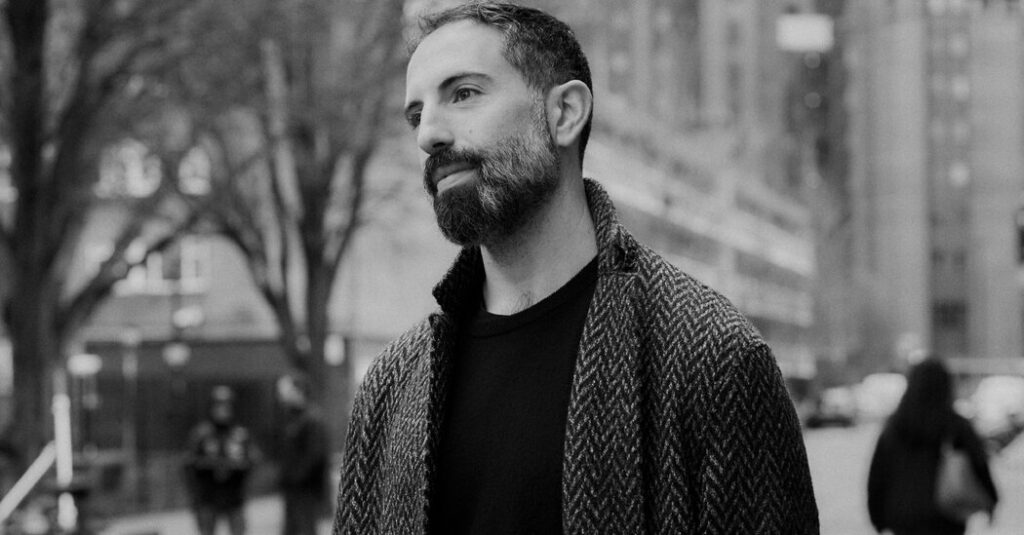
At the show’s premiere on Tuesday, the scene ran flawlessly, as Fein seemed to know it would. (The production runs through April 18.) Although at 39 he is younger than many celebrated peers, he exudes self-possession.
His résumé might have something to do with it. Right now, he is one of the fastest-rising names in London theater.
Last year, his expansive staging of “Fiddler on the Roof” received 13 Olivier Award nominations. The production took home three prizes (including best musical revival), toured Britain and will head to Australia and Ireland this year. Fein’s exquisitely detailed version of “Into the Woods,” which opened in December, is in the running for 11 Oliviers this year.
“There’s such confidence in his work,” said Nicholas Hytner, the artistic director of the Bridge theater, where “Into the Woods” is playing through May 30. “Jordan could do almost anything he wants.”
In an interview at the Young Vic, Fein acknowledged that “Broken Glass” hadn’t been plain sailing. One of Miller’s final plays, completed when the writer was in his late 70s, it is an enigmatic, rarely staged chamber piece for six actors. Set in a Jewish household in Brooklyn in 1938, it focuses on a wife who is suddenly unable to walk for reasons that no doctor can explain.
Is her ailment psychological, related to strains with her husband? Or is the cause somehow political: her sense that her fellow American Jews barely care what’s happening in Germany? Kristallnacht, the “night of broken glass” referenced in the title, has just happened, but everyone around her seems to be looking the other way.
“It’s about the consequences of being inert,” Fein said. “Sylvia, the wife, is really grappling with that. She’s called crazy for noticing.”
Fein added that the play was, as so often with this playwright, about the inseparable connection between the individual and society. “There’s an amazing interview with Arthur Miller where he says, ‘The fish is in the water, but the water’s also in the fish.’ I keep thinking of that right now.”
The play’s examination of Jewishness — and Miller’s own difficult relationship with his Jewish heritage — is also impossible to ignore, Fein said. The playwright was an outspoken atheist; Fein was brought up in a Jewish household and describes himself as “nonreligious.”
“Broken Glass” has, like “Fiddler on the Roof,” made Fein contemplate his own identity, he said. “It’s made me reckon with what my responsibility is as a Jew,” he said. “And I don’t know the answer to that.”
Born in Philadelphia, Fein grew up in what he described as a “huge, sprawling family.” Music rather than theater was the household obsession, but nonetheless many birthday and Hanukkah gifts were tickets for shows, often in New York City.
Fein caught the drama bug in high school and went on to study at New York University, then decamped to Berlin for three months — a “transformative” experience, he said. “I saw theater every night: the Schaubühne, the Volksbühne, the Berliner Ensemble.”
A taste for the experimental came with him when he returned to New York — he cited influences including the Wooster Group and Ivo van Hove’s collaborations with the Theater Workshop — but he was also itching to work on bigger stages.
As well as dipping his toe into opera and off-off-Broadway shows, one of Fein’s first assistant director jobs was on Scott Ellis’s 2014 Broadway production of “The Elephant Man.” This led to a yearslong connection with Daniel Fish’s sexily stripped-back “Oklahoma!”, which he assisted on before shepherding it to London as a co-director in 2022.
“There were points where I really thought I was making a mistake by not focusing on one thing,” Fein said. “But in retrospect, I feel so lucky. Everything from wonderful downtown theater at the Bushwick Starr to assisting on fancy Broadway shows — all those parts of my brain feel developed.”
Music has also retained its hold on his imagination. As well as directing operas by Tchaikovsky, Mozart, Britten and Korngold, Fein has shown a passionate love for musical theater. (He first encountered “Into the Woods” on VHS as a child, he said, and had always dreamed of staging it.)
He said he had little time for people who regard musicals as a lesser art form. “Often musicals — do I want to say this? — aren’t treated seriously by the people making them,” he said. They required “rigor,” he added, which wasn’t always on show.
Fein’s versions of “Fiddler on the Roof” and “Into the Woods” both exhibit seriousness of purpose as well as a sense of fun. Both are also collaborations with his offstage partner, the British designer Tom Scutt — who is also the reason that Fein has been based in London since 2019.
They are still figuring out the best way to work together, Fein said. “The creative part, we’re really good at,” he said. “The hardest part is like: We’ve just had breakfast together, how do we move into talking about Act 2?”
Fein said he relished the variety of theater in London but missed the scrappy energy and tolerance for risk in New York’s independent scene. “Because of the lack of financial support, there’s sometimes more experimentation,” he said. “The stakes are very high.”
Even if London feels like home, he added, it is a strange time to be an American living abroad — particularly while rehearsing a play about experiencing violence at a remove, filtered through the filter of the news media.
“I’m at this amazing moment in my life where I’m getting to make things I love and with people I love, but the world around me is so dark,” he said. “That contrast can be quite overwhelming.”
Broken Glass Through April 18 at the Young Vic in London; youngvic.org.
The post A Fast-Rising American Director Is Wowing the West End appeared first on New York Times.