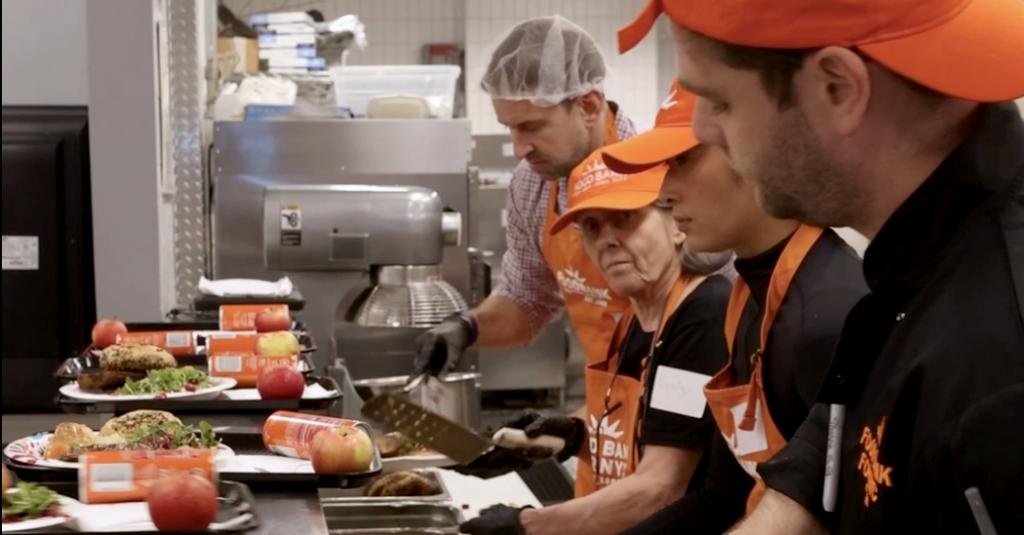
Since Pat Chisholm was laid off early in the pandemic by a Manhattan law firm, after spending 20 years as a legal assistant, she has depleted her life savings and applied for more jobs than she can remember. At 62, her only income is the $292 she receives in food stamps each month.
Ms. Chisholm learned recently that she might lose that, too. She is among the estimated 180,000 New York City residents who receive federal food assistance but could have it eliminated or reduced in the coming months, thanks to the tougher eligibility rules imposed by President Trump’s sweeping domestic policy law.
Passed last year, the law made drastic cuts to the social safety net program for low-income people, in order to help pay for tax cuts that largely aid wealthier ones. The new eligibility rules, which require that significantly more recipients work, volunteer or enroll in skills training in order to receive their benefits, took effect this month.
Now, Ms. Chisholm and many others — including homeless people, veterans, parents with children older than 14 and people age 55 to 64, including retirees — who are able-bodied and had been exempt from previous work requirements must comply by June to maintain their benefits.
“A lot of people do not want to sit around on public assistance,” said Ms. Chisholm, who lives in the Bronx, “but they are not finding jobs either.”
Nearly 42 million Americans rely on food stamps every month, most of them members of families that include children. About a third of all households in New York City, one of the most expensive cities in the world, receive them, representing 1.8 million people.
The new rules have sparked a panic at city and state agencies and numerous community groups that help people sign up for food stamps through the Supplemental Nutrition Assistance Program, or SNAP.
Officials and social workers have been scrambling to inform community groups and recipients of the monumental changes, and help people apply for jobs or secure volunteer positions, including at food banks and aid organizations.
Still, an estimated 10 percent of households on SNAP in the city could have their benefits eliminated or reduced, representing a devastating blow to low-income families as well as the markets where they shop. That would lead to 180 million fewer meals consumed per year, according to anti-hunger groups.
Across the state, more than 300,000 households are expected to lose benefits, with an average loss of $220 per month, the New York State Office of Temporary and Disability Assistance, which oversees the program, said. The maximum benefit is $292 for a single person and $785 for a family of three.
Social workers said they were worried that people would be unable to find volunteer positions or jobs, particularly in the weak labor market. The unemployment rate is 5.6 percent in New York City, and 4.3 percent nationwide.
They also fear that recipients, especially non-English speakers, may not fully understand the requirements or the voluminous paperwork required of them to show compliance.
Case managers said they were particularly concerned about retirees on fixed budgets and other older people who will now need to spend at least 80 hours a month working or performing another qualifying activity.
“This is purely a punitive approach,” said Scott French, the administrator at the New York City Human Resources Administration, the city’s social services agency. “The purpose is about having people lose their benefits.”
Mr. Trump and other Republicans have long criticized SNAP, arguing that the program encourages recipients not to work and is badly managed.
“We know there is so much significant fraud in the SNAP program that it is rampant,” Brooke Rollins, the agriculture secretary, said in December. (Anti-hunger groups said that, more often, SNAP recipients are the victims of fraud, with thieves siphoning benefits from their cards using skimming devices.)
The new work requirements are expected to trim 2.4 million from the program nationwide; in his recent State of the Union speech, Mr. Trump described those people as being “lifted” from poverty.
As the new rules roll out, food banks across the city are preparing for an influx of new families, coming on top of the increase in demand they have seen since the pandemic, years ago. In lines that form outside the pantries, workers have been encouraging recipients to find solutions quickly, before the grace period ends in June.
Mr. French said the city has been urging food banks and social service agencies to open up their volunteer positions to SNAP recipients. Dozens of groups have signed on to the initiative, but they won’t be able to find a place for everyone who needs to be volunteering monthly.
Ms. Chisholm signed up this week for her first volunteer shifts at the Food Bank for New York City, using an online portal to claim as many shifts as she could. She will have to repeat the process each week, competing with others who, like herself, are desperate to keep their food assistance.
Zac Hall, the food bank’s senior vice president of programs, called the looming crisis a man-made catastrophe that was entirely avoidable, and driven by what he described as false beliefs that Mr. Trump and other critics held about the program.
“In my lifetime at this organization, I have not seen this tsunami of need on the horizon, other than major events like Covid, hurricanes and blackouts,” he said.
Mr. Hall said that he expected a surge in need similar to that which occurred in November, when some food stamp recipients had their benefits disrupted during the federal government shutdown.
The Food Bank for New York City and another large hunger-relief organization, City Harvest, both expect to provide more meals this year than last as a result of the SNAP changes. At City Harvest, the group plans to deliver an additional million pounds of food in 2026, if not more.
Still, it isn’t likely to be enough to feed everyone, said Jilly Stephens, its chief executive. “We’ll do everything we can, as we always do, but we won’t be able to fill the gap,” Ms. Stephens said.
People in every corner of New York City rely on food stamps, but nowhere is need greater than in the Bronx. There, about 37 percent of households depend on them, one of the highest rates in the country, according to census figures.
Able-bodied recipients in the Bronx, as in most areas of New York State, were exempt from the former work requirements for SNAP because of the area’s high unemployment rate, or the lack of available jobs. The Bronx has the highest unemployment rate in the state, at 7.4 percent.
Evelyn Torres-Viera, who left a job in investment banking to work at Life Together Works NYC, a community organization in the Bronx, said that the composition of the group showing up at its food pantry or seeking food stamps had changed in recent years.
“There are people on the line that are working, coming on their lunch break,” Ms. Torres-Viera said, including school bus drivers, who park at a nearby depot after their morning shifts.
The group serves about 600 families a week, up from about 150 less than four years ago, she said.
Luis Tirado, owner of the People’s Choice Meat Market and Grill, a butcher shop in the South Bronx, said he was distressed over the possibility that some customers could lose their food assistance. About 80 percent of the purchases at his market are paid for with food stamps, with sales spiking at the start of every month, when benefits are replenished, he said.
Now, he is worried about his ability to repay a $500,000 Small Business Administration loan he took out during the pandemic.
“Of course it’s going to harm me, because people are just going to buy less,” Mr. Tirado said of the looming loss to his customers. “That’s why I don’t sleep well at night.”
Matthew Haag is a Times reporter covering the New York City economy and the intersection of real estate and politics in the region.
The post 180,000 New Yorkers May Lose Food Stamp Benefits Under New Work Rules appeared first on New York Times.