Technology giants are spending hundreds of billions of dollars to build energy-hungry data centers for artificial intelligence, and many Americans worry that the A.I. boom could drive up their electricity bills.
Now Silicon Valley — and President Trump — are trying to head off a backlash.
Mr. Trump hosted executives from Google, Meta, Microsoft, OpenAI and other large tech companies at the White House on Wednesday. The firms all signed a “ratepayer protection pledge” and promised to shoulder a greater share of the energy costs from data centers.
The pledge is voluntary, and experts say it could be tricky to put into practice, which means no one knows how much it will really do to lower prices for everyone else. But the issue isn’t going away: Politicians across the country have been debating how to get tech companies to pay more for electricity and prevent utility bills from spiking for ordinary households. In many cases, they’re finding it’s not easy.
Here’s a look at the issue.
How data centers could affect electric bills
New data centers could increase energy prices for everyone else in several ways.
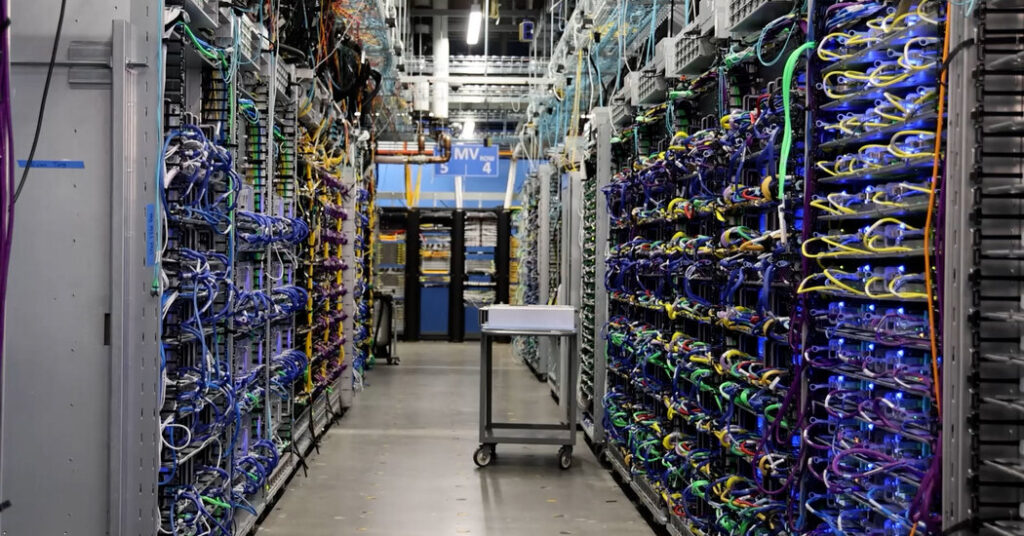
Many of the hulking facilities being built today to train cutting-edge A.I. models need as much electricity as a small city to power the hundreds of thousands of specialized computer chips and cooling equipment inside. That means they can require billions of dollars’ worth of new power plants, transmission lines and other upgrades to connect to the local grid.
If the electric bills paid by data centers don’t cover all those costs, other customers have to make up the shortfall. Researchers have found some evidence that these costs may be getting shifted onto ordinary households, though it can be hard to prove because the utility contracts signed by owners of data centers are often confidential.
In states like Ohio and Georgia, critics have also raised concerns that utilities might make expensive new grid investments to prepare for future data centers that never materialize — either because the technology changes or the A.I. bubble bursts.
“We’re spending billions and billions of dollars to modernize and expand the grid, and the question is, who’s paying for that?” said Abe Silverman, an energy researcher at Johns Hopkins University. “Are the big tech firms paying? Or is Grandma going to be left holding the bag?”
Electricity-guzzling data centers can also get built faster than new power plants can come online, which means they can drive up electricity prices through higher demand. The frenzy of data center construction can also push up the costs of equipment like gas turbines and power transformers.
At PJM Interconnection, a regional grid that serves 65 million people in the Mid-Atlantic States, wholesale electric capacity prices have skyrocketed over the past year, leading to higher bills in places like Maryland and Pennsylvania. Some analyses have blamed those spikes on a surge of data center demand just as older coal plants have retired, while newer gas and renewable plants have been slow to come online.
Some utilities and researchers dispute just how much data centers drive price increases. Since 2019, retail electric prices have risen faster than inflation in roughly two dozen states, and, in many cases, other factors like wildfires in California or gas constraints in New England have played a bigger role. Some analyses also find that new data centers could help suppress prices by allowing utilities to spread the fixed costs of maintaining the grid among a larger set of customers.
Yet the pressure will keep building. Data centers today use around 5 percent of U.S. electricity, and that could grow to as much as 17 percent by 2030 as interest in A.I. grows, according to the Electric Power Research Institute.
One popular idea: Make tech companies pay more
Politicians in both parties have increasingly settled on a solution: Just get the companies behind the data centers to pay more for electricity.
Trump Administration: Live Updates
Updated
- Daines drops re-election bid in Montana, upending a Senate race.
- U.S. court takes first steps toward ordering tariff refunds.
- The inspector general for D.H.S. accuses Noem of obstructing his work.
At the White House event on Wednesday, Mr. Trump said that under the new ratepayer protection pledge, tech companies would pay for any power plants and grid upgrades needed for their data centers and willingly pay higher rates.
“They’re going to be producing massive amounts of electricity and energy on the grid, so the American consumers aren’t going to have to even think about it, and your electric costs are going to be going down,” Mr. Trump said.
Most tech companies say they are fine with the idea. Microsoft and Anthropic had already released detailed pledges to cover the cost of the electricity they use.
And experts say it’s a good concept, at least in theory.
“If you could actually get data centers to commit to bring their own generation equal to their load, that would solve a lot of problems,” Mr. Silverman said. “But that doesn’t mean it’s easy to do.”
For starters, neither the White House nor tech companies actually decide how much data centers pay for electricity. Those details are usually determined by complex rules set by state regulators and local utilities, as well as regional grid operators.
The accounting can be tricky. Many tech firms, for instance, are building their own natural gas generators for power. But that raises questions of how to fairly charge them if these plants end up relying on the grid for backup.
“Everyone says they want to pay their fair share of the costs,” said Ted Kury, the director of energy studies at the University of Florida’s Public Utility Research Center. “But lots of people are going to have different ideas of what their fair share is.”
In January, the White House and several Democratic governors floated a plan for an emergency auction at PJM, the Mid-Atlantic grid, that would have tech companies pay to build new power plants in the region through specialized 15-year contracts. But PJM is still haggling with companies and state regulators, and it is not yet clear whether the complicated plan will be approved.
Dozens of states are experimenting with their own approaches. In Ohio, regulators approved a utility plan requiring large new data centers to cover the cost of at least 85 percent of the energy they say they will use, even if they end up using less. In Indiana, one utility created a program that allowed data centers to enter into direct contracts to finance new power plants.
Already this year, more than 300 data center bills have been filed in legislatures in 30 states, according to MultiState, a consulting firm.
“It’s still very much a work in progress,” Dr. Kury said. “I don’t think there’s any state that can say yet, Yeah we’ve figured out this is the best approach.”
The data center backlash is growing
Tech companies have been willing to pay more in part because opposition to data centers has been steadily mounting.
At least 25 proposed data centers were canceled last year after protests by nearby communities, according to research by Heatmap, an energy news site. Several polls have found that Americans are especially concerned about the projects’ effects on utility bills.
Some politicians are weighing the idea of pausing or banning data centers altogether. Senator Bernie Sanders of Vermont, an independent, has endorsed a data center moratorium, and legislators in New York and Oklahoma have introduced bills that would temporarily halt new construction.
The Trump administration has been eager to speed up the data center build-out as it competes with China for the most advanced A.I. systems. And in the past, officials dismissed the idea that data centers were a big reason for the increase in electricity rates, instead blaming policies that aimed to promote renewable power.
Lately, however, some officials have sounded more concerned, especially since affordability is shaping up to become a major issue in this year’s midterm elections.
“They need some P.R. help,” Mr. Trump said of the tech companies on Wednesday.
“These data centers are key for us to lead in A.I., they’re key for our national security,” Energy Secretary Chris Wright said last week in a call with reporters. “They’re large capital investments that are going to stimulate our economy and create jobs and taxpayer revenues and all the things we want to see happen.”
But “we‘ve been in very candid dialogues with them from the start that, look, if you drive up electricity prices, or are perceived to drive up electricity prices, there’s going to be a backlash against that,” he added. “That’s not good for America. That’s not good for you.”
How that translates into policy changes remains to be seen.
“Talk is cheap, power plants are expensive,” Mr. Silverman said. “The big question is whether, after making these big commitments at the White House, we’re going to see Big Tech show up in the halls of Harrisburg and Annapolis and Trenton and actually walking the walk. That’s what I’ll be watching for.”
Brad Plumer is a Times reporter who covers technology and policy efforts to address global warming.
The post Why Tech Firms Are Working With Trump on Data Centers and Energy Costs appeared first on New York Times.