Do you play sports in or out of school? Have you ever had a personal coach or trainer? Would you want one?
In “The Next Big Thing in Youth Sports? Personal Trainers.,” Charley Locke writes about the rising number of young athletes who work with private coaches:
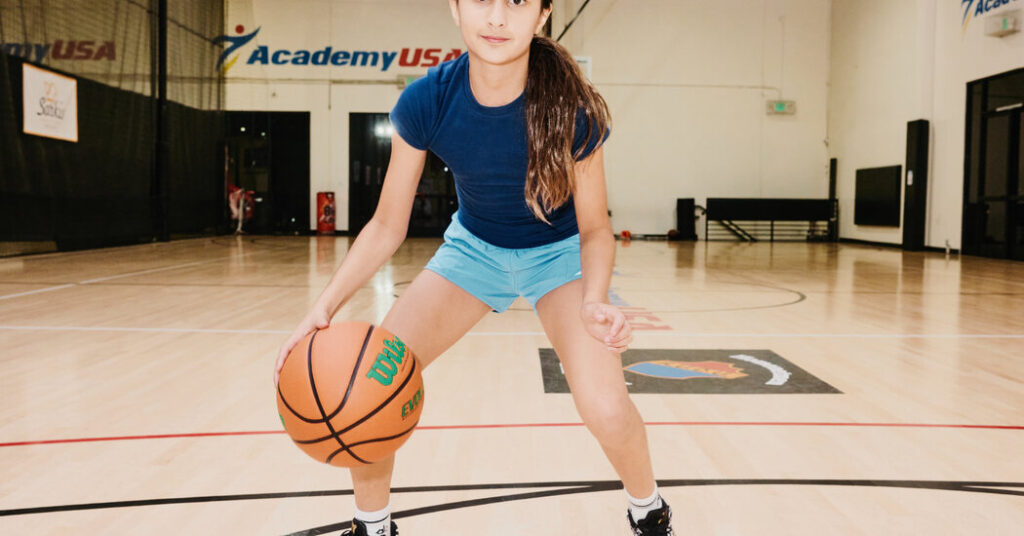
It was a Friday evening at Academy USA, a training facility in Glendale, Calif., and the courts were full of kids running shooting drills and sprints. On one court, Lyla Megeredchian, a 10-year-old fourth grader, practiced alone with her personal coach, Shaun Gerardo.
After making a three-pointer, Lyla ran over to her parents, her ponytail swishing.
“Did you see that?” Lyla said. “The corner shot is my shot!”
Lyla and her siblings are part of a growing cohort of preteen athletes who are booking sessions with personal sports trainers. Professional-level sports coaching has long been available for elite high school athletes; coaches like Mr. Gerardo are bringing that ethos to elementary schoolers, both for specific sports and for general fitness.
American youth sports have grown into a $40 billion business. In 2024, the average family with kids who play sports spent $1,016 on their child’s primary sport, nearly twice what they spent in 2019, according to surveys from the Aspen Institute.
That has presented an opening for coaches like Mr. Gerardo, who has built a business privately coaching basketball players as young as 7. “I usually get kids who are very obsessed with the sport,” said Mr. Gerardo, whose rates start at $80 an hour, “and the parents are just as obsessed as the kids are.”
The article discusses why many parents hire trainers for their children:
Families like the Megeredchians are investing heavily in their kids’ athletic careers for a few reasons. For some, it’s about admission to elite universities with slim acceptance rates. Others are recognizing how, thanks to the landmark N.C.A.A. settlements last June, elite teenage players can now earn serious money. “If kids didn’t want to play D1 sports before, now they do, with deals in the six figures,” said Mr. Gerardo.
But many families are doing it for the age-old reason: Because everybody else is. “Anybody that plays travel basketball has some kind of private coaching on the side,” Mr. Megeredchian said.
It also looks at the physical toll of the extra training, citing a study conducted by Dr. Neeru Jayanthi, a director of the Youth Sports Medicine Program at Emory University:
In one study he led, young athletes who spent at least twice as much time in organized sports as in free play were more likely to have serious overuse injuries. When kids casually play a sport together, they’ll likely stop before they get hurt, Dr. Jayanthi reasoned, while strict regimens of high-intensity coaching might push them further than they would go on their own.
The American Academy of Pediatrics has found that overuse injuries and overtraining often lead to burnout, too; another AAP study found that 70 percent of kids drop out of organized sports by age 13.
Students, read the entire article and then tell us:
-
Do you play sports at school, in leagues or just for fun? What are your positive and negative experiences?
-
If you don’t play sports, what other hobbies or activities (music, gaming, art) do you prefer and why?
-
Have you ever had a personal coach for a sport or a hobby? If not, would you want one? Why or why not?
-
Is there an age that’s too young for child athletes to have personal trainers? Why?
-
What is your reaction to the article and the story of 10-year-old Lyla and other preteens who work with personal sports trainers? What did you find most interesting, surprising or memorable? Did any part resonate with your experiences or observations of youth sports?
Students 13 and older in the United States and Britain, and 16 and older elsewhere, are invited to comment. All comments are moderated by the Learning Network staff, but please keep in mind that once your comment is accepted, it will be made public and may appear in print.
Find more Student Opinion questions here. Teachers, check out this guide to learn how you can incorporate these prompts into your classroom.
Jeremy Engle is an editor of The Learning Network who worked in teaching for more than 20 years before joining The Times.
The post What’s Too Young for Child Athletes to Have Personal Trainers? appeared first on New York Times.