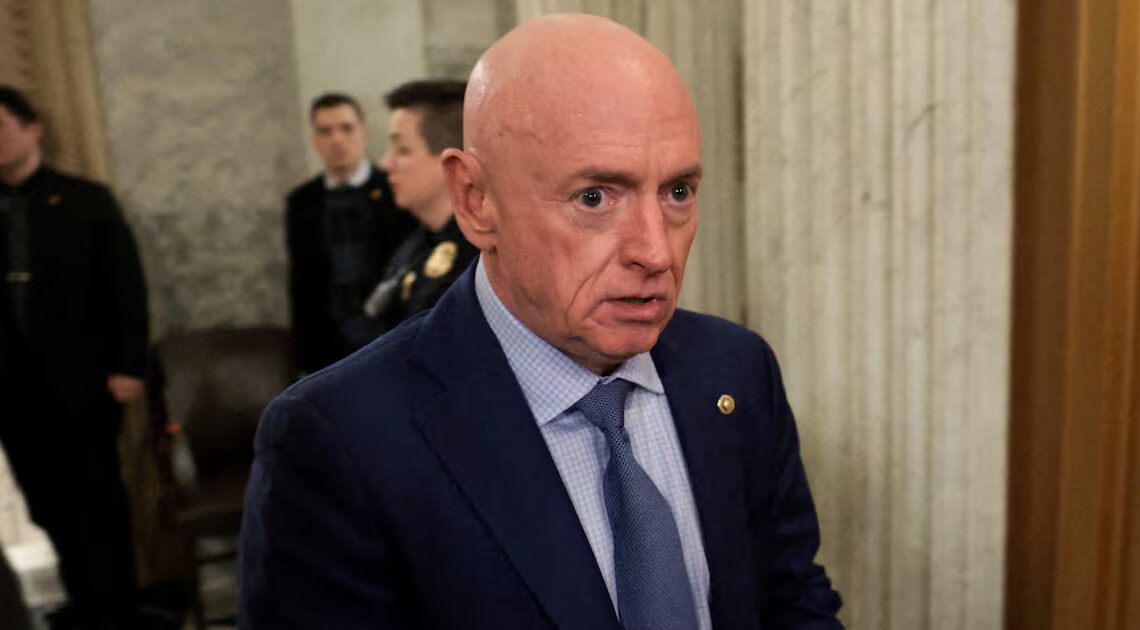
A decorated military veteran has sharply criticized President Donald Trump’s approach to Iran, claiming that even “random people off the street” could manage the country better than him.
On Wednesday’s edition of The Briefing with Jen Psaki, Arizona Sen. Mark Kelly, a retired U.S. Navy captain and former combat pilot, drew on his own combat experience to criticize the Trump administration’s handling of Iran after the U.S. and Israel launched a major unprovoked coordinated air campaign against the country over the weekend, marking a significant escalation in the region.
Recalling the first Gulf War, he said, “I remember my commanding officer… talking to us about how they expect us to lose half of the airplanes.”
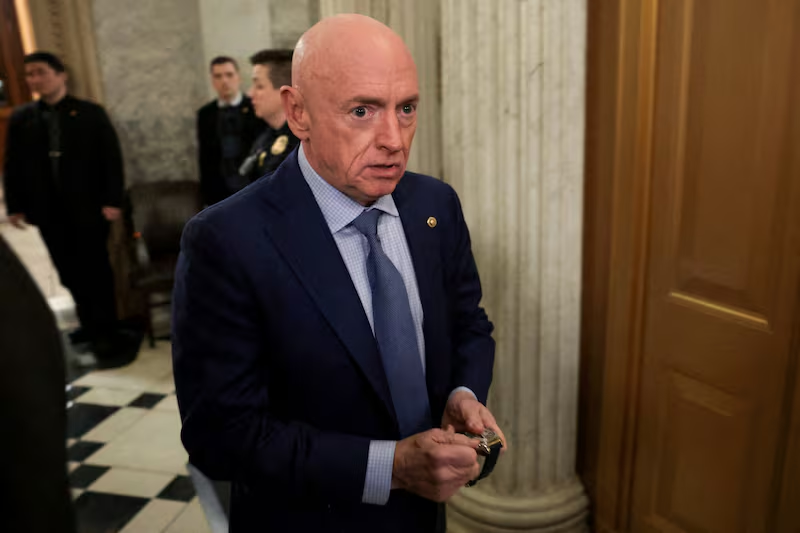
Reflecting on the pressure his commander faced, Kelly added, “He was only 39 years old at the time… you could just feel, just in his core, how significant of an issue this was that some of us might die.”
Comparing that to today, Kelly said, “I watch this group of people who were supposed to be leading our country… and I’m thinking you could pick a random group of people off the street… and they could probably do a better job than our government is doing right now with this.”
He warned, “They don’t have a goal. There’s no strategic plan. There’s no timeline. And what this is likely to lead to is… a long war with a lot of dead Americans and no rationale for how this is helping the American people.”
Since Trump launched the airstrikes, which saw Iran’s supreme leader, Ayatollah Ali Khamenei, and dozens of Iranian officials killed, he has faced mounting pressure to explain what his administration ultimately hopes to achieve in Iran.
In a letter to Congress invoked under the War Powers Act, Trump acknowledged significant uncertainty about the campaign’s future, admitting that the United States does not yet know the “full scope” or duration of the military operations now underway.
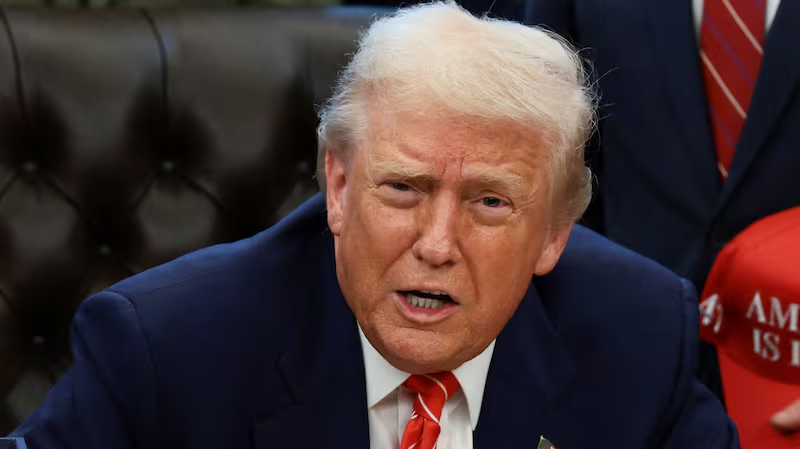
“Although the United States desires a quick and enduring peace, it is not possible at this time to know the full scope and duration of military operations that may be necessary,” Trump wrote.
It is also unclear how long airstrikes are projected to last.
On Monday, Trump said the operation in Iran was “projected [to last] four to five weeks.”
“But we have the capability to go far longer than that,” he said. “We’ll do whatever—somebody said today, they said, ‘Oh, well, if the President wants to do it really quickly after that, he’ll get bored.’ I don’t get bored. There’s nothing boring about this.”
At the same time, Trump and top members of his administration have delivered mixed messages about the objectives of what amounts to the most significant U.S. military campaign in the Middle East in nearly 20 years.
Early statements framed the mission as an effort to dismantle Iran’s nuclear program and potentially bring about regime change. But as the operation unfolded, the explanation evolved. By Monday, Trump was describing the conflict as a defensive move aimed at shielding the United States and its allies from potential Iranian attacks.
“An Iranian regime armed with long-range missiles and nuclear weapons would be an intolerable threat to the Middle East, but also to the American people,” Trump said.
On Wednesday, White House Press Secretary Karoline Leavitt said: “The president had a good feeling that the Iranian regime was going to strike the United States’ assets and our personnel in the region—and the president was faced with a choice: Does the United States of America use our military and our capabilities to strike first, to take out this threat that has been threatening our country and our people for 47 years?
“Or is he going to, as Commander-in-Chief, sit back and watch as the rogue Iranian regime attacks our people in the region?… The second choice is unacceptable to the president of the United States.”
Six days after the initial airstrikes, Trump has yet to define what Iran’s future looks like or what the next steps of the military operation are.
Meanwhile, retaliatory attacks on countries with U.S. military bases continue, which have killed six U.S. service members so far. And Trump has warned that there are likely to be more deaths of U.S. troops in the conflict with Iran.
“Sadly, there will likely be more before it ends,” he said on Saturday.
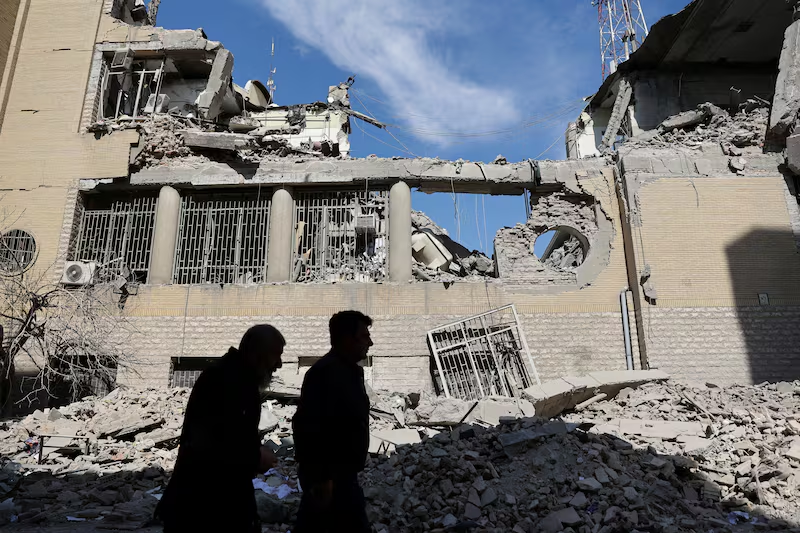
Amid the chaos, critics have warned that without a clear plan, there is a risk the conflict could turn into the kind of forever war that Trump railed against.
“We don‘t actually have a concept of victory. We—you know, our justification for going into the war is entirely different from what we‘re hearing from the president right now. Again, this is even after the president went publicly and spoke to that. And that all is a very scary situation. Like, for me, as someone who had to live through some really bad decisions in 2005 that the, you know, the then-administration did, if we don‘t know how we can get out of this war, if we don‘t know what the actual victory is, we‘re seeing potentially a long-term war,” Arizona Sen. Ruben Gallego, who is an Iraq war veteran, told CNN this week.

Defense Secretary Pete Hegseth has denied that the conflict will be another “endless” war.
“This is not Iraq. This is not endless. I was there for both. Our generation knows better, and so does this president,” Hegseth told reporters on Monday.
The post War Hero Says Random People Off the Street Would Handle Iran Better Than Trump appeared first on The Daily Beast.