Wednesday was a day South Korean investors will never forget.
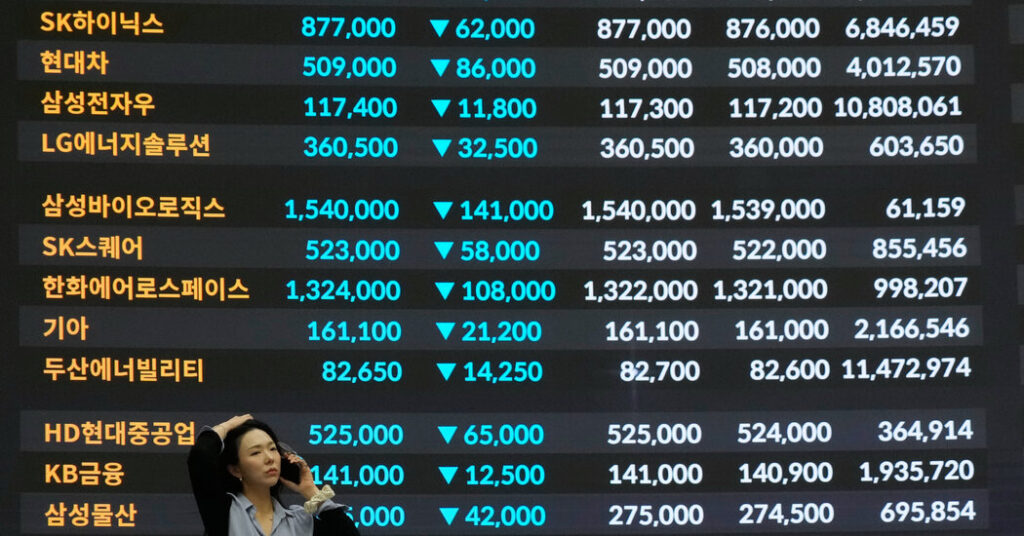
The nation’s benchmark Kospi index plunged over 12 percent, its largest drop ever in a single day. Investors were gripped by fears about the widening conflict in the Persian Gulf driving up energy prices in South Korea, which is heavily dependent on imports of oil and gas.
Things got so bad that at one point, trading was briefly suspended to stem further losses.
Stocks fell across Asia on Wednesday, but nowhere as steeply as South Korea. The Kospi is driven in large part by tech companies like Samsung Electronics and SK Hynix. Those two giants dominate the global production of memory chips, an essential part of artificial intelligence systems.
Global interest in A.I. has helped propel a massive stock market rally in South Korea in recent months. The Kospi doubled in value over the last year, making it the fastest growing major index in the world.
Wednesday’s free fall was a shock for South Korean investors who had flocked to the market during the surge.
Lee Hyeun-seung, 42, an office administrator at a private tutoring academy in Seoul, said he initially felt a rush of panic after hearing the news. But, he added, “experience has taught me to be patient.”
After investing regularly in both the Kospi and the S&P 500 for several years, Mr. Lee said he had experienced how markets can move wildly during times of distress, such as the Covid-19 pandemic. He stayed calm and did not sell in a panic.
That was a good thing — and usually the sound investing move — because on Thursday the Kospi snapped back, surging 9.6 percent by the close.
Samsung Electronics, which plunged 12 percent on Wednesday, and SK Hynix, after dropping 10 percent, both ended more than 10 percent higher on Thursday.
Their country’s indispensable position in the semiconductor industry has given South Koreans a sense of renewed wealth after a period of political turmoil led by the failed attempt by the former president to impose martial law in December 2024.
Dong Soon-yi, 33, a software engineer in Seoul, was another investor who kept his cool this week. The Middle East conflict is far from South Korea, he reasoned, and “it’s not like the companies I’ve invested in have changed fundamentally.”
Mr. Dong said that his stocks have increased in value by 50 percent since the end of last year, when the Kospi rally gained pace.
The country has a lot riding on its stock market: Over 60 percent of investors are South Korean, according to the Korea Stock Exchange.
On Thursday, President Lee Jae Myung, who took office last June, ordered the government to provide 100 trillion won ($68.3 billion) to support the capital markets. He has been a vocal booster of the stock market and pledged in his presidential campaign to pass investor-friendly reforms.
Other markets across Asia also rallied on Thursday. Stocks in Taiwan jumped nearly 3 percent after falling over 4 percent on Wednesday.
In South Korea, after Thursday’s recovery, the Kospi is up 32.5 percent this year. But the week’s tumult was enough to leave Mr. Lee, the office administrator, shaken. “I know it’s not fair for me to feel this way, but I felt a bit betrayed,” he said.
Jin Yu Young is a reporter and researcher for The Times, based in Seoul, covering South Korea and international breaking news.
The post They Made It Through the 24 Hours That Rocked South Korea’s Markets appeared first on New York Times.