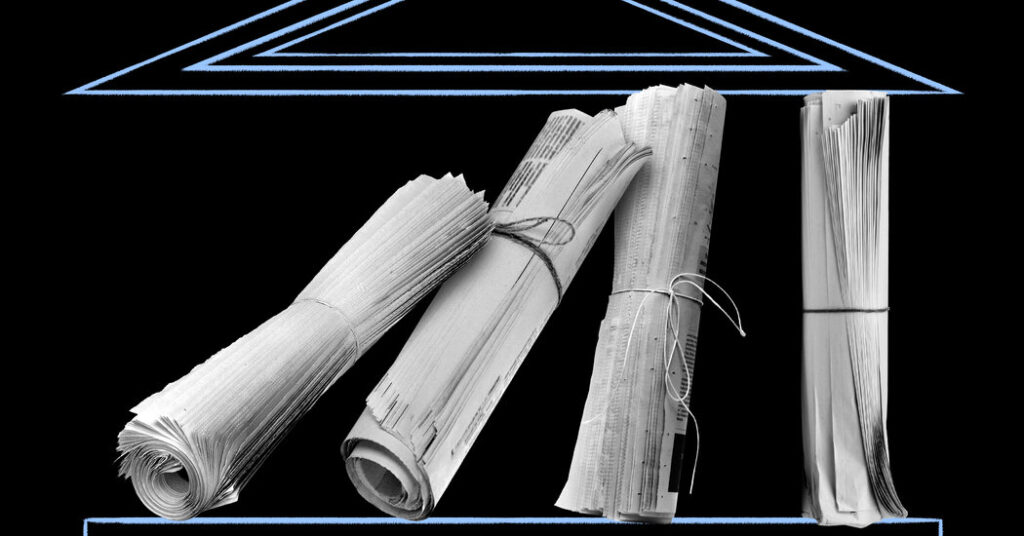
The shadow of press repression is spreading around the world. In the past decade, the number of journalists detained and imprisoned has soared as governments seek tighter control over the media. What started as a crackdown first by dictatorships and then by illiberal democracies is expanding to onetime bastions of civil liberties.
A recent high-profile case is Jimmy Lai, whom authorities in Hong Kong sentenced to 20 years in prison last month. He had campaigned against China’s choking of the territory’s freedoms. Mr. Lai, 78, has already spent five years in a dark cell and is ailing. The sentence effectively condemns him to dying in prison. Mr. Lai has denied all the charges against him.
His plight is increasingly common. At least 330 journalists worldwide were in prison at the end of 2025, according to the Committee to Protect Journalists, up from fewer than 200 a decade ago. More than a third of them were serving sentences of five years or more. Nearly half remained behind bars despite never having been formally sentenced. One-fifth say they were tortured or beaten. An additional 129 members of the press died while doing their jobs or because of them, the highest number since records began in 1992. Among the worst offenders against press freedom have been China, Russia, Egypt, Ethiopia, Iran, Israel, Myanmar, Sudan and Turkey.
These courageous journalists have sought to shine a light on the world around them. They ask questions that political leaders do not want to answer and publish information that leaders do not want the public to know. For their efforts, they have been falsely accused of being enemies of the state, terrorists, foreign agents or spies.
In February alone, according to the Committee to Protect Journalists:
-
Cambodia sentenced two journalists, Pheap Phara and Phon Sopheap, to 14-year terms each. They were reporting on a Cambodia-Thailand border dispute, and the government claimed their work damaged national security. Cambodia also charged Luot Sophal with demoralizing the armed forces after reporting on an alleged water shortage for Cambodian soldiers.
-
In Senegal, Abdou Nguer, a news commentator, was arrested for reporting that questioned a public prosecutor’s statement about the cause of a student’s death in a crackdown on university protests.
-
In Ethiopia, the government revoked the license of Addis Standard, an independent outlet known for incisive reporting. The government also refused to renew the accreditation of three Reuters journalists after the outlet reported that Ethiopia hosted a secret camp to train fighters for a Sudanese paramilitary group accused of war crimes.
The press faces challenges in freer societies, too. Israel’s war in Gaza led to the arrest of almost 100 Palestinian journalists, often without charge, and at least twice that number were killed over two years, a toll without modern precedent. In Mexico, the ruling party has tried to intimidate journalists who report inconvenient stories and regularly dismisses even legitimate information as “fake news.” In India, a court last month sentenced Ravi Nair to one year in prison related to social media posts that criticized a company run by a billionaire ally of Prime Minister Narendra Modi.
Even in the United States, home of the First Amendment and a longtime beacon of free speech, the media is being squeezed. Again and again, the Trump administration has tried to intimidate journalists who do not toe its line. It has issued rules requiring journalists covering the Pentagon to report only officially approved information. It has searched the home of a Washington Post reporter and arrested reporters covering an immigration protest in Minnesota. It has used the government’s regulatory power in an attempt to chill critical coverage and reward media companies that cozy up to the administration. Mr. Trump has filed dubious lawsuits against The New York Times, ABC News, CNN, The Wall Street Journal, The Washington Post and the owner of CBS News.
He has done more to violate the First Amendment and to restrict a free press than any modern president, even Richard Nixon.
Democrats have rightly criticized the Trump administration’s behavior. But standing up for press freedom also means resisting the temptation to adopt similar tactics. We note with concern the tactics of Representative Jasmine Crockett of Texas. Ms. Crockett reportedly ousted a reporter for The Atlantic from a campaign rally last month and then lied about the reporter, saying, “She has a history of being less than truthful.” Ms. Crockett also called the Capitol Police on a CNN reporter earlier in February. Ms. Crockett lost the Democratic Senate primary in her state on Tuesday.
The goal of leaders who try to muzzle the media is plain enough. They want to snuff out the truth and establish a monopoly on information. They want only news that flatters the government.
Most worrisome, attacks on the media can feed on themselves. When a government jails or harasses some journalists, others may fear the consequences of courageous reporting. The fewer free voices there are to call out tyrants, the easier it is for them to steal and repress. This last point is crucial. The consequences of media suppression are ultimately tangible. A society without a free press is one in which the government is likely to do a poorer job of providing its citizens with decent lives and instead to become a corrupt self-enrichment machine for elites.
The best protection for the many journalists who continue to report honestly and bravely — as well as for those unfairly imprisoned — is the world’s attention. By trying to silence journalists, autocrats and aspiring autocrats hope to make the world ignore what they are doing. The rest of us should refuse to do so. We stand with Mr. Lai, Mr. Phara, Mr. Sopheap, Mr. Sophal, Mr. Nguer and the many other reporters who fight for the truth around the world, and at home.
Source photographs by ConstantinosZ, urfinguss, membio and Thinglass, via Getty Images.
The Times is committed to publishing a diversity of letters to the editor. We’d like to hear what you think about this or any of our articles. Here are some tips. And here’s our email: [email protected].
Follow the New York Times Opinion section on Facebook, Instagram, TikTok, Bluesky, WhatsApp and Threads.
The post The Free Press Is Under Threat Globally appeared first on New York Times.