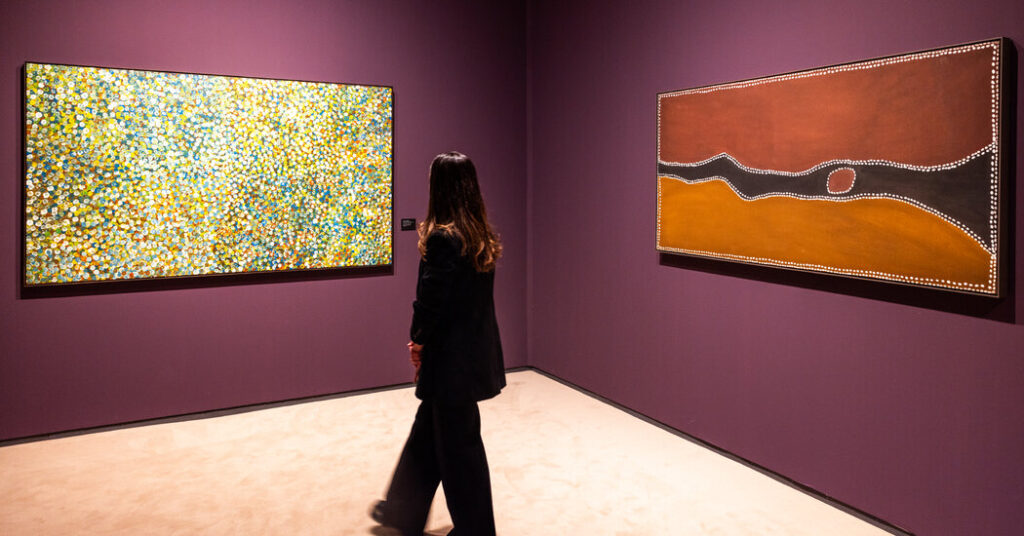
TEFAF Maastricht, the world’s biggest and most prestigious international fair for art and antiques, is one of Europe’s enduring cultural events. The 39th edition of this annual Dutch fair, running March 14-19, features 276 dealers from 24 countries showing pieces dating from the present back to ancient antiquity. Now that rival prestige shows such as the Paris Biennale and London’s Masterpiece have closed, it is the last remaining of Europe’s grand old art and antiques fairs.
The venue and the fair, held in the medieval Dutch city where the 1992 treaty that formed the blueprint for the European Union was signed, appear little changed since TEFAF’s first edition back in 1988. Visitors are still greeted by a huge display of Dutch flowers in the foyer. They walk down plushly carpeted aisles to browse booths staffed mostly by middle-aged men in suits and ties. The booths are filled with art and objects that seem to make time itself stand still.
But outside the fair walls, much has changed in the art world — and the wider world — over the last four decades. This presents TEFAF with challenges.
European old masters, the fair’s core specialty, have fallen out of fashion with most wealthy collectors. In 2024, just 3 percent of the world’s art dealers specialized in old masters, compared with 65 percent who traded in contemporary and postwar works, according to the most recent Art Basel and UBS Global Market Report. TEFAF scrapped its smaller fall fair in New York devoted to pre-20th century art in 2021; its spring event in New York is devoted to 20th and 21st century material.
For many in the art world, accustomed to sleek contemporary events like Art Basel and Frieze, TEFAF Maastricht has begun to resemble an aging distant relative. In 2025, Art Basel in Switzerland attracted 88,000 visitors and TEFAF Maastricht about 50,000, according to post-fair reports released by the respective organizers.
“We operate around connoisseurship over 7,000 years of history,” said Boris Vervoordt, an art dealer who lives and works in Antwerp, Belgium, and is president of the executive committee of traders that runs TEFAF. “If anything, we would like to stay timeless and relevant, rather than new.”
But doesn’t the fair need to move with the times to stay relevant? “It still looks very smart,” Vervoordt said. “There’s a timelessness about the structure. We don’t feel the need to change it.”
And in fact, despite the shifts in collecting patterns, TEFAF Maastricht does retain a stubborn relevance. After a two-year art market slump, during which the auction prices of many 21st century works, particularly by younger names, have fallen, some contemporary art collectors are looking back in time for investment value. The February season of old masters auctions in New York reaped a bumper $200 million, with records set for drawings by Michelangelo and Rembrandt, and for a painting by Artemisia Gentileschi.
What’s more, curators and supporting patrons from the beleaguered museum sector continue making the annual pilgrimage to TEFAF to admire and acquire, reaffirming the wider value of art in society.
“We are attending the fair because it is a world museum, with great European art from all periods at the heart, yet treasures from around the globe,” said Frederick Ilchman, chair of European art at the Museum of Fine Arts, Boston, which recently had to lay off more than 30 employees. (Like many American museums, the M.F.A. has endowed funds for acquisitions, but is struggling with day-to-day operational costs.)
Ilchman said that the M.F.A. is one of several American museums that will bring a substantial cohort of curators and patrons to the fair. TEFAF Maastricht provides such institutions with a unique opportunity to augment their encyclopedic collections.
“TEFAF remains the best fair for pre-1914 paintings, drawings, sculpture and decorative arts that exists,” said Nicholas Hall, an old masters exhibitor who lives and works in New York. “It has become a major convening point for museums all over the world, and many now see in TEFAF an opportunity to develop the interest and support of their trustees.”
The fair also gives dealers a rare opportunity to discuss their finest offerings face-to-face with leading museum curators and private collectors. This year, Hall is showing a rare early 14th-century Florentine miniature altarpiece by Bernardo Daddi and the little-known Master of the Misericordia, priced at more than $6 million.
Daddi is generally regarded by art historians as the second-most important painter working in Florence in the early 14th century, after Giotto. This kind of austerely expressive medieval art has a reputation for appealing to collectors of contemporary works.
While TEFAF’s dealers in old European pictures try to come up with images that resonate with today’s collectors and curators, exhibitors specializing in objects from further afield are having to grapple with new regulations. Last June, the European Union introduced a measure requiring dealers in cultural goods to provide evidence of lawful exportation for any items over 200 years old with a minimum value of 18,000 euros (about $21,000) imported into the bloc. The regulation affects exhibitors at TEFAF who deal in antiquities from Asia, India, Africa or Oceania.
“It’s getting complicated,” said Gisèle Croës, a dealer who lives and works in Brussels, who specializes in early Chinese objects and who has been showing at TEFAF for over 20 years. “We have to provide the exact provenance to everything bought outside the E.U. When we buy from dealers or collectors they often don’t have this information,” she added, referring to the difficulty in obtaining lengthy ownership histories for old objects offered to traders.
“It’s too early to tell what exact impact it will have. But after 50 years of dealing, I already see it’s going to be very different. If I see something in New York I want, it’s going to be much more difficult,” added Croës, who is showing six 8th-century Tang Dynasty terra cotta court ladies, priced at about $150,000 for the set, among museum-quality offerings.
But in today’s digital, smartphone-swiping age, a bigger concern for exhibitors, and for TEFAF, is a loss of continuity between the past and present. As many dealers reluctantly acknowledge, the analog art of previous eras is increasingly viewed by many, particularly the young, as something remote and unrelatable, another country that is difficult to access and to understand.
“People want to make quick money, rather than devote their lives to something complex,” said Croës, who is part of a dwindling cohort of dealers at TEFAF specializing in high-quality Asian antiques.
In the case of antique silver, the past is actually being erased to make quick money. The price of silver has increased by at least threefold in the last 12 months, encouraging owners to sell lower value pieces to be melted down for scrap. In early February, the Antiques Trade Gazette reported the demand to sell silver for scrap was so huge that precious metal dealers in Britain temporarily stopped making purchases.
“It’s generated huge interest and made everyone look at granny’s collection in the attic,” said Timo Koopman, a director at the London silver specialists Koopman Rare Art. “The objects we trade in are multiples of scrap value,” added Koopman, who pointed out that the surge of people scrapping lower value antique silver had “rarefied everything that remains.”
Koopman will be showing at TEFAF a monumental pair of candelabras by the silversmith Paul Storr, priced at £485,000 ($655,046).
Aware of the continuing need for relevance, TEFAF has in recent years significantly increased the number of exhibitors specializing in modern and contemporary art. This year the fair features 67 such dealers, in comparison with 56 showing old masters and 19th-century paintings.
Sofie Van de Velde, a gallerist operating out of Antwerp, Belgium, is a debut exhibitor. She will present a booth featuring both modern and contemporary paintings of interiors by Belgian artists.
The centerpiece will be the early James Ensor canvas in the Impressionist style, “Le salon bourgeois” (1880), priced at 1.25 million euros, flanked by recent figure studies by Felix De Clerq, a young painter living and working in Brussels, ranging from $11,000-$24,000.
“We think it’s important to show contemporary art with more traditional,” said Van de Velde, who noted that her father, Ronny, a dealer in modern and contemporary works, exhibited at the Pictura fair, a forerunner of TEFAF, dating back to the 1970s. “Everyone who comes into our gallery loves art history or contemporary,” she added. “We want to lead them to a different position, a different way of looking.”
As the content of the art world’s ever-proliferating contemporary fairs becomes increasingly homogeneous, perhaps TEFAF — with its multifarious mix of old and new — might inspire that different way of looking.
Scott Reyburn is a London-based freelance journalist who writes about the art world, artists and their markets.
The post TEFAF Maastricht, Known for Old Art, Faces the Future appeared first on New York Times.