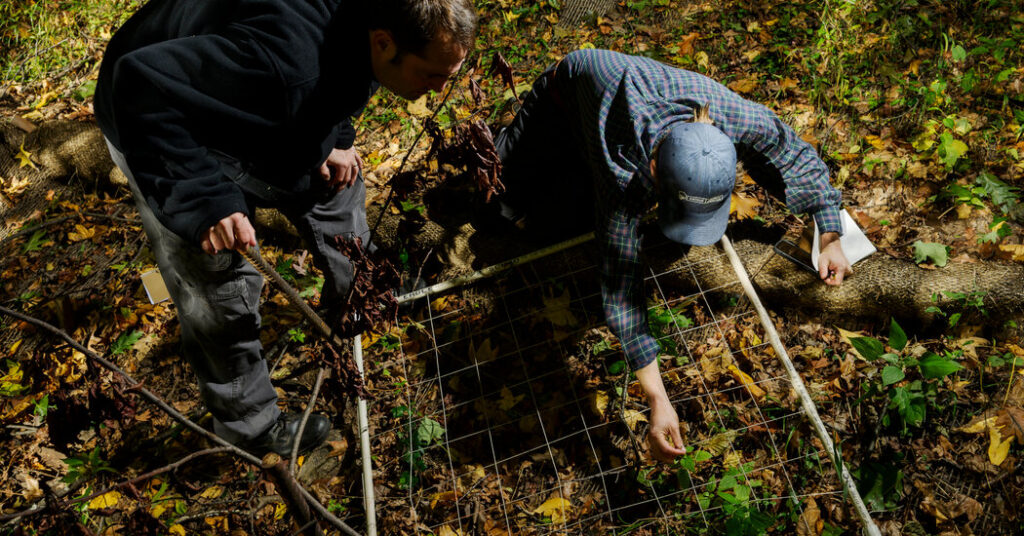
Aaron Sexton, an assistant professor of plant science from Cornell University, was addressing employees of the city’s parks department last year when he made a startling suggestion. “We should burn New York City parks,” he said.
His audience laughed, but he wasn’t exactly kidding.
Dr. Sexton was speaking in October 2025, less than a year after a spate of wildfires had overwhelmed the region with smoke. Unusually, forests in many of New York City’s parks burned, too, including a two-acre blaze at the center of Brooklyn’s Prospect Park, a rolling landscape of woodlands, water features and meadows that is one of the city’s gems.
The wildfires were alarming to New Yorkers, but they were also a rare scientific opportunity. Urban woodlands don’t catch fire very often. Dr. Sexton immediately knew he wanted to study them.
After months of measuring and counting seedlings that grew back in the charred soil, Dr. Sexton was convinced that fire was good for the parks. So much so, he began advocating that the city consider setting them alight on purpose.
Controlled burns, also called prescribed fires, are a common method of burning vegetation to restore wildlife habitats or reduce wildfire risk. Climate change has made deadly wildfires more common worldwide. Controlled burns are a win-win strategy for today’s and tomorrow’s problems, he said.
But New York City doesn’t do controlled burns and never has, according to a Parks Department official. And Dr. Sexton’s findings don’t stand alone. Another group of researchers has been separately studying the forests. Their conclusions? The opposite of his.
Their data, recently submitted to a scientific journal, showed that the fires killed healthy native trees and bolstered invasive plants, known for choking out native ones and smothering ecosystems.
Only time and more science will tell who might be right. Neither study’s results have yet been peer reviewed, the process by which experts check one another’s work.
But two groups agree on one thing. In ecology, a field that attempts to decode the unruly laws that govern the natural world, years are often necessary for a study to produce reliable results.
In the meantime, the clock is ticking. With wildfires doubling in intensity and frequency worldwide, many places are already preparing for a more fire-prone future.
The parks’ plants are certainly rebounding. At Prospect Park, the new foliage has grown so thick that, if not for the scorched tree trunks, a visitor may never realize it had once burned. Fire can give seeds a temporary boost by enriching the soil with nutrients and clearing out shade-causing plants, allowing more sunlight through.
Both researchers wanted to know how the fires affected native plants, which they say are an important for healthy habitats that support wildlife, even in a city. But not all plants are good news. On his latest survey of Inwood Hill Park in mid-October — where hilly paths wind through dense woods and offer views of the Hudson River — Dr. Sexton pointed out a mat of English ivy, an invasive species from Europe.
“Fire wipes them out and creates a clean slate,” he said. “The native seeds survive the fire and then pop back into the ecosystem.”
Dr. Sexton’s recent data shows that plant species growing in burned areas are now 90 percent native, compared to 25 percent in unburned areas.
This is because plants are often aligned with the “fire history” of the region they’re native to, he said. Plants in places with frequent fires can evolve to benefit from a burn, or at least survive one, giving them an edge over invasive plants.
But not all invasive plants respond poorly to fire. As Dr. Sexton approached Inwood Hill’s burn site, he noticed a small plant with round, spiky leaves peppering the forest floor. “Ugh, garlic mustard,” he said. An invasive. “I didn’t see any of it this summer,” he said.
Now, it seemed to be everywhere.
Kristen King, chief of natural resources in New York City’s parks and recreation department, was incredulous that places like Prospect Park or Inwood Hill would burn. (Most of the city’s park fires happen in oceanside reeds, she said, not woody forests.) “Climate change has been affecting our work in so many ways,” she said.
The department is unlikely to try a controlled burn any time soon, she said. The city currently reduces wildfire risk by using mowers or power tools to clear out excess brush.
Controlled burns have been conducted in other cities for decades. A few hours upstate, fire is used to maintain the Albany Pine Bush Preserve. Toronto annually burns parts of High Park, a 400-acre expanse near the heart of the city, to restore its black oak savannas. In Michigan, more than 100 burns are conducted each year in cities like Detroit and Ann Arbor.
Manhattan’s forests may not have always been free of intentional fires. Before settlers arrived in the 1600s, many researchers think Lenape peoples burned the island’s forests to improve them for hunting and agriculture.
But this was before the city existed and invasive plants became a problem. Historical evidence is limited, and experts have debated how extensively Indigenous fires shaped ecosystems in the region, unlike similar practices by tribes in other parts of the United States.
North America is simply too diverse to draw sweeping conclusions, said David Foster, director emeritus of Harvard University’s forest research site, who is known among his peers as a fire skeptic. “You have to be really careful not to rely on examples from other places,” he said.
The decision to burn depends on what kind of forest you want, said Erica Smithwick, a professor who studies forests and wildfires at Pennsylvania State University. There are many reasons fire might be used, but it will change which kinds of plants can grow back.
“If the goal is just to remove vegetation, then sure, fire works,” she said. “But if you’re also trying to maintain a certain habitat type, then fire may not work.”
The scientist leading the second group studying the park fires is Myla Aronson, an assistant professor at Rutgers who specializes in urban ecology. Fire is undoubtedly useful in the right ecosystems, she said, and like Dr. Sexton, she rushed to survey the burned areas of Prospect Park and Inwood Hill Park, and four other parks.
At first, Dr. Aronson also saw native plants return, a promising sign of recovery. But as the months of study wore on, that hope faded.
“Most of the invasives that we see don’t respond negatively to burning,” she said on a recent field trip with her graduate students to a burn site at Van Cortlandt Park, which had one of the largest fires. “We want to clear it out, but over time, they just come back.”
Her team found that the fires did give native seeds a boost, but invasive ones much more so, with nearly 2,000 percent more nonnative tree seedlings counted in the burned areas. This is probably because invasive plants are opportunistic, she said. They tend to encroach most rapidly when the habitat undergoes a disturbance, such as fire, floods or just trampling by people.
In some ways, the clashing results aren’t surprising. For one thing, the studies used different methods, a complicating issue that ecologists often face when comparing research results.
And wildfire research is notoriously difficult. The duration and intensity of fire can vary widely, with differing consequences for the plant life it touches. Even two sections of the same burn may not look alike.
Time, both researchers say, is the solution. Forests take decades to grow, and drawing such conclusions usually takes three to five years of research.
But still, they say these early results matter. Fire gives park managers a chance to reshape what comes back, and more information helps them to more effectively think about what to do.
In Brooklyn, that’s exactly what happened. “For us, the fires ended up being a really good opportunity,” said Howard Goldstein, a forest ecologist with the Prospect Park Alliance, a nonprofit that cares for the park, who helped both groups with their research.
After the fire burned away some English ivy, he said, his team took the chance to rip out the rest and began seeding native flowers and planting shrubs. This fall, they’re adding native trees, too.
Recently, he’s noticed new sprouts of Japanese knotweed, a tenacious invasive. His team worked quickly to remove it, and he’s optimistic about the park’s future.
“We’re so protective of our parks, here in the city,” he said. “Nature is resilient. Nature, of course, will recover. And we’re going to help direct that recovery.”
Sachi Kitajima Mulkey covers climate and the environment for The Times.
The post Should New York City Burn Its Parks? This Scientist Thinks So. appeared first on New York Times.