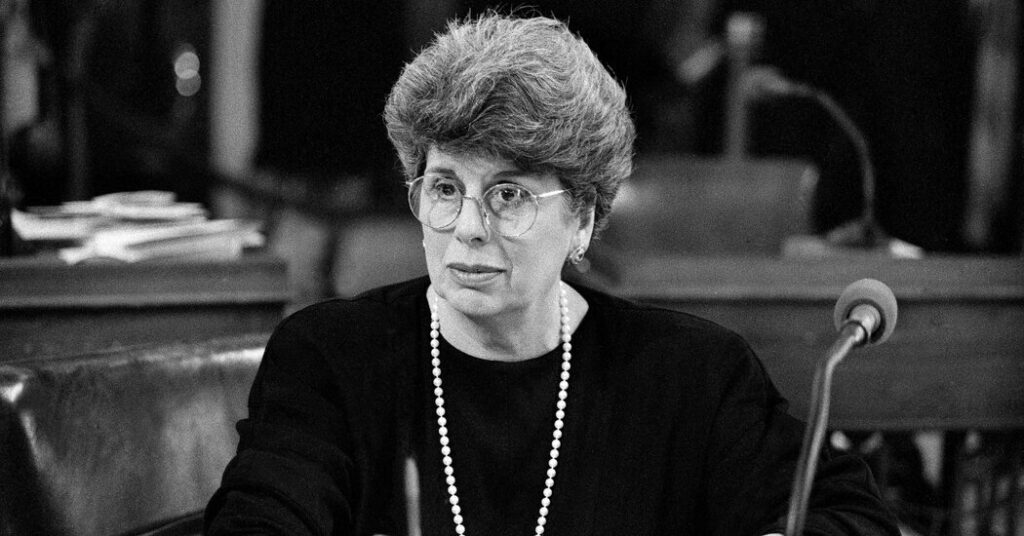
Ronnie M. Eldridge, a liberal Manhattan Democrat who helped found the anti-Vietnam War “Dump Johnson” movement, served as an influential political strategist to Mayor John V. Lindsay, spent 12 years on the City Council and championed the rights of women, gays, prisoners and other marginalized groups, died on Wednesday in Manhattan. She was 95.
Her death, at a hospital, was announced by her daughter Emily.
For decades, Ms. Eldridge was a fixture of New York’s political life — as an appointed official and an elected representative, and also as the spouse of Jimmy Breslin, the Pulitzer Prize-winning Daily News and Newsday columnist and best-selling author.
She liked to say she was “born political” because she shared a birthday with President Franklin D. Roosevelt. “I remember being 5 years old and wearing an F.D.R. button,” she told The New York Times. “I used to send birthday cards to the White House, and the White House used to send birthday cards to me.”
A political science major at Barnard College with a self-proclaimed mission of “trying to change the world,” she became a Reform Democratic leader on Manhattan’s Upper West Side. It whetted her appetite for office, but it was an era, she recalled, when women were expected to “serve coffee, address envelopes, act like ladies, be quiet and follow the men.”
However, as a young mother, she became an energetic volunteer, working for Robert F. Kennedy’s successful U.S. Senate run in 1964. Three years later, she opened her West 93rd Street brownstone to a disgruntled and prominent local group of antiwar Democrats who planned to demonstrate against President Lyndon B. Johnson at a party fund-raising dinner in New York and to recruit a challenger for the party’s nomination.
That protest led to the movement that persuaded Senator Eugene J. McCarthy of Minnesota and Senator Kennedy to challenge the president in the primaries, and that prompted Mr. Johnson’s stunning decision to withdraw from the race.
“That was all organized in my living room,” Ms. Eldridge recalled in an oral history interview with the John F. Kennedy Presidential Library. Mr. Kennedy’s assassination in June 1968, she later said, temporarily left her disillusioned with politics. But she quickly found herself with a new source of inspiration, Mayor John V. Lindsay, a liberal Republican whose stances on civil rights, student protests, the Vietnam War and the women’s and gay rights movements were in harmony with her own.
“He was the perfect mayor for those turbulent times,” Ms. Eldridge, who served as coordinator of Democrats for Lindsay in his 1969 re-election campaign, wrote in The Times.
That year, she persuaded her friend Bella S. Abzug, a prominent feminist and co-founder of Women Strike for Peace — an antinuclear and antiwar group — to join her in bolting the Democratic Party and endorsing Mr. Lindsay’s re-election after he lost the Republican primary. He won a second term that November running as a Liberal and an independent against a conservative Democratic opponent as well as a Republican rival.
Within the Lindsay administration, she was a trusted sounding board and troubleshooter who pursued her policy agenda relentlessly but disarmingly.
“She had a very clear moral compass,” Jay L. Kriegel, Mr. Lindsay’s chief of staff at the time, said in an interview for this obituary before his death in 2019. “Her values were instinctual. And Ronnie’s laugh had a shaming impact on many of us. Her laugh basically said, ‘Come on, be serious, it’s obvious, it’s clear.’”
An unnamed Lindsay aide praised her to The Times in 1970: “In the mucky‐muck of reform politics, she is one of the few who manages to have cordial relations with everybody. You couldn’t stay mad at her. She also has a very nice way of leaning on you to get something done. She’ll come back each day to ask, ‘Have you done it?’ She’ll smile, and you couldn’t get mad, but she’ll never let go.”
In his book “The Ungovernable City,” a 2001 political biography of Mr. Lindsay, Vincent J. Cannato described Ms. Eldridge’s presence at City Hall as “important because she served as a liaison to liberal Democrats and other previously marginalized groups,” including advocates for gay and women’s rights. She advanced an agenda that dealt with day care, drug addiction and lead paint poisoning.
“Ronnie was our conscience,” Sid Davidoff, another member of Mr. Lindsay’s inner circle, said in an interview for this obituary before his death last year.
With titles of special assistant to the mayor and later deputy city administrator, she was described by The Times as “one of the most influential women of politics in the city government.” She played a key role in making top appointments, including Robert M. Morgenthau — the future Manhattan district attorney — as a mayoral deputy.
However, Mr. Lindsay rejected Ms. Abzug’s request to be named City Hall’s “activist” emissary to Washington, and she refused to take the role of housing commissioner. When Ms. Eldridge was unable to mediate successfully, Ms. Abzug declared her candidacy in 1970 for what would be the first of three terms in the House of Representatives.
“I could not think of a job for her,” Ms. Eldridge recalled, adding: “She was so angry about that she decided to run for Congress — which was a very good thing.” She went on to assist Mr. Lindsay with his brief presidential primary bid in 1971 and managed Ms. Abzug’s successful re-election campaign in 1972.
In subsequent years, Ms. Eldridge was an executive producer at WNET-TV (Channel 13), ran unsuccessfully for Manhattan borough president, did community relations work for the Port Authority of New York and New Jersey, directed the state Division for Women under Gov. Mario M. Cuomo, was a founder of the New York City Battered Women‘s Defense Committee and, from 1989 to 2001, represented an Upper West Side district on the City Council, where she worked on issues including funding support for abused women.
“Politics is all of life,” she once explained to The Times. “Every relationship in which power is used is a political relationship. If I sit down to dinner with my kids and they want something, there’s a political interchange.”
Roslynn (a combination of her grandmothers’ names, Rosa and Lena) Myers was born in Manhattan on Jan. 30, 1931 .
Her father, Clifford, was a former hotel manager who handled public relations for Planned Parenthood and fund-raising for the Red Cross. Her mother, Aimee (Fleck) Myers, was an interior decorator.
Ms. Eldridge graduated from what was then known as the High School of Music & Art and in 1952 from Barnard. In 1955, she married Lawrence Eldridge, a psychologist. He died in 1970.
She was married to Mr. Breslin from 1982 until his death in 2017. She is survived by three children from her first marriage, Daniel, Emily and Lucy Eldridge; four stepchildren, James, Kevin, Patrick and Christopher Breslin; six grandchildren; six step-grandchildren; and a step-great-grandchild.
Mr. Breslin recalled that in 1989, at 6:30 in the morning after his wife was first elected to the Council, and after she promised him that she would serve only one term, “she wings out of bed and hits the floor with a thump” to attend a breakfast with labor leaders.
“What are you going there for?” he demanded. “You won the thing last night, remember?”
“Don’t be silly,” she replied. “This is how you get re-elected.”
Sam Roberts is an obituaries reporter for The Times, writing mini-biographies about the lives of remarkable people.
The post Ronnie Eldridge, a Fixture in N.Y. Politics, Dies at 95 appeared first on New York Times.