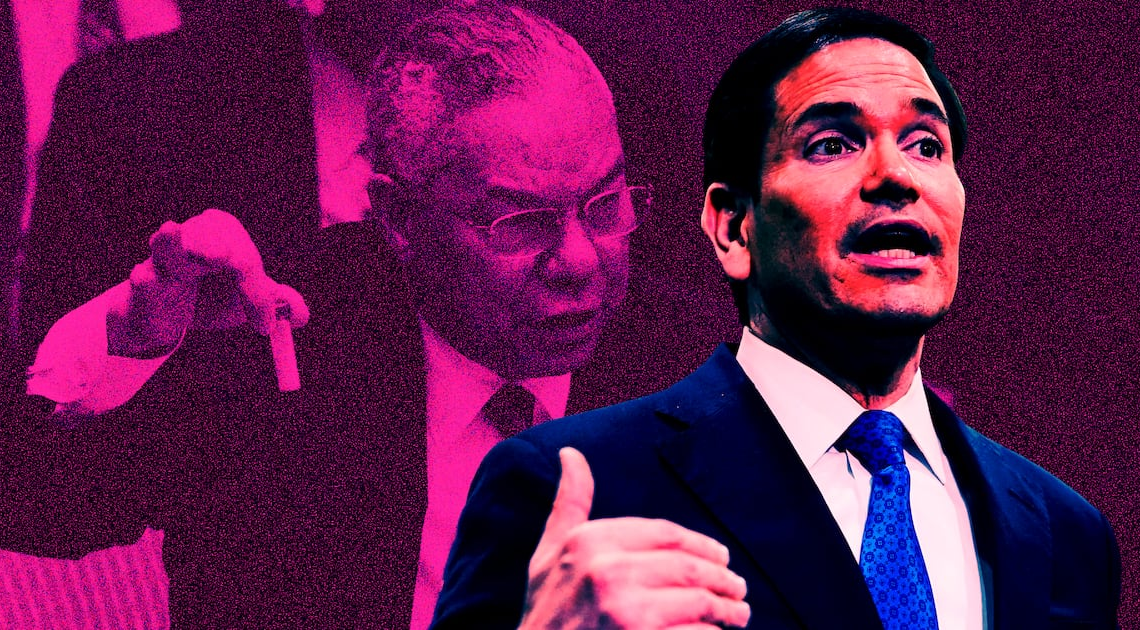
Colin Powell spent the final years of his life haunted by his February 2003 presentation to the United Nations Security Council, claiming the threat posed by Saddam Hussein’s regime in Iraq justified military action. It was a shameful performance in which he laid out the phony case—aluminum tubes, satellite photos and the WMDs that never were—with the full moral authority of a four-star general who’d bled for his country.
Before he died, Powell called backing the Iraq war a “blot” on his record. It was a stain he could never quite wash out.
Marco Rubio, at the moment, surely has no such regrets. It seems unlikely he will in the future either. That, more than anything, is what separates these two men, and it tells a sad story about how far U.S. diplomacy has fallen.
It’s tempting to see similarities between them. Both served as Secretary of State. Both are trailblazing men of color: Powell was the first Black American to hold the office; Rubio is the first Hispanic. Both were considered reasonable moderates in their party, though in Rubio’s case this means prior to his confirmation to Trump’s Cabinet. Since then, of course, he’s been chugging the MAGA Kool-Aid like he’s at one of Pete Hegseth’s frat parties.
They were the credentialed grown-ups brought in to reassure a skeptical world that their president—men who ran foreign policy on instinct and ego, each with well-documented reputations for incuriosity and disdain for history—was not as reckless, or as dimwitted, as he appeared.
New York Daily News Archive/NY Daily News via Getty Images
And yes, both used their “sensible guy” reputations to sell the public on a Middle East war that didn’t have to happen.
But here is where the comparison really breaks down. To treat these two men as moral or even political equivalents would be its own dishonesty.
Powell, whatever his failures of nerve, was deceived. He was handed bad intelligence by peers who wanted a particular decision, and he delivered it with a decorated soldier’s sense of honor and duty.
When the weapons of mass destruction never materialized and Iraq became a generational catastrophe, Powell owned it. He said he’d been wrong. He said it cost him.
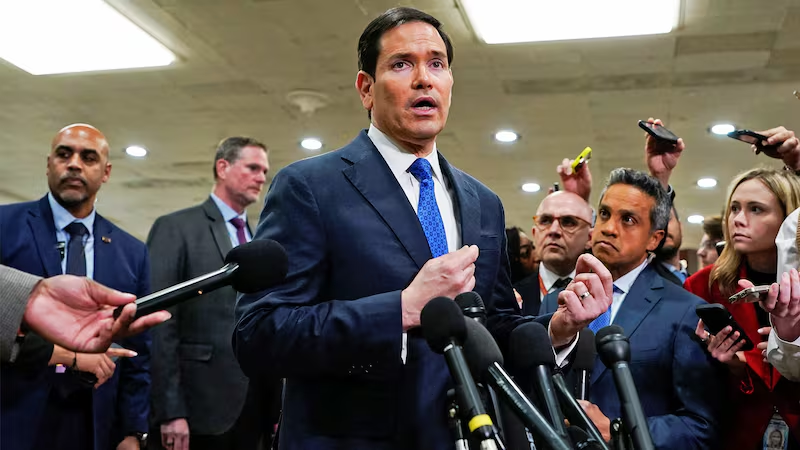
Rubio’s justifications for America’s role in attacking Iran, meanwhile, were pure politics. Pure spin. He already surely knows what’s rotten in the questionable case being made by the Trump administration. When asked about US involvement, he deflected, offering carefully constructed non-answers in a flippant tone that dripped with disdain.
His “aluminum tube” moment came when he cited the Islamic regime’s missile and drone capabilities as an imminent threat to Israel and the United States, less than a year after Trump ordered strikes on Iranian nuclear facilities which, the president said at the time, completely destroyed their capabilities. He invoked preemption—we had to strike first because they were going to strike us after Israel struck them first.
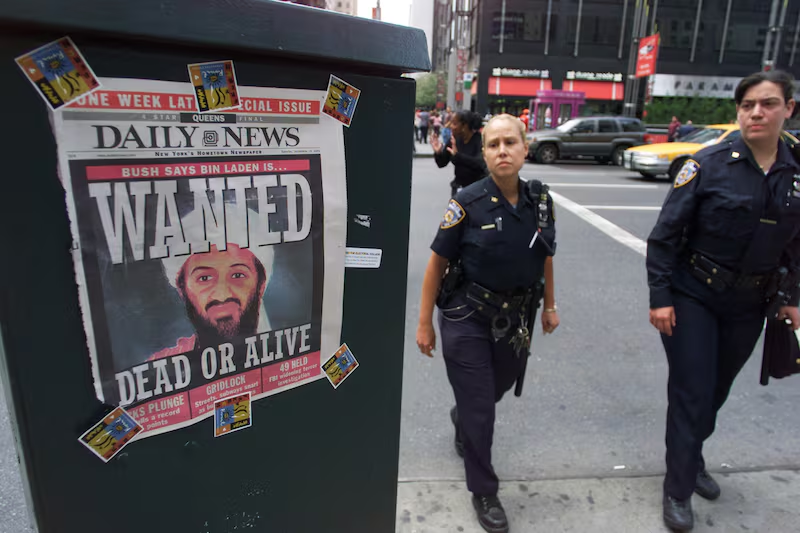
Sound familiar? It should. That’s the direct descendant of the “imminent threat” doctrine that gave us Iraq. The same carte blanche to attack. Bush signed one version. Trump has signed another.
And unlike Powell, Rubio hasn’t even attempted the rituals of diplomacy. Powell at least sought international backing and prioritized regional security as much as he could. Rubio has openly expressed a desire for the Iranian people to “overthrow this government” while insisting the military mission is limited to defensive aims.
To Rubio, the “clean hands” of preemptive defense coexist comfortably with ideological regime change. Political transformation becomes an overt policy pillar, not an unintended byproduct. Kidnap or kill or bomb and bomb some more, all according to the boss’s flippant whims, and without input from anyone else who knows better.
It is the Powell playbook stripped of rationalization, reluctance, conscience, and institutional memory.
In the end, Powell tried to serve his country. Rubio serves a constituency of one, a man who would throw the country under the bus if it benefited him.
The political consequences will find him. When Powell’s name was floated as a potential presidential contender in 2008, and again quietly in 2012, the wounds from Iraq were still too raw.
Rubio has made no secret that he wants to be president. He ran unsuccessfully in 2016, earning the nickname “little Marco” from Trump. Ten years later, it still rings true.
This stain too will follow Rubio into every town hall in 2028. If the war with Iran metastasizes the way Middle East interventions tend to do, his fingerprints will be all over it. They will be bloody.
The lesson of the Trump era is brutally consistent: fly too close to that sun, and you get burned. But the deeper problem isn’t political. It’s institutional.
Powell’s UN speech, for all its failures, represented a Secretary of State still trying to operate within a framework that believed in evidence, argument, international legitimacy, and consensus.
Yes, he was wrong. Yes, he was manipulated. But that framework meant something to him.
Rubio represents something else: a State Department transformed from a diplomatic corps into a communications arm for Donald Trump’s agenda. There is no deliberation. No courting allies. No anguish. The argument isn’t made in good faith. Rubio humiliates himself when he’s deployed to validate those vagaries and notions.
Powell gave us bad intelligence. He deserved the criticism, and he knew it. But he believed in American democracy.
Rubio is giving us bad faith. And he only believes in Donald Trump’s autocracy.
The post Opinion: Marco Rubio Is No Colin Powell. That’s the Problem appeared first on The Daily Beast.