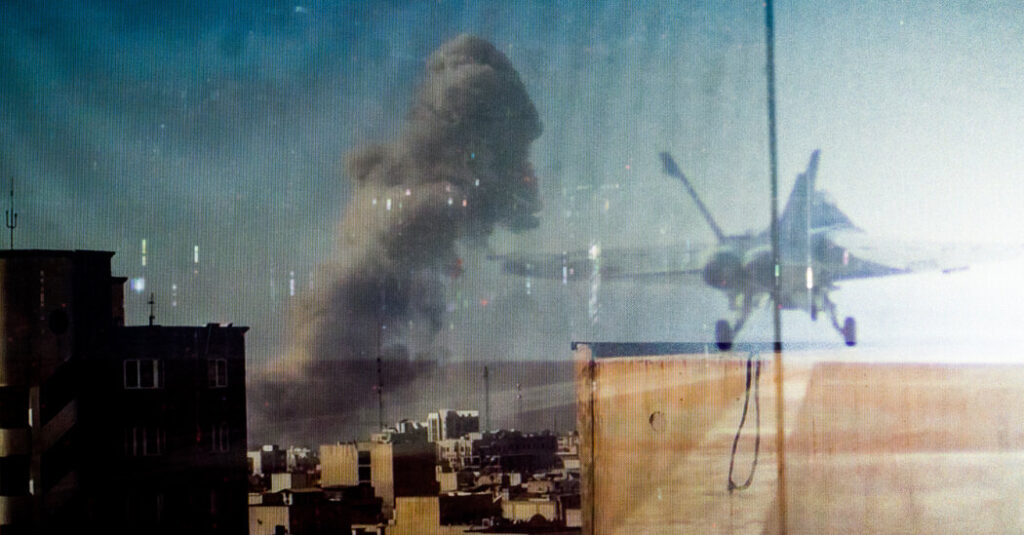
President Trump’s attack on Iran is astonishing in its audacity, aggression and lawlessness. Mr. Trump ordered strikes in the midst of negotiations with a nation that posed no remotely imminent threat to the United States. He did nothing to prepare his country for war. Now he’s offering a dizzying array of rationales and objectives, caught in a maelstrom of his own making.
Beyond breaking with precedent, Mr. Trump also broke with himself. In three straight presidential campaigns, he criticized American military adventures in the Middle East, relying on this stance to distinguish his “America First” mantra from rival Republicans and Democrats alike. “I’m not going to start wars,” he vowed on election night in 2024. “I’m going to stop wars.”
Yet for all its Trumpian characteristics, this war is the logical conclusion of how the United States has long dealt with Iran. For decades, presidents have depicted the Islamic Republic not just as a pernicious presence in the Middle East but also as an intolerable danger to the United States that no diplomatic deal could redress. When politicians inflate a threat and stigmatize peaceful means of handling it, an enterprising leader will one day reach for a radical solution.
That day, as Mr. Trump’s unique attributes combine with the ordinary pathologies of American foreign policy, has come.
Since returning to office, Mr. Trump’s appetite for military action has swelled with every new bite. Still, his earlier actions could be reconciled with his stated worldview. He objected to wars — whether in Afghanistan, Iraq or Libya — because, he argued, they became prolonged entanglements driven by idealistic aims. Until last Saturday, Mr. Trump found ways to use force that did not succumb to either flaw.
In June, his one-day bombing of Iran elicited minimal retaliation and put a stop to the 12-day Israel-Iran conflict. Mr. Trump then ordered airstrikes against a host of targets that could scarcely hit back — terrorist militants in Nigeria and Syria, and alleged drug-running boats in Central America. The president’s risk-taking grew in January when he ordered the abduction of the Venezuelan president, Nicolás Maduro. Despite the mission’s complexity, he once again avoided lengthy combat, this time by making a dirty deal with Mr. Maduro’s vice president.
Operation Epic Fury, as the administration named its Iran venture, is another matter altogether. The self-appointed president of peace has turned into an emboldened warmaker. This time, he adopted grandiose objectives, including annihilating Iran’s entire military arsenal and threatening the regime to the point of overthrow. The war promptly escalated into a regionwide confrontation that has cost American lives — the predictable product of giving Iran every incentive to retaliate. One struggles to imagine any of Mr. Trump’s predecessors so brazenly and confusedly rolling the dice.
Nevertheless, this war has emerged from more than Mr. Trump’s hubris. Iran, of course, bears ample responsibility, especially for sponsoring violent groups across the region and building nuclear capabilities. But the United States cannot escape blame. One administration after another has made it an article of faith that Iranian activities were wholly unprovoked, threatened vital U.S. interests and justified the use of force. Each of these axioms is dubious. All possessed a bipartisan pedigree.
If most Republicans of the pre-Trump era made no bones about preferring to handle Iran through force over diplomacy, the Democrats’ position has been more ambivalent and self-defeating. Desirous of negotiations but fearful of appearing weak, Democratic leaders have simultaneously demonized the Islamic Republic, chest-thumped about military action and gingerly engaged in talks — with one eye on Iran, the other on domestic politics. The result has been a policy at war with itself.
Barack Obama sought to break the mold, investing in diplomacy to prevent an Iranian bomb. But he too felt compelled to dangle the option of military force and framed his 2015 nuclear deal as a narrow instrument that would leave intact every other element of America’s hostility. Mr. Obama struggled to win over reluctant lawmakers of his own party, many of whom were more skeptical of negotiations than of war. Whatever victory he achieved proved short-lived: Mr. Trump exited the agreement in 2018.
Joe Biden campaigned on restoring the deal, but he shared neither Mr. Obama’s persistence nor his conviction that the diplomatic objective was worth the political risk. Mr. Biden embodied the default Democratic pose: Fearing domestic backlash, he halfheartedly engaged in negotiations while expressing willingness to resort to force and maintaining Mr. Trump’s economic sanctions, against which he had railed. Ultimately, he settled for a deteriorating status quo.
Diplomacy, in this setting, becomes a fool’s errand. A narrow deal cannot survive America’s politics, where it will be condemned for not addressing the full scope of Iran’s malign activities. A wider deal that ends all those activities, however, is transparently unrealistic: It would effectively require the Islamic Republic to stop being the Islamic Republic. Mr. Trump’s war is the outgrowth of this rotten impasse. If Iran presents a quasi-existential menace, diplomacy is a political liability and sanctions don’t work, what is left besides military force?
It will take new thinking to put American policy on steadier ground. That was plain from the reaction across the political spectrum to America’s military buildup and the onset of war. The Democratic leadership displayed pusillanimity by failing to vote on a War Powers Resolution before hostilities and timidity after by focusing its critique on the absence of procedural propriety and day-after plans. Republicans, for their part, parroted Mr. Trump’s kaleidoscopic absurdities. No meaningful constraint exists in a system that judges wars on how they end up rather than whether they are warranted and wise.
For a quarter-century, conflicting desires have driven U.S. conduct in the Middle East. On the one hand, America wants to pivot away, extricating itself from troubles it can’t fix and often makes worse; on the other, America feels drawn in by fears of ominous threats, intractable foes and imperiled allies. By holding both beliefs, Mr. Trump is now demonstrating their incompatibility. If the United States wants to stop plunging into Middle East wars, it needs to value its own interests more than it hates its old enemies.
Only Mr. Trump, perhaps, could have harnessed the country’s exhaustion with war and wound up trying make regime change great again. He is a most unusual figure. But the road to his war was paved by many. Without fundamental change, the United States will remain on the same path — continually resorting to force, at growing cost, in a region of diminishing importance.
Robert Malley is a lecturer at the Yale Jackson School and the author, with Hussein Agha, of “Tomorrow is Yesterday: Life, Death and the Pursuit of Peace in Israel/Palestine.” He served as U.S. special envoy for Iran from January 2021 to April 2023 and a lead negotiator of the 2015 Iran nuclear deal.
Stephen Wertheim is a senior fellow in the American Statecraft Program at the Carnegie Endowment for International Peace and a visiting lecturer at Yale Law School. He is the author of “Tomorrow, the World: The Birth of U.S. Global Supremacy.”
The Times is committed to publishing a diversity of letters to the editor. We’d like to hear what you think about this or any of our articles. Here are some tips. And here’s our email: [email protected].
Follow the New York Times Opinion section on Facebook, Instagram, TikTok, Bluesky, WhatsApp and Threads.
The post Of Course Trump Bombed Iran appeared first on New York Times.