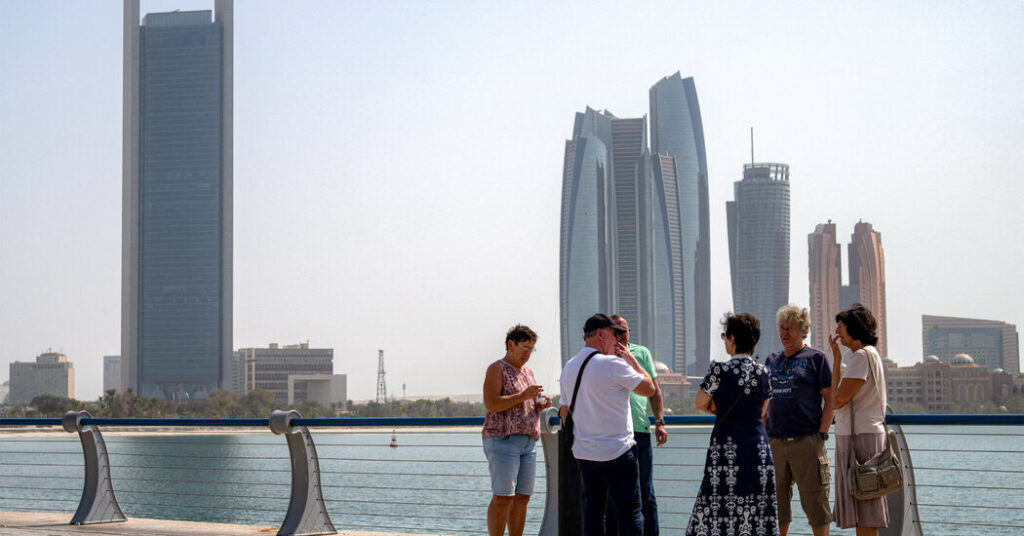
Instead of sleeping last night, Dr. Eddine Saich, 38, a French physician who is stranded in Kuala Lumpur, Malaysia, with his family of five, stayed up researching ways to get home after his connecting flight to Abu Dhabi was canceled last weekend.
He tried to identify which cities still had direct routes that connected to Paris. He looked at flying through India, Turkey, even Ethiopia.
“I even considered going the other way around, trying to route through the United States to get home, but either the flights didn’t exist at all, or they were completely unaffordable,” said Dr. Saich, who is from Lille. “And now we’re just jumping from one option to another, from one cancellation to the next.”
As the conflict with Iran rages, thousands of travelers remain stranded not only in Israel and the United Arab Emirates, but also in more distant places that rely on connections through global hubs like Dubai, Abu Dhabi and Doha, Qatar.
More than 20,000 flights to or from the Middle East have been canceled since Saturday. Stranded travelers say they’ve had to improvise expensive, often complex plans to get home. They report frantically messaging airlines, calling embassies and booking backup flights, sometimes traveling in the opposite direction, to steer clear of the affected airports. Many said they received no help rebooking flights or paying for hotels.
Dr. Saich said his airline, Etihad Airways, hadn’t offered any lodging assistance and that customer service had been “opaque and chaotic.” The French Embassy hasn’t provided concrete solutions either, he added. So far, he said he had spent $1,500 on accommodations over the last week. Economy airfare options for his family hovered in the tens of thousands, he noted.
After days of calling the airline, he was finally been rebooked on a flight set to depart on Sunday. But, he said, he expected it, too, would be canceled.
With commercial planes irregularly making it into and out of Gulf hubs, including repatriation flights by Etihad Airways, Emirates and some governments, a few travelers have been able to pounce on limited opportunities to flee.
But details on how to secure a coveted spot on these flights are scarce. Airlines advised travelers to stay clear of airports and to wait to be contacted. Though the U.S. State Department has advised Americans to leave the Middle East and promised to help them do so, travelers say they haven’t received assistance or clarity about the repatriation flights.
“The State Department will identify where you are and provide travel options directly to you,” Karoline Leavitt, the White House press secretary, said in a news conference on Wednesday, adding that the administration would be arranging free flights and booking commercial options, which it expected to “become increasingly available.”
European countries like Britain, France and Spain have already begun repatriation flights.
The Middle East is a linchpin of international aviation, accounting for 5.5 percent of global flights, more than double its share from two decades ago, according to data from the aviation analytics firm Cirium. More than 40 percent of flights in the region connect outside the Middle East to places like Australia, Indonesia, India, Britain, Germany, Italy, Russia and the United States, according to Cirium. As a result, the disruptions have reverberated widely.
Dubai International, one of the busiest airports in the world, has borne the brunt of the disruptions. Airports elsewhere in the region, including in Qatar, Saudi Arabia and Oman, have been able to offer travelers some escape options.
After spending several nights stuck in Dubai hearing missiles strike, Karen Wolcott, 32, of Los Angeles, learned that flights were still departing from Muscat, Oman, and hired a car service to make the seven-hour journey. She and her husband were on a trip around the world, exploring Jordan and bound for Thailand, when their connecting flight from Dubai was canceled.
“The roads were totally empty. We were pretty nervous until we got out of the city,” Ms. Wolcott said. In Muscat, she began scouring the internet for flights — anywhere — booking an $800-per-person departure to Thailand and a $1,000-each alternative flight to Mumbai, which ultimately turned out not to be feasible because it would have required a last-minute visa. She also called the U.S. State Department hotline, but the agent who eventually picked up was little help, she said, asking her to spell Oman and advising her to “monitor the news and shelter in place.”
She paid $420 for the drive to Oman, but a friend was later quoted $2,000 to make the same drive, Ms. Wolcott said.
Security firms specializing in global evacuation services said that they had arranged dozens of similar transports for clients in the last few days, driving them to airports in Muscat, as well as in Riyadh, Saudi Arabia. Still, experts cautioned, heading to a border country doesn’t guarantee better odds of a flight, because airport connectivity is limited.
“They are big for their country but not necessarily the massive transit hubs people think about with Dubai and Abu Dhabi,” said Tyler Hosford, a security director for International SOS, a global medical and security assistance company. “There are flights, but it might be a day or two before someone can find a seat.”
About 51 private jets departed the Gulf states and Jordan over the weekend, including 11 that took off from Al Maktoum Airport in Dubai, according to WingX, an aviation data firm. Private jet charter companies said demand had soared, causing the price to jump drastically. A charter from the Middle East to Istanbul that ordinarily might cost $75,000 is now being quoted in the hundreds of thousands, said Dan Richards, the chief executive of Global Rescue, a United States-based company that provides evacuation and field rescue services.
Gaspard Boscher, the head of marketing at LunaJets, a private jet charter company with an office in Dubai, said that in the last 24 hours the company had received more than 700 evacuation requests. He added that the company had facilitated fewer than a dozen private jet charters departing from the Middle East and had also worked with a local travel agency to organize a chartered flight for 160 passengers that departed from Muscat to Istanbul on Tuesday. Seats on this flight cost more than $2,000.
But this kind of expensive escape hatch isn’t available to most of the traveling public.
When Amber Manzanilla, 42, called the State Department hotline with questions about how she could get home to Austin, Texas, from Dubai, she said she the agent told her to “stop ranting and raving” and hung up on her.
“It was very infuriating,” she said. She managed to book a rare Emirates flight to San Francisco on Thursday and said that, if she made it, she’d then turn her attention to getting back to Austin.
Adam Harris and his fiancée, Letty Camarillo, were stranded in Israel on Wednesday after flying there late last month. Mr. Harris, 43, from Long Branch, N.J., said the couple had called the State Department hotline and the U.S. Embassy in Israel on Wednesday and were told the U.S. government could not help them leave the country.
With their wedding back home just a few weeks away, they considered trying to cross into Jordan or Egypt by land and flying from there. But they determined those options were too risky after Mike Huckabee, the U.S. ambassador to Israel, said on Monday in a social media post that he could not vouch for either route’s safety, but that he was “Praying your safe passage!”
“We’re religious people,” Mr. Harris said, “but that’s not exactly what you want to hear from the government.”
Ceylan Yeğinsu contributed reporting.
Follow New York Times Travel on Instagram and sign up for our Travel Dispatch newsletter to get expert tips on traveling smarter and inspiration for your next vacation. Dreaming up a future getaway or just armchair traveling? Check out our 52 Places to Go in 2026.
Christine Chung is a Times reporter covering airlines and consumer travel.
The post No Help and Few Options for Travelers Stranded by Mideast Conflict appeared first on New York Times.