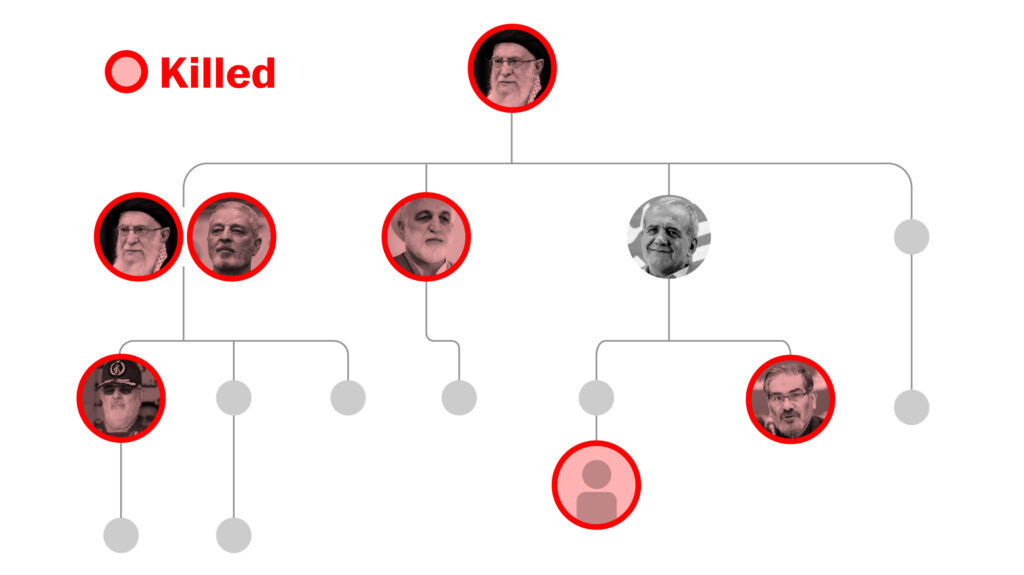
The U.S. and Israeli air campaign against Iran has decimated the highest ranks of political and military leadership, destroyed critical military command-and-control infrastructure and fighting capability, and damaged civilian buildings across the country.
In Tehran, the expanding conflict appears to be frustrating the succession process after Supreme Leader Ayatollah Ali Khamenei was killed. Khamenei’s funeral was postponed after the group charged with choosing his successor was targeted by Israeli strikes. Following that attack, Iranian state media announced that voting for the next supreme leader would be conducted remotely.
But so far, some six days into a war that has now touched 12 countries across the Middle East, major military operations have not threatened the Iranian regime’s grip on power, according to European and Arab officials briefed on assessments of the regime’s standing since the conflict began.
Iran, the officials say, was prepared for this conflict. The command structures built to survive a decapitation strike appear to remain substantially intact, allowing Iranian retaliatory strikes to begin against Israel, Qatar and Bahrain within hours of the initial attacks. And inside the country since the conflict began, Iranians report a heavier security presence in city streets, with Basij paramilitary forces patrolling on motorbikes.
“Iran’s senior leaders are dead; the so-called governing council that might have selected a successor, dead, missing or cowering in bunkers, too terrified to even occupy the same room,” Defense Secretary Pete Hegseth said in a briefing Wednesday touting successes as he outlined how operations would expand.
President Donald Trump said Tuesday that the strikes killed “most of the people” the United States favored to replace the recently killed regime members.
But despite the intensity of the strikes and the broad nature of the destruction, so far there are no reports of significant defections within regime ranks or popular uprisings, according to European and Arab assessments described to The Washington Post by officials from those countries. U.S. intelligence also saw no signs of uprisings or defections in the first days of the campaign, according to a person familiar with the situation who spoke on the condition on anonymity to describe an ongoing operation.
“There’s not a single sign of anything in the system breaking or defecting. Nothing. Zero,” said a senior European official, speaking on the condition of anonymity to describe government briefings on the latest assessments of the strength of the Iranian regime. “The control is complete,” he said. The official said he was aware of reports of regime security forces failing to show up for duty, but believed that could be because of orders to no longer congregate in compounds and barracks, for fear of being targeted.
The officials said Iran’s military and political command has proved durable because of the “layered system” the regime built to withstand a crisis, decentralizing leadership by appointing multiple individuals to immediately replace any key figure who might be killed.
After Iranian Defense Minister Aziz Nasirzadeh was killed in strikes Saturday, Majid Ebnelreza was appointed as the caretaker minister on Monday by Iranian President Masoud Pezeshkian, who himself was rumored to have been targeted in the attack’s initial waves. Since then, media reports have speculated that Ebnelreza was killed in subsequent attacks, but Iranian state media has not responded to the allegations.
In the lead-up to the conflict, a senior Arab official said, U.S. allies in the Persian Gulf thought that Iran would be more vulnerable to outside military pressure and that the potential killing of the supreme leader would be an early turning point, triggering a mass mobilization against the regime.
“We were looking for the demonstrations in the streets, but we were surprised by their unity,” he said, speaking on the condition of anonymity to describe sensitive internal planning.
In January, as the regime buckled under massive anti-government protests across the country and responded with a brutal crackdown, many of Iran’s neighbors assessed a deep weakness within the political and security leadership structures.
But amid an unrelenting bombing campaign, the governance structure has largely stayed intact and continues to exert unilateral control, surprising seasoned Iran watchers in the region. Both the European and the Arab officials cautioned that the Iranian regime remains opaque and regime collapse can be almost impossible to anticipate from the outside.
Information on the impact of the U.S. and Israeli attacks against Iran is sporadic. The country is under a near-total internet blackout. But initial visual analysis by The Washington Post reveals extensive damage to military targets, government buildings and internal security structures. Israel has also recently claimed strikes targeting Iran’s clerical establishment.
In total, U.S. Central Command says, more than 2,000 targets were hit inside Iran in the space of over four days. The Israel Defense Forces said its planes have dropped more than 4,000 munitions on Iran since Saturday.
“Undoubtably, Iran has been considerably weakened,” said Gregory Brew, an Iran analyst with the Eurasia Group. Considering Iran’s military losses alone, the United States and Israel destroyed most of the country’s navy, a significant portion of its missile stockpile and its means of producing more missiles, he said.
“They’re blowing up a lot of buildings, but most of these buildings are probably empty. They’re annihilating the physical edifice of the Islamic republic,” Brew said.
Meanwhile, Iran’s police force and the Basij have continued to function, according to Iranians inside the country, said the European official. Brew said that’s because these forces don’t operate heavy weaponry and can quickly disperse from buildings easily targeted from the air and then reemerge once the fighting ceases.
After the 12-day war in June, Iran structured its armed forces in anticipation of further decapitation strikes. Iranian Foreign Minister Abbas Araghchi appeared to reference the reorganization in an interview with Al Jazeera on Sunday, in which he described Iranian military units as “isolated” and acting on “general instructions given to them in advance.”
It is unclear how long Iran will be able to hold out in the face of U.S. and Israeli attacks. Earlier this week, the tempo of Iranian retaliation dropped, suggesting that Iran is running low on munitions or is unable to access buried stockpiles. However, Thursday saw heavy bursts of Iranian retaliatory attacks against Bahrain, Qatar and the United Arab Emirates. As the conflict progresses and Iran’s armed forces are forced to adapt and draft new plans, the country’s leadership losses could become more serious.
But Iranian officials have signaled that they are prepared for a long fight against militarily superior adversaries. Tehran believes that the only way it can prevail is if it can outlast the United States and Israel, according to a second European official briefed on assessments of Iranian regime strength since the outset of the war.
“They understand that they will not be able to defeat the most powerful army in the world, but with asymmetric warfare they can try to inject as much damage as possible, to make the U.S. seek de-escalation,” he said. This is why Iran has prioritized retaliation against Persian Gulf nations and countries that could begin to pressure the United States to seek an off-ramp, the official said.
The official said Iran has wagered that its system and its people are more capable of enduring prolonged hardship than those of the Persian Gulf and the United States, but he cautioned that the longer the conflict lasts, the more deadly it is likely to become on all sides.
“This regime is built to last, and they aren’t going to go quietly,” he said.
Warren Strobel, Evan Hill, Imogen Piper, Jarrett Ley and Meg Kelly contributed reporting.
The post Iran’s regime maintains its grip, despite devastating losses appeared first on Washington Post.