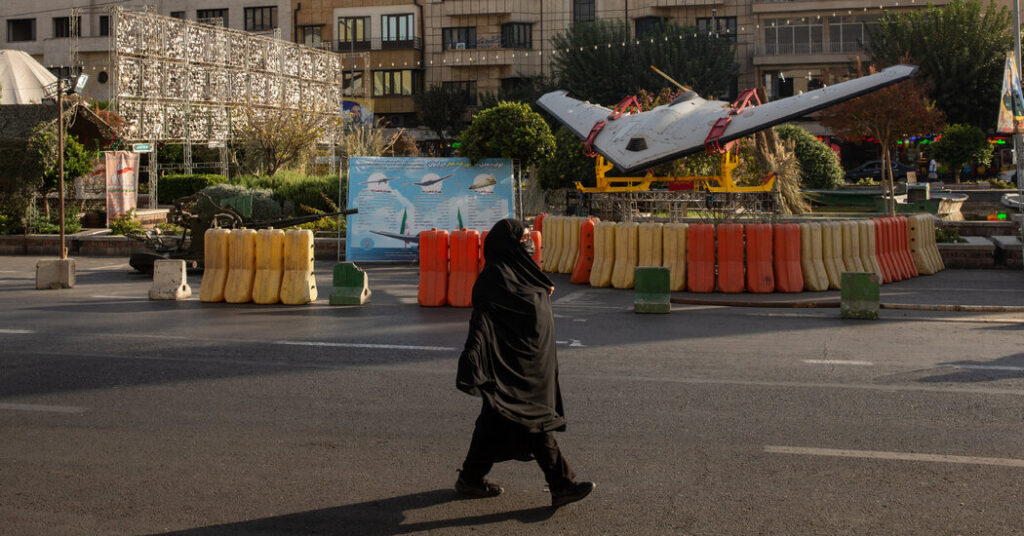
The United States is dominating the skies above Iran. But math is not necessarily on America’s side. Iran is using low-cost drones for precision attacks in the Middle East. The United States and its allies have air defense systems capable of intercepting a vast majority of Iranian ballistic missiles and drones, which are sophisticated yet costly.
“It is definitely more expensive to shoot down a drone than to put a drone in the sky,” said Arthur Erickson, the chief executive and a co-founder of Hylio, a drone manufacturer in Texas. “It’s a money game. The cost ratio per shot, per interception, is at best 10 to one. But it could be more like 60 or 70 to one in terms of cost, in favor of Iran.”
Iran has fired off more than 2,000 one-way drones since the United States and Israel started attacking it on Saturday, and some reached their targets, despite billion-dollar air defense systems. It’s a looming problem — not just in the Middle East, but everywhere. In a world where attack drones are cheap, and defending against them expensive, the bill could become unsustainable over time.
What makes Iranian drones so effective?
Iran’s Shahed drones are triangle-shaped loitering munitions, roughly 11 feet long, that roar like lawn mowers and carry an explosive payload in their nose that detonates when they crash into their targets. They are small enough to be launched from the back of a truck, making them relatively easy to hide and tough to hunt down. The long-range version of the Shahed drone, known as the 136, can travel roughly 1,200 miles, which makes it capable of reaching targets across the Middle East, according to Stacie Pettyjohn, a senior fellow and director of the defense program at the Center for a New American Security, a Washington think tank.
How much do Iran’s drones cost?
Built with off-the-shelf commercial electronics, each Shahed is said to cost $20,000 to $50,000 to manufacture, depending on the model, Ms. Pettyjohn said.
Russia mass produces a version of the Shahed for use against Ukraine. Iran may have manufactured many thousands of them.
How much does it cost to neutralize Iranian drones?
The gold standard in missile defense, called the Patriot air defense system, uses interceptors that can cost more than $3 million per shot and are in limited supply. For instance, Lockheed Martin delivered just 620 PAC-3 interceptors in 2025, which broke a record for production.
“We have pushed every counter-UAS system forward, sparing no expense,” Defense Secretary Pete Hegseth said at a press briefing on Wednesday, an acknowledgment of the punishing math behind successful interception.
Are there less expensive ways to counter Iran’s attacks?
The American military also uses other, less expensive forms of counter-drone technology. The Raytheon Coyote system, which launches drones that hunt and destroy other drones, is estimated to cost $126,500 per interceptor, according a report by the Center for a New American Security. That’s much less expensive than a PAC-3, but still several times more expensive than a Shahed.
“They are trying to use the cheapest bullet they can to do the job they need it to do,” Riki Ellison, chairman and founder at Missile Defense Advocacy Alliance, said of the American military.
There are a host of other systems that can disorient or disable drones, including equipment that jams the radio frequencies that control navigation systems and those that use microwaves or lasers to disable drones or send them off course. Such counter-drone systems are far more affordable than interceptors, but they have a mixed track record of success or are extremely disruptive to civilian life.
In Ukraine, counter-drone tactics must be constantly updated to keep pace with changes in the way that Russian drones attack. Ukrainians have even used low-tech solutions like fishing nets and shotguns to defeat low-flying drones. But such solutions are difficult to deploy reliably at scale.
Doesn’t the United States have its own drones?
The U.S. military invested heavily for years in large, exquisite unmanned systems such as Predator drones, but it has struggled to produce the low-cost, expendable systems that have dominated the war in Ukraine.
In recent months, the Defense Department has tried to jump-start the production of such drones by rolling out contract awards that will be worth $1.1 billion over the next two years in four phases. Twenty-five companies, including some Ukrainian firms, are competing for a slice of $150 million in funding. Winners will be required to deliver drones within months rather than years.
American leaders have announced that they reverse-engineered a captured Iranian Shahed drone and are using a tweaked version of it in the current conflict, a nod to the ingenuity of Iranians who developed it despite economic embargoes limiting what they could import. The American version, called LUCAS, for Low-cost Unmanned Combat Attack System, is built by Arizona-based SpektreWorks. The company did not respond to an email requesting comment.
How long will America’s interceptors last?
There has been considerable speculation that the United States and its allies will run low on interceptors needed to defend the region against Iranian missiles and drones, partly fueled by the fact that the United States and its allies have never been able to provide Ukraine with enough interceptors to repel every Russian attack.
A report released in December by the Center for Strategic and International Studies, a Washington think tank, tracks public data on military procurement and suggests that the United States has been procuring relatively small numbers of interceptors in recent years — in the hundreds, not thousands — suggesting a mismatch between the needs in a hot conflict and the available supply. Although the Defense Department has recently signed contracts ramping up procurement, it will take years for factories to fulfill increased demand.
On Wednesday, Gen. Dan Caine, the chairman of the Joint Chiefs of Staff, acknowledged the concern but assured reporters that the country had enough.
“We have sufficient precision munitions for the task at hand — both on the offense and the defense,” he said. “But I want to tell you, teammates, as a matter of practice, I don’t want to be talking about quantities.”
Farah Stockman is a Times business reporter writing about manufacturing and the government policies that influence companies that make things in the United States.
The post Iran’s Drones Cost a Fraction of the U.S. Weapons Shooting Them Down appeared first on New York Times.