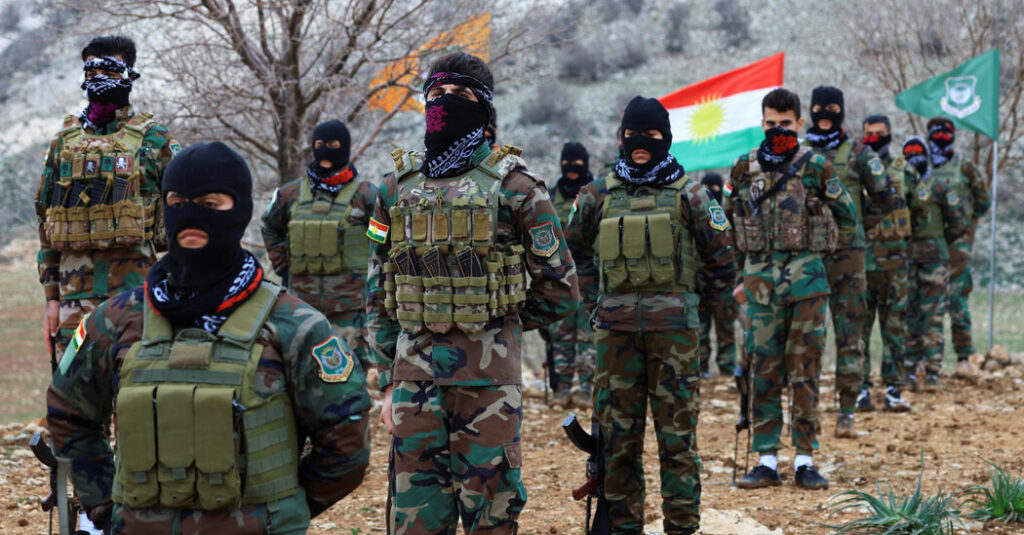
Iranian Kurdish forces, based in Iraq, are preparing armed units that could be sent into Iran, potentially with U.S. support, in an insurgency that would open a new front against the Iranian government.
Though the White House has denied that it agreed to any plan for the Kurds to launch an insurgency in Iran, the United States has a long history of working with Kurdish militias around the region.
It also has a reputation for abandoning them: After the 1991 Persian Gulf war, the United States encouraged a Kurdish uprising in Iraq then stood by as the Iraqi army slaughtered Kurdish forces.
Who are the Kurds?
The Kurds are an ethnic group of roughly 40 million people spread largely across four countries: Iran, Iraq, Syria and Turkey. They have long sought either a state of their own or greater autonomy, and are often considered to be the largest contiguous ethnic group in the world without an independent state.
In the aftermath of World War I and the collapse of the Ottoman Empire, Kurds across the Middle East were promised a nation of their own by world powers, but it never came to be.
Many Kurds blame the Sykes-Picot Agreement of 1916 — a secret deal between Britain and France that carved up the Middle East along often illogical boundaries — for denying them a country of their own and dividing them among states that have, at times, proved hostile.
Since then, Kurdish people have faced varying degrees of discrimination, including bans on speaking their own language, celebrating their culture or even receiving citizenship.
Those measures fueled calls for greater Kurdish autonomy. Some countries saw the rise of armed groups, such as the Kurdistan Workers’ Party, or P.K.K., which is considered a terrorist organization by Turkey, the United States and other countries.
How big is Iran’s Kurdish minority?
Kurds make up 10 percent of Iran’s population and are concentrated in the northwest, along its border with Iraq. They have at times been at the forefront of protest movements against Iran’s theocratic government.
In 2022, a 22-year-old Kurdish Iranian woman, Mahsa Amini, died after she was arrested by the country’s morality police, accused of violating the country’s strict codes on modest dress for women. Her death sparked a nationwide protest movement, which was centered around women’s rights and freedoms in Iran but also touched on longstanding grievances held by the Kurdish minority.
At one point, Kurdish protesters seized control of Oshnavieh, a city in the Kurdish region of Iran, though it was soon retaken by government forces.
“This is not all about the head scarf,” Hana Yazdanpana, a spokeswoman for the Kurdistan Freedom Party, an Iranian paramilitary group based in Iraq, said at the time. “The Kurds want freedom.”
Some Iranian Kurdish armed groups are based in Iraqi Kurdistan, a region in the north of Iraq that broke away from the central government’s control in 1992 with U.S. support. It is recognized as a semiautonomous region by the United Nations and the United States, among others.
Will the Kurds join the fighting in Iran?
Kurdish militias have previously crossed borders to aid one another, most notably in Syria’s civil war. Kurds from Turkey, Iraq and Iran came together to fight there alongside Syria’s minority. It is unclear to what extent an armed uprising in Iran’s Kurdish region would galvanize other Kurds around the region.
For more than a decade, Kurdish forces were the United States’ closest allies in Syria, fighting against ISIS, guarding American bases and running internment camps and prisons that held tens of thousands of ISIS fighters and their relatives.
That alliance has been disintegrating, however, as the United States has thrown its support behind the new government of Syrian President Ahmed al-Sharaa.
Raja Abdulrahim reports on the Middle East and is based in Jerusalem.
The post Iranian Kurdish Forces Say They May Enter Iran. Who Are the Kurds? appeared first on New York Times.