Three kinds of events have historically pushed the United States into recessions: financial crises, oil price shocks and pandemics.
The U.S. and Israeli attacks on Iran have already brought about the second circumstance on that list and, if things go badly, potentially the first.
Much will depend on how long the conflict lasts and how severe it remains. The impact has grown as strikes have expanded beyond Iran, paralyzing airports and damaging industrial facilities across the Middle East. If there is a cease-fire in the next week, trade flows could get back to normal fairly quickly.
But if the bombs keep falling for more weeks or months — as President Trump has foreshadowed — the economic drag could become much heavier and the cost to U.S. taxpayers much greater. Here are the main channels through which Americans may feel the effects.
Strangling Oil Supplies
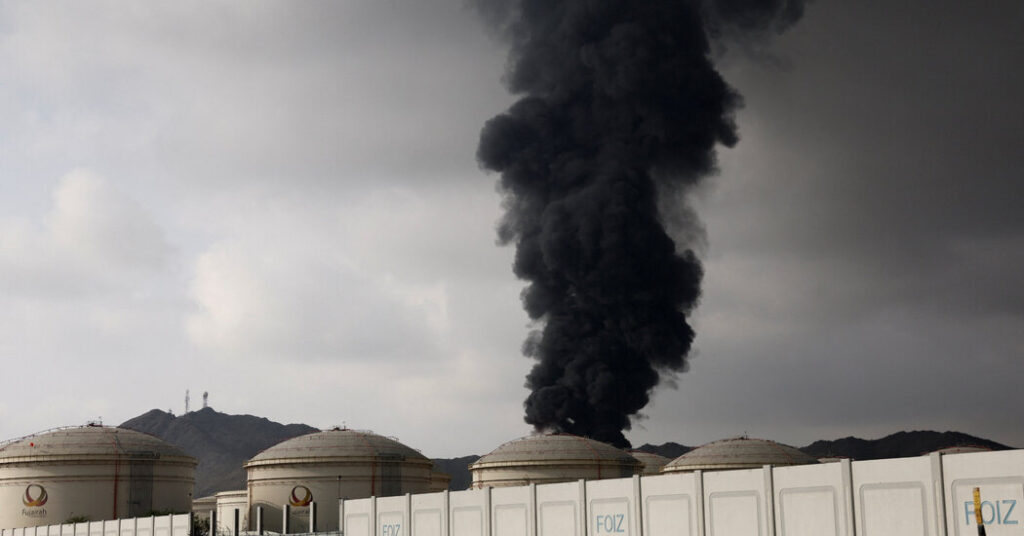
In the days after the war began, tankers stopped entering the Strait of Hormuz, which Iran controls and through which 20 percent of the world’s oil is channeled. About 200 ships are stranded in the Persian Gulf region, according to Lloyd’s List, and oil shipping rates have shot up. Saudi Arabia’s largest oil refinery and Qatar’s largest liquefied natural gas export facility shut down after drone attacks.
Oil prices surged and are up about 10 percent since the fighting started, at about $80 a barrel. Diesel prices rose to over $4 a gallon on average, their highest level since April 2024, according to AAA. The average gasoline price has jumped to $3.21 a gallon, from $2.99 last week, according to GasBuddy. Even if the fighting stops, oil prices will remain elevated through the rest of the year, Goldman Sachs estimates, and if the strait remains closed for weeks, they could reach $100 a barrel.
Of course, this isn’t the 1970s, when turmoil in the Middle East led to fuel shortages that sent inflation skyrocketing and created lines at gas stations. The U.S. economy has become less dependent on oil because of the rise of wind- and solar-generated electricity as well as the shale boom, which has made the United States a net energy exporter. Some American gas companies have already sought to capitalize on higher prices.
Inflation is expected to rise, decreasing the likelihood that the Federal Reserve will cut interest rates in the coming months. As usual, smaller businesses are more exposed to volatile prices, because they can’t afford long-term contracts or financial instruments that protect them against fluctuations.
“Any sort of industrial business is going to hedge out all their energy exposure,” said Chris Hodge, chief U.S. economist for Natixis Corporate & Investment Banking. “That cost of hedging is going to go up a little bit, but it’s probably not going to impede any sort of capital expenditure plans.”
The same goes for consumers: Those with low incomes tend to spend a higher share of their earnings on gasoline. As prices per gallon rise, people cut back on other priorities. With the personal savings rate at its lowest point in more than three years and delinquency rates on credit cards and auto loans rising to levels not seen since the Great Recession, there is not a lot of cushion left.
Retailers and restaurants that serve low-income customers, and consumers in suburbs that require driving everywhere, are most exposed, said Michael Gunther, the senior vice president of research at Consumer Edge, a credit card data company. He expects the wedge in spending between low and high earners to widen, as it did in 2022 when inflation topped 9 percent.
“When there’s a general inflation shock, and gas prices were up a lot then, too, that differential really blew out,” Mr. Gunther said. “It’s not as if spending fell off a cliff, but it certainly weakened from before.”
Trade Frictions
The Strait of Hormuz is not an essential route for goods besides oil. And although the whole region is now riskier to sail through, trade had already shifted away from the nearby Suez Canal because of the risk of attacks by Houthi rebels over the past few years, limiting the immediate downside. Still, absent the outbreak of new hostilities, conditions might have improved.
“Rather than prompting a new, disruptive diversion of container shipping, the conflict will mainly postpone plans that shipping companies had to return to the Suez Canal trade route later this year,” wrote Simon MacAdam, the deputy chief global economist for Capital Economics, in a note on Wednesday.
Also, uncertainty about whether the war will widen and disruptions linger comes as U.S. consumer goods companies are buying raw materials, with an eye toward the Christmas shopping season. On top of the tariff landscape, which was upended again when Mr. Trump rushed to replace duties invalidated by the Supreme Court, the war is clouding importers’ decision making even further.
“We’re in that small window right now where any major impact can have a significant knock-on to the consumer holiday season later in the year,” said David Warrick, executive vice president with Overhaul, a company that helps clients manage supply chains.
Risk Upon Risks
There is never a great time to launch an open-ended war. In this case, the United States is already straining under high debt loads, with an economy that has become heavily dependent on one sector and a stock market that appears overvalued.
Despite a few years of healthy growth and low unemployment, deep tax cuts and heavy spending during the pandemic have kept federal debt as a share of gross domestic product at historic highs. High interest rates have exploded what it costs to service that borrowed money. Investors sold off U.S. Treasury bonds after the attacks began, rather than flocking to them as they typically do in times of global instability.
“Foreigners are beginning to doubt whether we’re a reliable debtor,” said Desmond Lachman, a resident fellow at the American Enterprise Institute. “The last thing you need is a military action that is likely to require more defense spending.”
Economic growth, meanwhile, has been disproportionately driven by investment in artificial-intelligence-serving data centers and the complex equipment that goes into them — much of which is transported from Asia, across newly perilous and expensive trade routes.
If investors lose confidence in a handful of technology companies’ ability to deliver on their promises, stock markets that have become heavily concentrated in their stocks could take a hit. Since people enjoying the benefits of that stock boom have been propping up consumer spending for months, a sharp downturn could quickly lead to layoffs.
“When you put it all together, there’s a risk that this could trigger a lot of trouble,” Mr. Lachman said.
Lydia DePillis reports on the American economy for The Times. She has been a journalist since 2009, and can be reached at [email protected].
The post How War in the Persian Gulf Could Spill Into the U.S. Economy appeared first on New York Times.