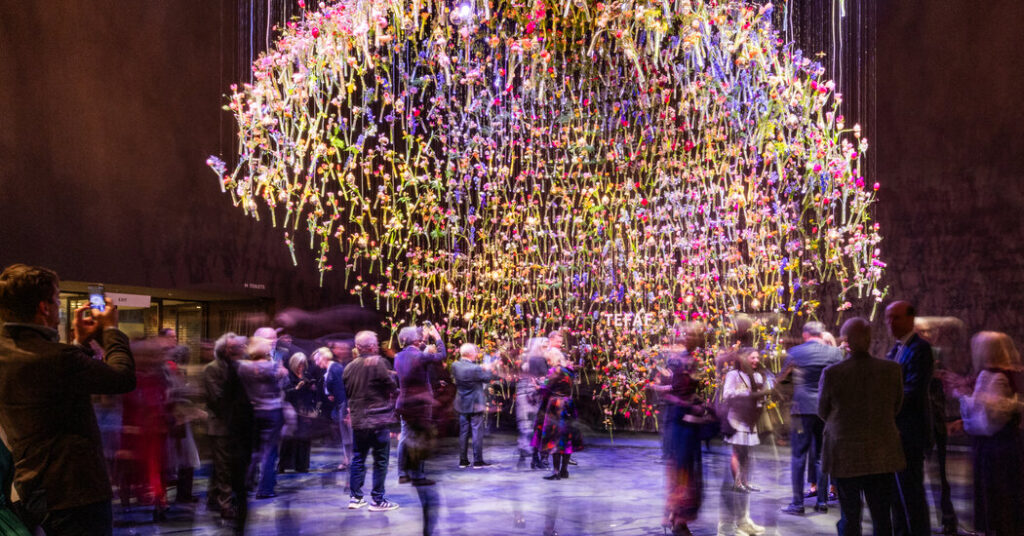
Before the doors open each morning at TEFAF Maastricht, the European Fine Art Foundation’s annual March fair, a ritual unfolds: A dozen florists fan out across the MECC convention center. Some, perched on cherry pickers, tend flower arrangements up to 27 feet in diameter, suspended high in the air, while others make final adjustments to fresh installations near cases of antique jewelry and old master paintings.
Though the fair is known for rare antiquities and multimillion-dollar artworks, it is often these flowers — whose sweet fragrances scent the air — that first set the mood.
Since TEFAF’s founding in 1988, the Dutch florist Ten Kate has overseen the event’s florals, helping define its visual and olfactory identity, both at the MECC convention center, its home base, and in its more recent outpost in New York City, the Park Avenue Armory.
In last year’s Maastricht edition, visitors entered beneath a massive dome of tulips, daffodils, ranunculus and other blooms suspended in test tubes on fine wires, some 30 feet above. Smaller suspended arrangements were repeated throughout the halls for visual continuity. In total, the Ten Kate team used about 75,000 seasonal flowers and 500 flowering branches for the entire floral fantasia.
“Large-scale floral installations at TEFAF act as more than decoration; they help define the fair’s identity and shape how it feels to experience,” Manon van den Beuken, the director of TEFAF Maastricht, said in an email interview. “For visitors, the installations slow the pace and soften the atmosphere. Amid high value, historically significant works, the flowers add warmth, sensuality and a moment of pause, making the experience feel immersive and memorable.”
Though the floral installations might appear effortless to the casual visitor, they are in fact the result of a large-scale design and logistical operation that begins months before the fair opens. The production cycle begins each January in the eastern Dutch city of Deventer, some three hours from Maastricht by train, where Joachime Hutten, 45, and her brother, Bastiaan Hutten, 43, the owners of Ten Kate, work with their team to finalize the floral designs.
During the fair the florists are already looking ahead. “We are thinking about ideas for the following year, but more will come to action around November or December with the first drawings,” Joachime Hutten explained in a phone interview.
In Maastricht, installation unfolds in phases: an advance team of two or three arrives about 10 days before the fair, and it expands to about 14 people during the peak buildup week before the fair opens. During the fair, the florists work before and after-hours to keep the arrangements fresh.
The florals are developed in collaboration with Tom Postma Design, the Amsterdam-based exhibition designers responsible for TEFAF’s spatial layout, and Stabilo, the fair’s construction partner, with the florists making examples for the others to review.
Over the decades, the design approach has evolved alongside the fair itself. In its early years, Hutten said, when TEFAF was smaller, the decoration was more modest and handled by one or two people. As the event grew, so did the ambition of the installations.
“Nowadays, we work with a bigger team,” she said. “Also, the decoration is more technical. Every year we try to surpass the previous year. Or at least ensure a completely different look and feel. In the past, we used a lot of French tulips. We still use tulips, but also other seasonal flowers like anemone, ranunculus, roses.”
Flowers are sourced through Ten Kate’s suppliers and delivered to Maastricht, with varieties arriving from the Netherlands and southern Europe.
For longtime exhibitors, the flowers are closely tied to the experience of TEFAF. “They generate a strong energy, a desire for everyone to encounter, through the works of art on display, the very best,” Tamio Ikeda of the Paris-based Galerie Tanakaya said in an email interview.
“The flowers I have contemplated each year since first participating in TEFAF as an exhibitor 16 years ago are, through their selection, their arrangement and their continual renewal, themselves works of art, born of a deeply creative spirit,” he added. “For visitors, they signal entry into the finest an art and antiques fair can offer.”
Galerie Tanakaya is even contributing to the atmosphere in its own way, by bringing a rare 1926 woodblock print of cherry blossoms by Hiroshi Yoshida, “Kumoi Cherry Trees (Kumoi Sakura),” a nod to the fair’s floral identity.
For the florists, the work is as much about coordination as design, shaped by years of collaboration with TEFAF’s designers and organizers. “The whole period in Maastricht is special,” Hutten said. “It’s a project we do with our whole team, and we have a lot of pleasure working together.”
Among the florists’ most memorable installations was a towering wall of succulents interwoven with white, pink and purple flowers.
“Everyone is always enthusiastic and curious about what we make,” Hutten said. “It happens that someone prefers the previous year’s decoration, but I think that’s normal and simply a matter of taste.”
Asked what visitors can expect during this year’s edition of the fair, March 14-19, Hutten offered only this, “Totally different from last year.”
For her, however, the real reward comes not in the reveal, but in the process itself.
“The most satisfying moment is when the end result matches the drawings and the test setups,” she said. “That gives me a real kick.”
The post How the Florists Behind TEFAF Maastricht Work Their Magic appeared first on New York Times.