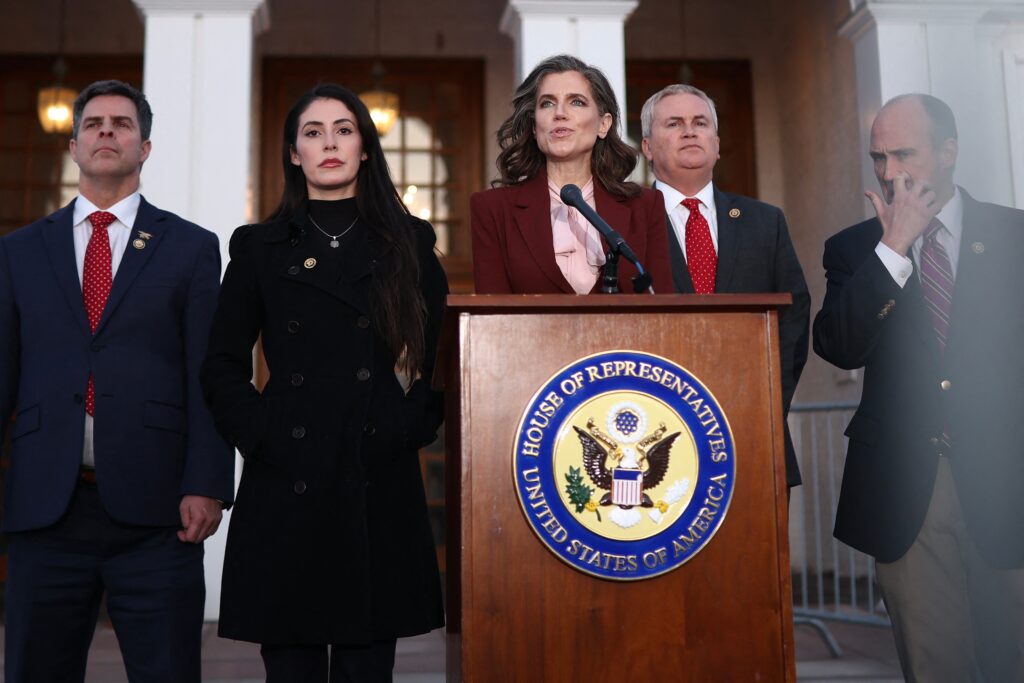
The House Oversight and Government Reform Committee voted to subpoena Attorney General Pam Bondi on Wednesday, setting up yet another clash between House Republicans and the White House over convicted sex offender Jeffrey Epstein.
The vote compels Bondi to appear before the committee for a closed-door deposition regarding the Justice Department’s handling of the investigation into Epstein and his associates in compliance with the Epstein Files Transparency Act, which required the Justice Department to release all its files related to Epstein.
Rep. Nancy Mace (R-South Carolina) introduced the motion to consider the subpoena. Every Democrat on the committee voted in favor of subpoenaing the attorney general, as did Republican Reps. Lauren Boebert (Colorado), Michael Cloud (Texas), Scott Perry (Pennsylvania) and Tim Burchett (Tennessee).
“For months, Attorney General Bondi has been instrumental in orchestrating the White House’s cover-up of the Epstein files, and has failed to comply with our bipartisan subpoena for the release of the complete, unredacted files. The American people deserve transparency, survivors deserve justice, and we are demanding answers,” said Rep. Robert Garcia (California), the ranking Democrat on the committee.
It was not clear Wednesday how Bondi would respond to the subpoena, and the attorney general did not immediately respond to requests for comment.
The Epstein Files Transparency Act required that all of the Justice Department’s Epstein files be publicly released by Dec. 19. The department released more than 100,000 pages of material by that deadline but did not release the majority of its files until the end of January. The delay drew condemnation from Democrats and some Republicans.
The Justice Department has been under fire for months over its compliance with the law, with lawmakers finding fault in the missed deadline, the level of redactions in the documents, the interruption of public access to certain documents and the failure to redact some information related to victims’ identities. Several lawmakers have also accused the department of withholding files required to be released.
Last month, Bondi touted the Justice Department’s efforts to comply with the law during an appearance before the House Judiciary Committee.
“More than 500 attorneys and reviewers spent thousands of hours painstakingly reviewing millions of pages to comply with Congress’s law,” Bondi said. “We’ve released more than 3 million pages, including 180,000 images, all to the public, while doing our very best in the time frame allotted by the legislation to protect victims.”
A Wall Street Journal analysis published Tuesday found that more than 47,000 files appear to be missing from the public archive posted on the Justice Department’s website, including FBI documents that the Journal says contain allegations against President Donald Trump.
Trump was once friendly with Epstein but has said he cut ties with the financier in the mid-2000s. Trump has repeatedly said he had no knowledge of Epstein’s criminal behavior and has repeatedly denied any wrongdoing in connection to Epstein.
Multiple news outlets have reported that three summaries of interviews the FBI conducted in 2019 with a woman who accused Trump of sexually assaulting her were not included in the documents released to date.
The existence of those summaries is noted, however, in an index that the Justice Department made public, which said she had met with investigators four times. A summary of only one of those interviews is included in the publicly released files.
The woman told investigators she had been abused by Trump decades earlier when she was a minor, according to the available summary. No evidence has emerged to publicly corroborate that accusation.
Rep. Yassamin Ansari (D-Arizona) told The Washington Post that she hoped to learn more about the decision to withhold the documents during any deposition.
“Pam Bondi has a direct hand in the cover-up of the Epstein files, the most egregious cover-up in American history,” Ansari said. “I specifically want to know why the DOJ is withholding FBI documents pertaining to allegations against Donald Trump of sexual abuse against a minor.”
The White House rebutted the woman’s allegation when asked about it Wednesday.
“Just as President Trump has said, he’s been totally exonerated on anything relating to Epstein,” White House spokeswoman Abigail Jackson said in response to the allegation of abuse. “And by releasing thousands of pages of documents, cooperating with the House Oversight Committee’s subpoena request, signing the Epstein Files Transparency Act and calling for more investigations into Epstein’s Democrat friends, President Trump has done more for Epstein’s victims than anyone before him.”
A department spokesperson said Wednesday that no files had been deleted from the site but that 47,635 documents “were offline” for further review to ensure that their release complies with the Epstein transparency law.
Of that tranche of missing files, department officials said they expected to upload some 25,000 of them by the end of the day Wednesday, with the rest of those deemed publishable to follow by the end of the week.
“This is the most transparent Department of Justice in history, and all responsive documents will be repopulated online once proper redactions are made,” Justice Department spokesperson Natalie Baldassarre said in a statement.
Although complying with congressional subpoenas is not optional, several past attorneys general in both Republican and Democratic administrations have rejected congressional subpoenas for testimony or documents, citing executive privileges, law enforcement confidentiality or separation-of-powers issues.
In 2024, the Republican-held House voted to hold then-Attorney General Merrick Garland in contempt for his refusal to release audio recordings of President Joe Biden’s interview with a special counsel investigating his retention of classified material.
Five years earlier, then-Attorney General William P. Barr was held in contempt of Congress for rebuffing subpoenas for documents and testimony related to special counsel Robert S. Mueller III’s investigation of Trump during his first term.
It is up to the Justice Department, however, to prosecute any contempt charges recommended by Congress. And the department took no action on either the Garland or Barr referrals.
The post House Oversight Committee votes to subpoena Attorney General Pam Bondi appeared first on Washington Post.