Good afternoon. As the war in Iran entered its sixth day, concerns about the global flow of energy supplies continued to mount. The scale of the disruption will depend on the duration of the conflict. Here’s what we know so far about the climate and energy implications:
-
American oil and gas companies may be in for a huge payday, Ivan Penn reports.
-
Gasoline prices are up in the U.S. as oil shipping traffic through a key waterway has slowed to a trickle, Lydia DePillis points out.
-
Here’s a visualization of how shipping has been affected, where tankers were headed and which oil and energy facilities have been damaged.
Empty desks at the federal government
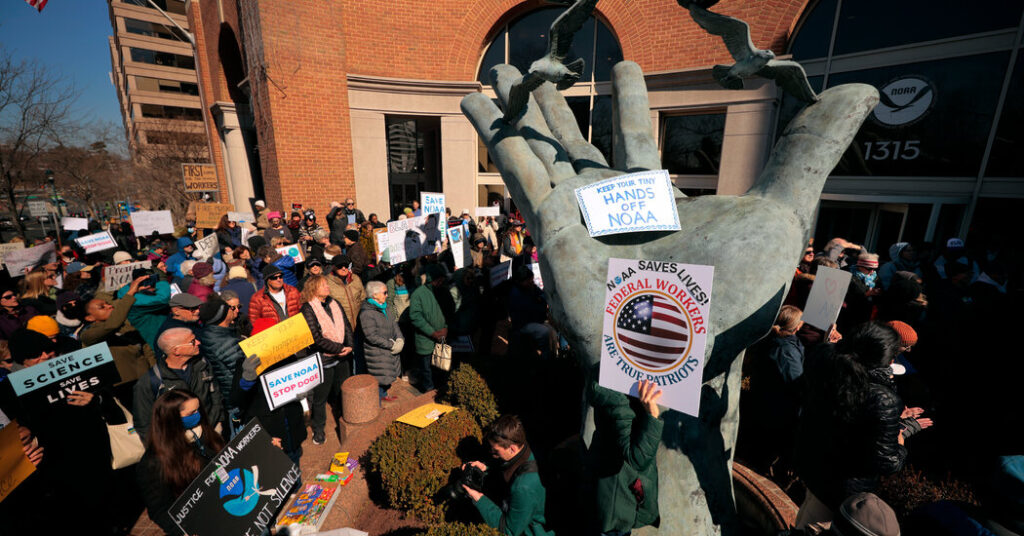
The numbers are in: One year after the Trump administration began its aggressive campaign to cut the federal work force, some 260,000 positions had been struck from government payrolls as of January. And agencies that oversee climate science and adaptation have been particularly hard hit.
The payrolls of the National Oceanic and Atmospheric Administration and the U.S. Geological Survey both shrank by around 20 percent, according to a recent analysis by the American Institute of Physics. The Department of Agriculture, which oversees everything from supplemental food assistance to farm subsidies, lost about 20,000 employees, the agency’s inspector general found. In total, science agencies saw nearly 95,000 departures.
Rick Spinrad, who led NOAA during the Biden administration, told me there’s a phrase for cuts that are spread evenly across an agency: peanut buttering.
Today, we look at a few examples of what the cuts have done to government climate work. And if you missed our series last year that profiled individual scientists who lost jobs or had their funding cut, you can read it here.
Farmers lose their footing
Hurricane Helene ravaged western North Carolina in the fall of 2024, devastating farms nestled in the Blue Ridge Mountains. The Department of Agriculture offered an emergency conservation program to help pay for fence repairs, new soil and debris removal.
To qualify, farmers had to pay for repairs out of pocket, and then submit receipts to their local U.S.D.A. office for reimbursement. But soon after President Trump took office, those local offices began losing staff.
“After the change in administration, early 2025 is when everything sort of fell apart,” said Nicole DelCogliano, owner of Green Toe Ground farm in Burnsville, N.C., which was severely damaged in the hurricane. She called the period an “exodus of expertise.”
Mary Carroll Dodd, who grows organic fruits and vegetables at Red Scout Farm in Black Mountain, N.C., said her local Farm Service Agency office lost two of its three employees.
“It delayed a lot of payments because there just simply weren’t people in the office to help the farmers apply for and process these applications,” she said.
Farm payment delays are not confined to special disaster response programs. In Dayton, Texas, Karena Poke, a farmer, signed up for a conservation program that would partly reimburse her for installing rain barrels and a hoop house at her farm, Lettuce Live. But the U.S.D.A. employee who has to verify the construction is stretched between multiple counties.
“I can’t spend any more money until I get that money back,” Ms. Poke said. “I can’t do anything that I need around here.”
Rebecca Schewe, a research and policy analyst at the National Sustainable Agriculture Coalition, said small- and mid-scale farms were especially vulnerable to staffing shortages and program delays.
“Losing 18 percent of the staff who farmers in rural communities depend on is certainly as impactful as the tariffs for many, many farms,” she said.
Key roles unfilled
At other government agencies, losing science employees has left those who remain trying to do more with less.
Spinrad, the former NOAA administrator, draws an analogy to a football team, which is typically made up of 11 players on the field at a time. “The Ohio State football team is arguably one of the best in the country,” he said. “But I guarantee you that if they field a team of eight men, they’re going to lose.”
Last July, a flash flood in Texas killed more than 100 people. The National Weather Service’s forecast was very good, Spinrad said, but there was no one filling a position responsible for warning local officials and emergency managers at the time.
NOAA did not immediately respond to request for comment. In a statement, the USDA said that “President Trump is utilizing all the tools available to ensure farmers have what they need to continue their farming operations.”
We’ve written about the piecemeal effects of job cuts on virtually every corner of the government. Vacancies have made it harder for meteorologists to keep up with routine weather balloon launches. As national parks lose rangers, visitors to Yosemite have been littering, cliff jumping and flying drones. The government has even filed fewer lawsuits against major polluters as lawyers leave in droves.
So how much money has this all saved? The Department of Government Efficiency, led by Elon Musk, initially boasted it could reduce federal spending by $1 trillion.
One year later, federal spending has only gone up.
Easing voter concerns over A.I.’s effect on electric bills won’t be easy.
Technology giants are spending hundreds of billions of dollars to build energy-hungry data centers for artificial intelligence, and many Americans worry that the A.I. boom could drive up their electricity bills.
Now Silicon Valley — and President Trump — are trying to head off a backlash.
Mr. Trump hosted executives from Google, Meta, Microsoft, OpenAI and other large tech companies at the White House on Wednesday. The firms all signed a “ratepayer protection pledge” and promised to shoulder a greater share of the energy costs from data centers.
The pledge is voluntary, and experts say it could be tricky to put into practice, which means no one knows how much it will really do to lower prices for everyone else. But the issue isn’t going away: Politicians across the country have been debating how to get tech companies to pay more for electricity and prevent utility bills from spiking for ordinary households. In many cases, they’re finding it’s not easy. We took a look at the issues. — Brad Plumer
Related: Trump Announces A.I. Industry Pledge to Pay for Power
More climate news from around the web:
-
The conflict in Iran has sent fertilizer prices soaring, just as farmers are gearing up for spring planting, Wired reports.
-
A start-up is claiming it can stop lightning and prevent wildfires, M.I.T. Technology Review writes. Researchers are skeptical.
Read past editions of the newsletter here.
If you’re enjoying what you’re reading, please consider recommending it to others. They can sign up here.
Follow The New York Times on Instagram, Threads, Facebook and TikTok at @nytimes.
Reach us at [email protected]. We read every message, and reply to many!
Claire Brown covers climate change for The Times and writes for the Climate Forward newsletter.
The post Feeling the Effects of 260,000 Federal Jobs Lost appeared first on New York Times.