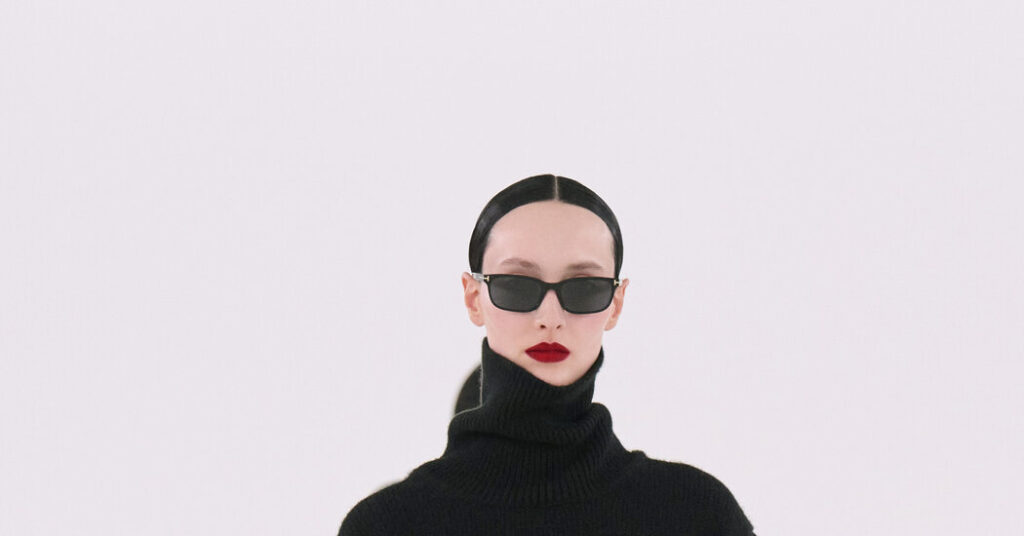
It took awhile for the eyes to adjust.
When the lights came up in the white room where the Tom Ford show took place, they were almost blinding. At first, it all seemed black and white: a mistress of the universe white safari jacket, belted at the waist, over a pencil skirt; double-breasted tycoon-tastic black suiting that flirted with an “American Psycho” edge. Black shades. Black leather gloves.
But — wait, what was that? A flash of skin offered by a trio of matching low-slung black trousers, worn by both men and women, one side dipping dangerously below the hip bone and held on only by a thin belt bisecting the exposed waist, like a lifeline. Then things got a little more, well, transparent.
Literally, with clear vinyl raincoats and jackets and skirts in strictly tailored lines worn to reveal the pinstripes and lacy lingerie and sheer black stockings below. Exposing not just what was styled underneath all that power suiting — what someone might see, if they peeled it off — but the kink that might be simmering below the surface. (And not the corrupted, contemptuous kind exposed in the Jeffrey Epstein files, but the kind rooted in mutual pleasure.)
Ah, adult desire, that layered, nuanced thing: Nice to see you. You’ve been missing from fashion for a while.
There’s been a lot of talk on the runways recently about sex. Not just the usual questions about “what’s sexy now,” in part because Demna, one of fashion’s pacesetters, put bodycon (and bodies, period) front and center in his Gucci show in Milan.
Entangled lust and emotion is in the air, with romantasy topping best-seller charts and “Love Story,” “Heated Rivalry” and “Wuthering Heights” on screens big and small. There has been a lot of chasing the TikTok generation and their nostalgia for the 1990s and early-2000s slip dresses they missed.
There even, conversely, has been a lot of swaddling, protective dressing, as if many designers believe there’s a general need for the body to disappear. And there have been a lot of dual-gender shows, featuring both men’s and women’s wear. Less because of mating rituals than because, you know: It’s one vision.
But until Haider Ackermann’s Tom Ford show on Wednesday, there hadn’t been much sophisticated yearning on the runway.
That’s a lot more complicated than, say, the slick “Night Porter” leathers, glinting animal prints and draped devoré cocktail dresses cut to show a long length of leg here, a lacy bralet there, on view in Antonin Tron’s debut for Balmain. Though that collection had a pleasingly fussy Frenchness that could be a reset for the brand.
But the space between boardroom and bedroom games is a territory Mr. Ackermann, now in his third season at Tom Ford, is increasingly defining, and claiming, as his own. One that plays with clothes that convey total control — no shredded hems or oversize tailoring here, no casual Friday mufti, not even a tie flapping around (ties were tucked into pants), just razor-sharp suiting that skims the body with finesse — and clothes that suggest the hunger to lose it. Or what might happen when things come undone.
On the Tom Ford runway, at least as Mr. Ackermann has envisioned it, the men and the women don’t just wear the same styles, though they often do: banker shirts in an almost gossamer material, that tease the skin below; sharp-shouldered houndstooth with a glint of sparkle woven through; dark denim with the creases pressed in like crushed flesh; cropped white-tie waistcoats undone below the throat, scarves loosely knotted, like a snapshot from after the after-party. The models (of all ages, natch) mill around the runway, sizing each other up. They have the same attitude.
One that says something like: I have made my own money, I know my own mind, I want what I want. What they wear simply allows them to convey it. To, perhaps, unbutton their buttoned-up shirts to the navel, to slouch one hand into a pocket and drape an already disrobed jacket in the crook of an arm, or clutch a coat lapel near the throat. To interact as equals.
That’s surprisingly rare. And it is awfully alluring.
Vanessa Friedman has been the fashion director and chief fashion critic for The Times since 2014.
The post Dressing Adult Desire appeared first on New York Times.