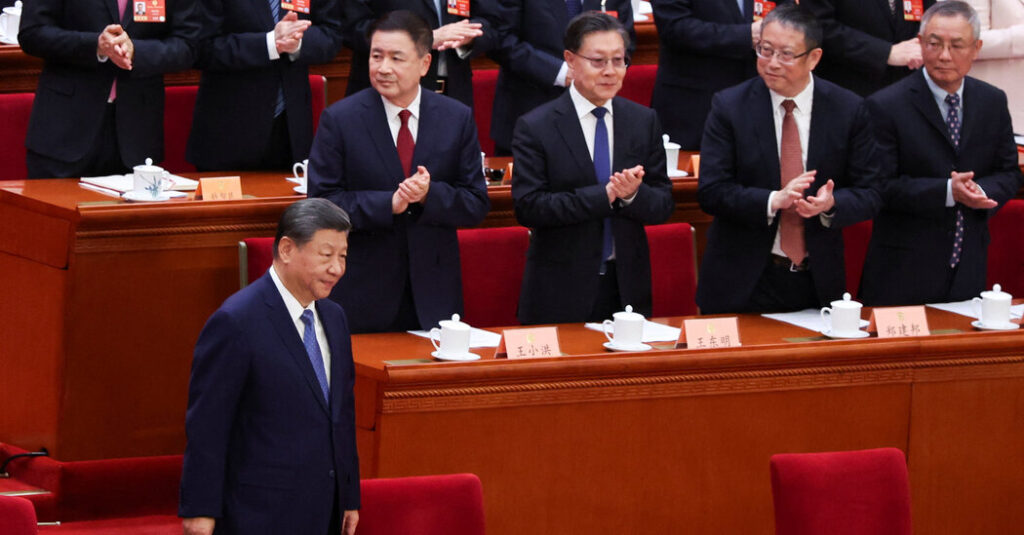
Every March, China’s leaders gather in Beijing’s Great Hall of the People to announce how much the world’s second-largest economy is expected to grow that year.
It doesn’t change much from year to year.
On Thursday, the target for 2026 was set at between 4.5 percent and 5 percent. It was the first time in more than three decades that the benchmark was placed below the 5 percent mark, an acknowledgment that China is on a slower growth path.
The announcement came at the start of the National People’s Congress, the meeting of China’s Communist Party controlled legislature, when leaders unveil the government’s main economic and policy priorities for the year.
Speculation over whether the target would be below 5 percent, where it has been for the past three years, was a parlor game among China watchers.
The unveiling of the growth target is followed closely by financial markets because it lays out the expectations of the country’s officials, including the China’s leader, Xi Jinping. In a political system heavily directed from top levels, the number can offer clues about plans for economic policymaking.
In recent years, China has endured downward pressures in its domestic economy, such as chronic price deflation, high youth unemployment and lagging consumer confidence. A trade war with President Trump, currently in an uneasy truce, has caused China to redirect its considerable exports, pressuring businesses and causing factories to scramble for new markets.
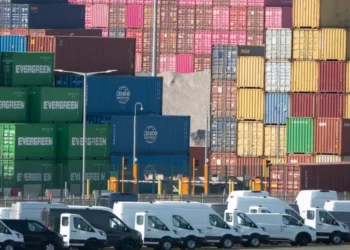
But those exports, which produced a record trade surplus of $1.19 trillion in 2025, remain a powerful economic driver. The government reported in January that growth last year was 5 percent, exactly the same as the previous year.
Not everyone accepts the official numbers at face value. Some experts say that the economy’s actual growth may be half of what official statistics indicate. Rhodium Group, a New York-based research firm specializing in China, estimated that the Chinese economy grew less than 3 percent last year.
In recent months, many of China’s provinces and major cities released their own 2026 growth targets that were lower than those for last year. That fueled speculation from economists that the national target might fall below 5 percent this year for the first time since 1991, according to an analysis by Macquarie Group, an investment bank. (Officials did not release a growth target in 2020 because of the Covid-19 pandemic.)
For years after the country opened up to foreign investors and businesses, China grew rapidly. As it has expanded, becoming now the world’s second largest economy, the growth has slowed as it became harder to be more productive.
“The more you have caught up in terms of productivity, the less straightforward it is to keep powering ahead,” said Louis Kuijs, chief economist for Asia-Pacific at S&P Global Ratings.
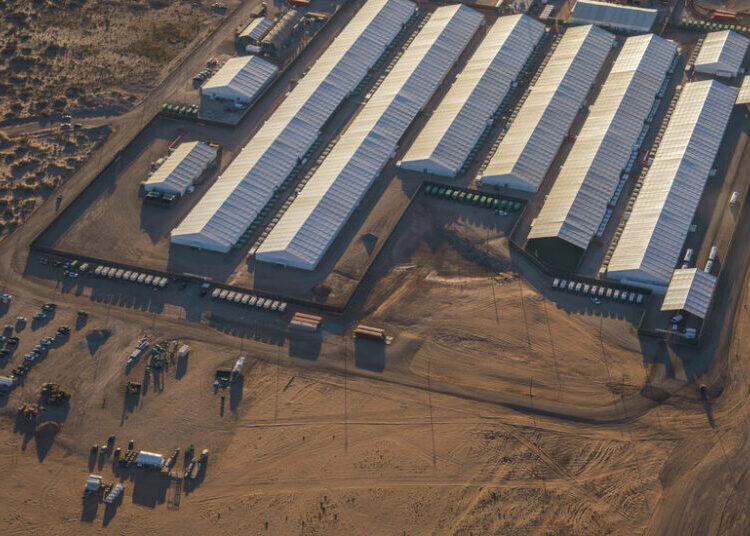
Much of China’s economic strength comes from manufacturing. The country has built vast industrial parks, electric-vehicle plants and data centers, often financed by cheap loans from its state-owned banks. China’s factories produce much of the world’s electric vehicles, solar panels and lithium batteries. Last year, the Chinese carmaker BYD overtook Tesla as the world’s largest electric vehicle producer.
But relying too much on manufacturing has created problems for Beijing. Excess factory capacity and fierce competition have driven down prices in a cycle known as “involution,” crushing profit margins across industries. Companies produce more, but earn less.
Improving the economic outlook requires stronger domestic spending along with a shift toward what the government calls “high-quality growth” in advanced sectors like artificial intelligence.
Economists and outside organizations like the International Monetary Fund have long argued that China should adopt policies to encourage more consumer spending.
Those calls grew louder in the past few years after a severe slump in the housing market ate into household wealth, and stagnant wage growth left consumers even more wary of spending. The lack of a robust social safety net also feeds into the heavy savings rate in China as households worry about how they will cover future medical bills and expenses in retirement.
Boosting consumption, according to Mr. Kuijs, requires structural changes, including expanding access to public services such as education and health care, particularly for migrant workers in cities.
To jump-start that spending, the government has tried offering subsidies for consumer goods, including rebates on appliances and electric vehicles. Officials have also raised pensions and introduced child care subsidies to ease the financial burden on families.
Those measures, however, have not been enough to make a significant difference and don’t solve the underlying issues. Wage growth has lagged across much of the economy, limiting how much households can spend, said Alicia García-Herrero, chief economist for Asia-Pacific at Natixis. Without stronger income growth, policies to boost spending are unlikely to have much effect.
“How can you consume if you don’t earn any money?” she said.
@li
The post China Sets Economy’s Growth Target Below 5% for First Time in Decades appeared first on New York Times.