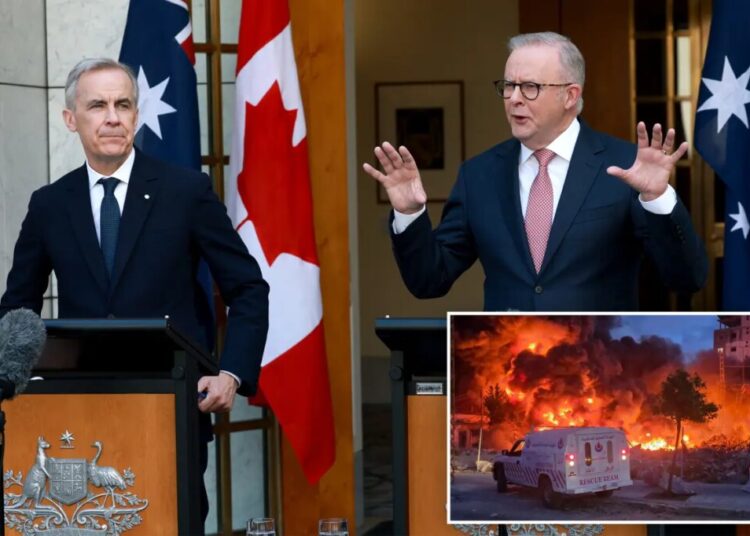
When Prime Minister Mark Carney of Canada called on the world’s “middle powers” to band together and resist President Trump, perhaps the most obvious ally for Canada was Australia, another sprawling, former British colony.
As Mr. Carney pulled up in front of the Australian Parliament on Thursday, there was a subtle sign of the two countries’ mutual understanding. A row of Australian Army howitzers boomed out a 19-gun salute. The countries’ shared political system meant that Australia knew that a 21-gun salute is reserved for the governor general, Canada’s head of state as King Charles representative.
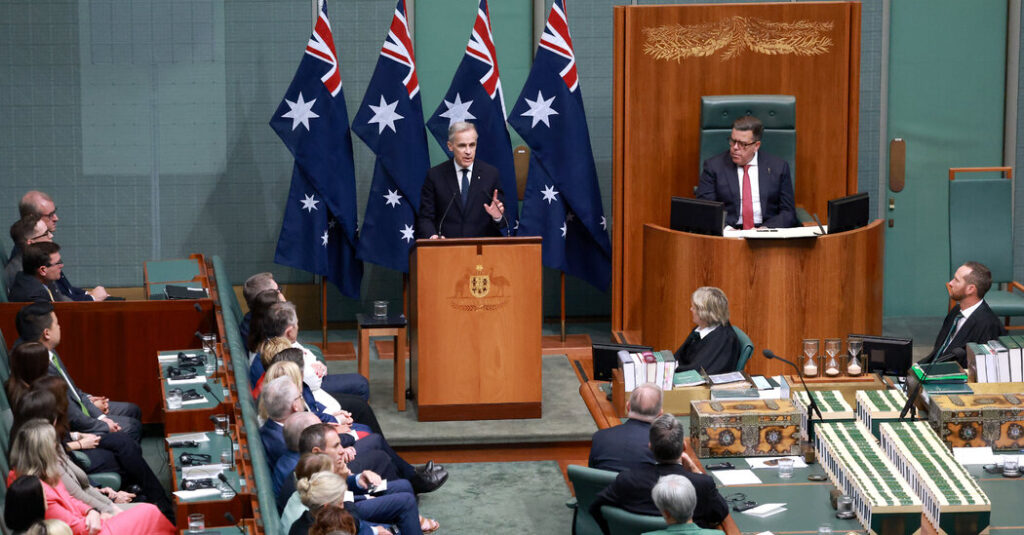
Inside, as was the case during Mr. Carney’s initial calls for new alliances during the World Economic Forum in Davos, Switzerland, in January, he drew a prolonged standing ovation.
“Though we could not be further apart, Canada and Australia are strategic cousins,” Mr. Carney told Australia’s lawmakers.
He added: “Canada and Australia cannot compel like the great powers, but we can convene, set the agenda, shape the rules, and organize and build capacity through coalitions to deliver results at speed and global scale.”
Mr. Carney has become a leading voice for what he calls “middle powers,” largely because of Mr. Trump’s tariffs on key Canadian industries like steel, aluminum and auto making. As well, the effort is intended to assert Canada’s sovereignty in the wake of Mr. Trump’s musings about making it the 51st state.
To advance his hunt for allies, Mr. Carney is on a world tour this week. He restarted relations with India before moving onto Australia, and will finally be going to Japan on Friday. And so far he has not missed an opportunity to remind audiences of his contention at Davos that the world order has experienced an irreparable “rupture” following Mr. Trump’s return to office — a charge he continues to make while still carefully not mentioning Mr. Trump or the United States by name.
“With that global architecture now breaking down from consecutive crises, I have come to Australia to reaffirm our alliance and to suggest where we can go next,” Mr. Carney said in Australia’s modern legislative building, much of which lies under a large grass berm.
“Because it is my fundamental belief — the result of an optimism I may have picked up from this great country — that from this rupture we can build something better, more prosperous, more resilient, more just,” he said.
In Davos, much of the reaction centered on the idea that Mr. Carney had said what many political leaders thought, but were reluctant to say out of fear of provoking Mr. Trump, who has repeatedly used tariffs and threats of tariffs to punish nations that offend him.
Since Mr. Trump’s return to office, Mr. Carney said that the middle powers “compete with each other to be the most accommodating,” undermining their sovereignty.
Prime Minister Anthony Albanese of Australia picked up on that theme as he introduced Mr. Carney in the House of Representatives.
“Peace, security and prosperity are not the preserve of the great powers alone,” Mr. Albanese said. “They are our common cause and our collective responsibility.”
On Thursday, as was the case in India, the two leaders announced a number of accords, many of which appear to be expansions of existing agreements or previously announced measures. They particularly focused on one that calls for the two nations to cooperate on critical minerals they both produce, like lithium, iron ore and nickel.
There was also talk about increasing military cooperation, although with few details. One of Canada’s major defense purchases in the near future will be a $4 billion Australian radar system that can detect aircraft and missiles beyond the horizon. It will be used by the North American Aerospace Defense Command, or NORAD, which is under joint American and Canadian command.
“In a post-ruptured world, the nations that are trusted and can work together will be quicker to the punch,” Mr. Carney said in his speech. “Ultimately, those countries will be more secure and prosperous.”
Ian Austen reports on Canada for The Times. A Windsor, Ontario, native now based in Ottawa, he has reported on the country for two decades. He can be reached at [email protected].
The post Carney Says Canada and Australia Can ‘Set the Agenda’ as World Faces ‘Crises’ appeared first on New York Times.