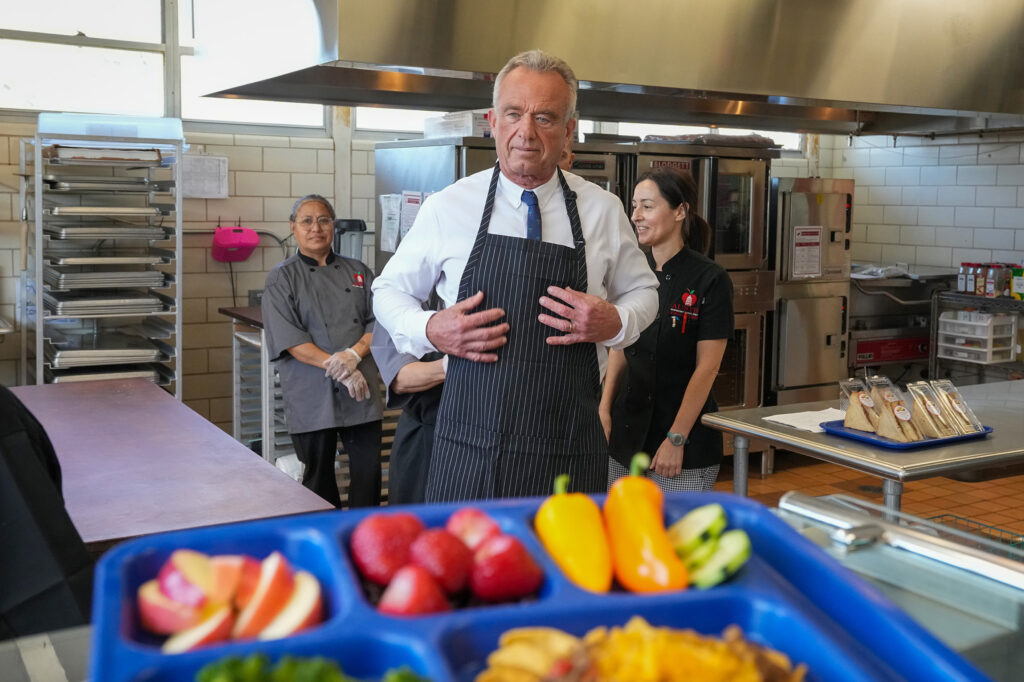
Over 50 medical schools will pledge Thursday to boost their nutrition education amid a push from Health Secretary Robert F. Kennedy Jr. and his allies.
Kennedy has frequently argued medical schools fail to equip future doctors with the ability to help prevent chronic diseases through better eating habits, and the administration has been in talks with schools to increase such training. More than 50 schools have agreed to assess their current curriculum and post plans for reaching roughly 40 hours of nutrition education or an equivalent starting this coming fall, according to senior health officials who spoke on the condition of anonymity due to ground rules set by the administration.
The commitments, which will be officially announced at an event Thursday morning, are voluntary as Kennedy has often used his bully pulpit to seek cooperation from industries instead of mandating change. The effort to push more nutritional education courses is a pillar of the Make America Healthy Again movement formed as Kennedy endorsed Donald Trump’s bid for a second presidential term. Kennedy included the idea in a 2024 op-ed he penned in the Wall Street Journal, laying out some of the foundational policies for his MAHA agenda.
The Trump administration has been downplaying its push to overhaul vaccine policy and instead touting work on food and nutrition ahead of this year’s midterm elections. Kennedy’s concerns about the food supply are broadly popular — in contrast to his deeply controversial moves on vaccines — as studies increasingly link ultra-processed foods to health problems.
Medical schools making the new commitments include George Washington University, Tufts University and University of Oklahoma College of Medicine, according to the Department of Health and Human Services.
“We actually developed a curriculum that’s extraordinary,” Kennedy said at a rally last week where he teased the announcement. “But we said you don’t have to use that, use whatever you want, teach whatever you want, but you need to teach nutrition.”
In January, Kennedy’s health department sent a list of 71 subject areas schools could consider to assess students, according to a letter and framework sent to universities first reported by the New York Times. The administration is not insisting schools follow a certain curriculum, the officials told reporters, allowing them instead to create their own programs.
Some of the possible subject areas resemble a consensus statement from a panel of nutrition experts and residency program directors published in JAMA, such as demonstrating knowledge on the functions of essential nutrients and identifying patients who could be at risk of malnutrition. Some MAHA-friendly ideas are also included in the health department’s list, such as adjusting agriculture methods aimed at improving the nutrient contents of produce as a clinical intervention and integrating digital technology like wearables. Health officials said some schools have said they would implement all the subject areas, while others have chosen a mix.
Casey Means, the surgeon general nominee, has promoted regenerative agriculture and digital technology like wearables. In one of her newsletters titled her “health wishlist for the next Administration,” Means listed “Require nutrition and functional medicine courses in medical schools.” She wrote in her book authored with her brother, Calley Means, that doctors don’t understand the role they play in the “economic and political puppet strings controlling their educational curriculum, the research literature around nutrition, and their decision-making.”
The Association of American Medical Colleges — which represents over 170 U.S. and Canadian medical schools — as well as the accrediting body for U.S. medical schools do not prescribe specific curriculum or requirements, according to Alison Whelan, the AAMC’s chief academic officer.
A survey published in 2015 found that most U.S. medical schools during the 2012-2013 academic year did not provide the minimum of 25 hours of nutrition education recommended in the 1985 Report of the National Research Council’s Committee on Nutrition in Medical Education, with some providing less than half that amount. AAMC says it has seen “significant increases” in recent years of nutrition content incorporated into schools’ programs, and argued some critiques of nutrition education, such as by counting hours of instruction, fail to capture the “nuanced and integrated” approach often taken. In the fall, the group issued a call to action encouraging medical schools to find ways to further embed nutrition education into their curriculum.
Last spring, Kennedy indicated that medical schools without nutrition programs could be at risk of losing federal funding, and over the summer, HHS directed medical education organizations to submit plans by September on embedding new nutritional education efforts. However health officials this week stressed the agreements are not mandatory, and an event Thursday at the health department’s headquarters is intended to be “celebratory.”
Some nutrition experts praised the efforts, saying medical schools have moved too slowly. But others also expressed skepticism, citing Kennedy’s statements disparaging vaccines.
“It’s a necessary and desirable outcome,” said David Seres, a retired director of medical nutrition and professor of medicine in the Institute of Human Nutrition at Columbia University Medical Center. “However, I’m very concerned about the source of the effort. The secretary has a number of things that he’s indicated support for over many years that are anti-science and not evidence-based.”
Lena H. Sun and Lauren Weber contributed to this report.
The post Can RFK Jr. reshape how doctors learn about food? Med schools are pledging changes. appeared first on Washington Post.