In the summer of 1970, right before they started calling themselves the Supports/Surfaces group, several French painters decided to take their work out into the open.
Their approach was not so much a novel take on plein-air painting as a complete explosion of the notion of what a painting might be. Across the south of France, the artists laid out strings of painted corrugated cardboard shapes across fields, placed thin grids on rocky outcrops, suspended colored nets in courtyards and fought the wind on beaches with long, flimsy structures of canvas and wooden pole.
Patrick Saytour, a quieter member of the cohort with a poetic disposition, noted that the artworks, liberated from any gallery framing, acquired lives and meanings all their own. “Children were disappointed when we removed works because it disrupted the game they created with them,” he later wrote in “Été 70,” the ephemeral project’s catalog.
In 2023, Saytour died at 87. His early experimentation now takes the stage at TEFAF Maastricht, running March 14-19, where the gallery Ceysson & Bénétière will present a selection of eight of his key works from 1968-70 in the fair’s Focus section. These pieces show how Saytour used everyday actions (wrapping, folding, burning) to make work: the idea was to find a totally new way of painting, at a time when many thought painting was dead.
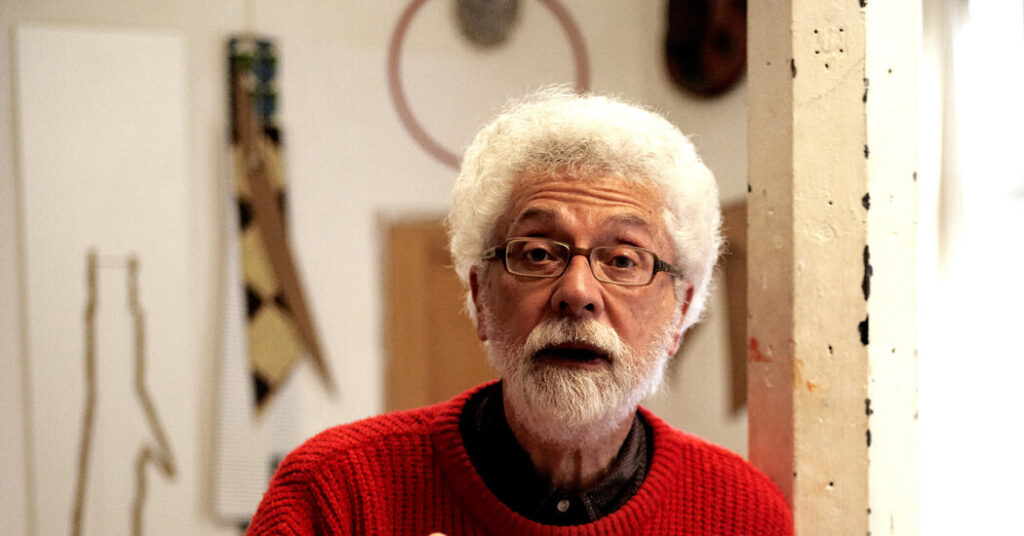
In conjunction with a 2010 exhibition, Saytour did an interview, on video, in which he explained how his process had begun decades earlier. “The work I do in painting started around 1965, when I began working with the notion of folding,” he said, his curly hair white, and his southern lilt gravelly with age. “In folding, there is a fragmentation, regular or geometric, more or less simplistic, of the surface of the picture.” He continued, explaining how, from a conceptual perspective, breaking down the concept of painting into its component parts (frame, surface, canvas, stretcher) was basically what he had been doing since.
On the fair stand at TEFAF, visitors will encounter a group of sculptural works that crisscross the space like masts in a harbor, many simply leaning against walls. Playing with the idea of a frame, the two “Enrubanné” pieces and “Torsade” each include a pair of tall wooden battens, that lean against the wall and are either wrapped or draped with rope. Three pieces from his 1970 “Tension” series, nearby, feature wooden strips partially dyed red and tied with string into triangular shapes.
Loïc Garrier, director of Ceysson & Bénétière’s Paris outpost, noted in a recent phone interview that today, some 60 years after they were made, these early works by Saytour remained “very radical,” as demanding and opaque as the artist himself.
Nine years ago, the art historian Romain Mathieu, who knew the artist well, curated an exhibition in Nîmes, France, on how the Supports/Surfaces movement came about. In a recent phone interview, he recalled installing the show with Saytour, and how exacting the artist was when it came to art: “You really had to watch what you said,” he said. “He was so on point, so precise, with such a singular approach.”
The movement is commonly held to be the last avant-garde group to emerge from France. It was born between the art schools in Paris and Montpellier and Nice, Saytour’s hometown. His parents were involved in the city’s theater scene. He followed in their footsteps, combining art and theater studies.
“In the ’60s, Nice becomes a place of real effervescence,” Mathieu explained. Artists including Matisse, Picasso and Chagall had had long-established ties there, as did proponents of two other midcentury art movements, New Realism and Fluxus. The Fondation Maeght, in the nearby village of St. Paul-de-Vence, was ensuring the international scene’s presence, too: showing an exhibition of American art in 1970, at a time, Mathieu noted, “when few knew about American art in France.”
After completing his military service in Algeria, from 1959 to 1961, Saytour returned to work as both a theater director and teacher at the municipal drawing school in Nice. There he met many of the future Supports/Surfaces members.
“From 1966 already, we see processes being put in place, artists meeting each other, and group shows happening,” Mathieu said, adding that, eventually, “each artist starts figuring things out.”
Saytour was wrapping, tying, suspending, folding and burning things, not for aesthetic reasons, but to obtain pictorial results. Later on, he would often refer to these systems for making work that he came up with during these foundational years. “Trophées,” for example, is a large series of wall-based pieces he made in 2004 by piling up bits of whatever he had lying around in the studio (“I never throw anything away,” he explained in the 2010 video. “I’ve got leftovers from projects that are 10, 20, 25 years old.”)
He then drilled a hole through them and strung them up together to hang them from a nail on the wall. In that interview, he described this compositional process — how he would simply observe the shape into which the pieces would settle. It is like a bunch of keys, he said. “I’m not going to compose my bunch of keys well or badly, they’re obviously well composed. And I accept, in the spirit of my generation, I accept the way they compose themselves.”
In 1970, after that summer of ephemeral outdoor exhibitions, collectively titled “Intérieur/Extérieur,” Saytour, Claude Viallat, Daniel Dezeuze, André Valensi, Vincent Bioulès, Marc Devade and Bernard Pagès were invited to exhibit their work in the newly created contemporary department of the Musée d’Art Moderne de la Ville de Paris, the ARC (shorthand for “Animation Recherche Confrontation”). Pagès withdrew before the opening. Bioulès came up with “Support/Surface” (without the “s”) as both the title of the show and the name of the group.
From the start, theory and politics were paramount, and the 12 artists who were officially members of the group fought about all of it. As Garrier put it, “there would always be one or two who refused to take part in a show.” France’s youth were in turmoil over the war they had just been forced to fight in Algeria. The revolt of May 1968, just two years earlier, had seen students and workers take to the street, aflame with Marxist hopes for a fairer future. The air was electric.
In keeping with those tumultuous times, the group was short lived. Officially, Mathieu said, “the movement doesn’t last long at all, just a year really, in 1970,” though, he added, the wider avant-garde activities continued until the mid-70s. Nouvelle Peinture en France: Pratiques/Théories, the first exhibition with all 12 members convened took place after the movement disbanded, in 1974, at the Museum of Art and Industry in Saint Étienne.
To Garrier, the director of Ceysson & Bénétière’s Paris outpost, those passions are what sustain any extant members of the Supports/Surfaces group to this day. And their works continue to find new audiences. This spring, the Golden Tree Foundation in Venice will host Saytour’s first exhibition in Italy, opening just ahead of the Biennale.
When Saytour died, Rima Abdul Malak, then the French culture minister, described him in an official homage released by the Ministry of Culture, as “discrete, critical, unexpected” and “a pillar of contemporary art in France.”
Garrier, who worked with Saytour at the gallery, which has represented him for nearly 20 years, concurred.
“He rarely came to his own openings, because it didn’t interest him.” he said. “His goal was to talk of art and only of art. He really was a complete artist.”
The post At TEFAF Maastricht, a Paris Gallery Honors a Revolutionary French Painter appeared first on New York Times.