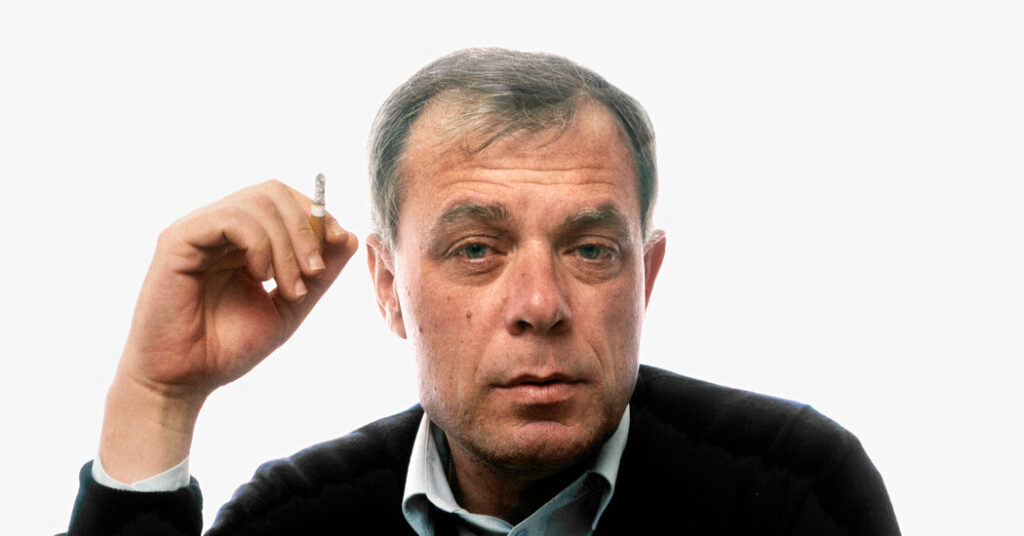
António Lobo Antunes, a prolific Portuguese novelist whose multilayered narratives dissecting the faultlines of Portuguese society made him a literary giant in his native country and further afield, died on Thursday in Lisbon. He was 83.
His death was announced by Luís Montenegro, the prime minister of Portugal, and by his publisher Dom Quixote, in social media posts.
In more than 30 novels and collections of other writings, Mr. Antunes charted Portugal’s halting emergence from the crippling dictatorship of Gen. António de Oliveira Salazar from 1932 to 1968, and its failed colonial wars in Africa. His career was studded with literary awards, including the Jerusalem Prize in 2005 and the Camões Prize, Portugal’s highest literary honor, in 2007.
His adventurous approach to form allowed him to transcend his identity as an often difficult writer from an overlooked second-rank European country. He was on many critics’ Nobel Prize shortlist for literature, with some feeling that he deserved it more than his Portuguese compatriot José Saramago, who won in 1998. His friends said he felt some bitterness at not receiving it.
His work as a doctor provided him a lens through which he explored the battered psychology of his diminished nation. For 27 months, from 1971-73, he served as an army medic in his country’s war in Angola, witnessing the brutality of Portugal’s futile attempts to keep its African colonies.
The novels, especially the early ones, were also a no-holds-barred exposure of suppressed truths about the hypocrisies of Portuguese society. His first two works, “Elephant Memory” and “South of Nowhere,” both published in 1979, centered on those experiences and brought him overnight acclaim in his homeland and abroad.
His experiments with form and language drew the attention of major critics like Harold Bloom and George Steiner, who set Mr. Antunes high in the ranks of modernist writers. Mr. Bloom considered him “one of the living writers who will matter most,” and Mr. Steiner called him “a novelist of the very first rank,” likening him to Joseph Conrad and William Faulkner.
Mr. Antunes often eschewed punctuation, clear plotlines and chronology. Individual voices were deliberately mixed and intertwined, sometimes in the same paragraph or in the course of a sentence, such as in one of his most esteemed novels, “Fado Alexandrino” (1983).
Mosaic-like, the novel recounted the pained confessions of four veterans in Portugal’s colonial wars to a mysterious “Captain” who patiently listens to these woeful tales. It builds collective portraits of futility and unexorcised despair as it jumps between its narrators: a lieutenant colonel who is haunted by his wife’s death while he was away from the front; a snarling second lieutenant who has bought and impregnated a child mistress in Mozambique; a soldier who has returned unwelcome to Portugal from Africa; and the Marxist “communications officer” engaged in futile indoctrination efforts in a Lisbon bureaucracy. It is all held together by the sizzling vigor of Mr. Antunes’s imagery.
He uses similar techniques in other major novels, such as “The Inquisitors’ Manual” (1996), which focused on a brutal former minister under Salazar’s dictatorship; and “What Can I Do When Everything’s on Fire?” (2001), which depicted the uneasy mental excursions of the son of a Lisbon drag queen.
Some critics were less convinced of Mr. Antunes’s technique. Dwight Garner wrote in The New York Times that while the author’s stream-of-consciousness style could be “magnificent” at times, “What Can I Do When Everything’s on Fire?” was excruciating. “I’d rather pull a toenail off with rusty pliers than march through its punishing 585 pages again,” he wrote. Richard Eder, another Times critic, wrote that the Nobel committee had made the right choice in picking Mr. Saramago over Mr. Antunes.
In the English-language world, Mr. Antunes’s works remain obscure. Richard Zenith, one of Mr. Antunes’s translators, noted in The Times Literary Supplement in 1997 that all four of his translated novels were by then out of print in Britain. “Anglo-Saxon literature really likes a good story,” Mr. Zenith said in a phone interview from his home in Portugal. “English doesn’t put up as easily with ambiguity. Latin literature revels in it.” In addition to which, “he’s not an easy read.”
Easy reading, however, was never Mr. Antunes’s intention.
“I don’t want people to ‘read’ my novels,” Mr. Antunes told Maria-Luisa Blanco, who published a book of conversations with him in 2001. “I want people to live them, to ‘catch’ them, the way you would catch an illness.” In Mr. Antunes’s optic, the absence of a discernible plot is much closer to the way people actually “live” their lives.
Antonio Lobo Antunes was born in Lisbon on Sept. 1, 1942, to João Alfredo de Figueiredo Lobo Antunes, a neurologist and professor, and Maria Margarida Machado de Almeida Lima. He was the oldest of six brothers, several of whom achieved prominence as doctors. His younger brother Manuel was Portugal’s ambassador to the United Kingdom.
Mr. Antunes had a somewhat stilted upbringing in the upper reaches of the Lisbon bourgeoisie, in what he called his “very protected, almost tribal childhood.” The faded, melancholy city by the sea in which he spent his whole life often featured as a looming backdrop to his work. “Outside, on the street, the rainy March of the night before was running down the decrepit facades like the makeup of a weeping old woman,” he wrote in “Fado Alexandrino.”
His parents were cultivated but maintained an emotional distance from their six sons. He and his mother had only “very formal relations,” he said in the 2005 Le Monde interview. The young Antonio was subjected to weekly quizzes about his father’s favorite reading. The dictatorship stifled Portuguese society — Mr. Antunes’s father had been one of Salazar’s doctors — and squashed dissent about Portugal’s colonial wars.
“Growing up, it was normal not to have a passport, not to talk about politics, not to use the word democracy,” he told The Paris Review in 2011. “I remember once asking my father as a boy, ‘What is democracy?’ And he answered, ‘Shut up and eat.’”
As he grew up, his relationship with his father became strained. When Mr. Antunes published his first novel, his father told him, “One can tell this is the work of a beginner,” the author said to Le Monde. After that, he said, “We never spoke again about my literary work, though he told one of my brothers, many years later, that he admired me.”
In 1959, Mr. Antunes began his medical studies at the University of Lisbon, graduating as a doctor, before beginning military service in 1970.
That year, he married Maria José Xavier da Fonseca e Costa, with whom he had two daughters: Maria José Lobo Antunes and Joana Lobo Antunes. He later married Maria João Espírito Santo Bustorff Silva and had another daughter, Maria Isabel Bustorff Lobo Antunes. In 2010, after his second divorce, he married Cristina Ferreira de Almeida.
Survivors include his wife and three daughters.
In 1973, he returned from Angola to practice psychiatry at the Hospital Miguel Bombarda in Lisbon, writing his novels at night.
From the beginning, Mr. Antunes’s war experience in Angola, and the scars they left, was a central impetus of his work.
The war, in his telling, was a black hole of cruelty, where Portuguese officers casually whipped out their pistols and dispatched captured rebels, and raped Africans at gunpoint, with no legacy beyond despair. The war’s children were stunted and unable to cope with what passed for ordinary life back in Portugal.
“I just wanted to return alive,” he recalled to The Paris Review in 2011. “I remember we kept calendars and would cross off each day that we were still alive! I’ve talked to people who were in the Vietnam War, the Algerian War, and I’ve understood them perfectly.”
His first three books were concerned with haunted war veterans, and war marked his subsequent novels, too.
Among his last published works was “Until Stones Become Lighter Than Water” (2016). It explored, in experimental prose, the aftershocks of the Angolan War.
An author who practiced psychiatry, he wanted his writing to mirror the vagaries of the human mind. What he was attempting was to “put myself into a state close to that of a dream,” he told the critic Raphaëlle Rérolle in Le Monde in 2005, “so that my internal political police lowers its guard.”
It was that “police,” he explained, “that forbids us from thinking in a non-Cartesian way,” explaining his belief in the non-linearity of human perception. Shedding such constraints allowed Mr. Antunes to “grasp the world ‘as it is,’ before we have aligned it with our social categories of perception,” the French writer Hédi Kaddour wrote in Le Monde, comparing him to Marcel Proust and Virginia Woolf.
Explaining his concept of the novel, Mr. Antunes called it “structured delirium.”
Ash Wu contributed reporting.
Adam Nossiter has been bureau chief in Kabul, Paris, West Africa and New Orleans and is now a writer on the Obituaries desk.
The post António Lobo Antunes, One of Europe’s Most Revered Writers, Dies at 83 appeared first on New York Times.