In the unlikely event any U.S. importers rubbed their hands together at the prospect of a tariff rebate this year, they will be sorely disappointed. Treasury Secretary Scott Bessent believes $175 billion (collected under a tariff scheme that has now been ruled illegal) will never see the light of day for American consumers. And Wilbur Ross, who served as Commerce Secretary in the first Trump administration, is inclined to agree. Ross believes tariff rebate cases will drag on for years, ultimately returning to the Supreme Court that stepped away from refund decisions in the first place. Late last month, the Supreme Court ruled that President Trump could not use the International Emergency Economic Powers Act (IEEPA) to levy duties on trading partners and directed revenues to be contested in international trading courts. Already, a bevy of cases have been brought forward by importers seeking to recover some of the duties they paid last year.
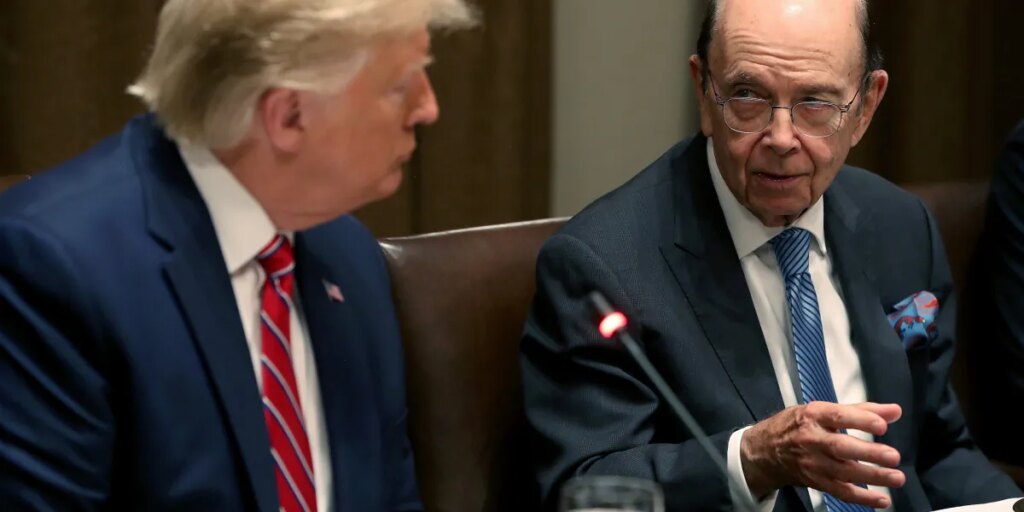
They’ll be in for a long wait, said Ross, 88, who served in Trump’s cabinet from 2017 to 2021. He warned that consumers will the ultimate losers. While importers shouldered the initial tariff hit, some or all of that burden likely trickled back to consumers, via wholesalers and retailers. The Yale Budget Lab estimates an implied passthrough of tariff costs to consumers of roughly 40–76% for core goods and 47–106% for durables.
Even discounting the passthrough effect, Ross said it would still be fiendishly complicated for a court to establish which businesses should receive a rebate, and for how much: “No two products and their related tariffs have the same mathematical progression. It’s gonna have to be probably product by product, which is immensely complex, there are tens of thousands, maybe hundreds of thousands, of iterations.
“Then you probably have given that guy a windfall, but you haven’t done anything to help the ultimate consumer.”
In an optimist’s world where a court attempted to repay the consumer, it gets even more complicated: “One guy might have bought an imported car on which he paid a huge total dollar amount of tariff, another family might have just bought two pairs of sneakers from Vietnam. How you divide it among the people if you went at the consumer level? If you try to go to the extremely detailed level, try to figure out all the intricacies of the supply chain and then all the differences of the families, it would probably use up all the AI capability in the whole world before you got to an answer.”
This problem, argued Ross, is what the Treasury’s Bessent meant when he told the Economic Club of Dallas after the court ruling: “I got a feeling the American people won’t see it.”
A hopeful suggestion might also be that businesses would pass back the refunds, though Secretary Ross is of the opinion that this litigation will escalate back to the Supreme Court over the course of years: “And it probably will get there in different forms because so many suits have been filed, they’re filed in different courts, and each has a little different basis, so it’s an immense litigation mess.”
An unusual loophole
In the immediate aftermath of the ruling, the Trump team confirmed it would be enforcing a 15% tariff rate under Section 122 of the 1974 Trade Act, which allows for levies to be enforced for 150 days—allowing the White House to get its ducks in a row to enforce the duties in the longer term. Widely, the White House is expected to pursue a longer-term legal basis such as a Section 232 (a national security justification) or Section 301 (unfair trade practices)—either of which Secretary Ross sees as a viable option.
But Secretary Ross, who held the role of chairman or lead director of more than 100 companies across more than 20 different countries during his career, highlighted the “peculiar” ruling by the court did leave open a loophole the Oval Office could employ if it really needed to: An all-out ban on a certain product. Given the fact that the court viewed the tariffs created under IEEPA as a form of taxation, and thus illegal in its former guise, it did not rule on whether a complete ban on a certain product or country would be legal.
“One wild card that’s at least theoretically possible is the Supreme Court ruling … did not knock out [Trump’s] ability to ban imports,” Ross said. “So in theory he could ban altogether the import of a product from an individual country or from all countries. They didn’t, they didn’t address that at all.”
This, of course, would be far less palatable than a tariff regime: While a ban would reduce dependency on foreign economies, it wouldn’t generate the hundreds of billions of dollars the Treasury could employ to help rebalance the budget.
Yet the loophole does leave Trump with a weapon in his arsenal if any trading partners try and push an advantage, Ross said: “As far as I can tell, most countries are taking a wait-and-see attitude, in the sense that I haven’t seen a lot of countries renege on the concessions they made to Trump … If that does start to happen, I’m sure he would do something to retaliate, and it could very well be he would impose a ban on something or another as a retaliation.
“It’s strange in that while the legal basis of what he had done was knocked out, a lot of the factual implications are still in place.”
The post American consumers are the ultimate losers in the ‘immense mess’ that is $175 billion tariff refund, says Trump’s former commerce secretary appeared first on Fortune.