By the second week of Debbie Sutherland’s vacation to Cuba last month, there were ominous signs of trouble.
Gasoline was being rationed, excursions were canceled and all of the stores in a nearby mall were closed.
Ms. Sutherland’s hotel in Cayo Las Brujas, a part of a small chain of islands just north of central Cuba, reserved a block of rooms for stranded employees. That section of the hotel was completely dark: Only tourists got electricity.
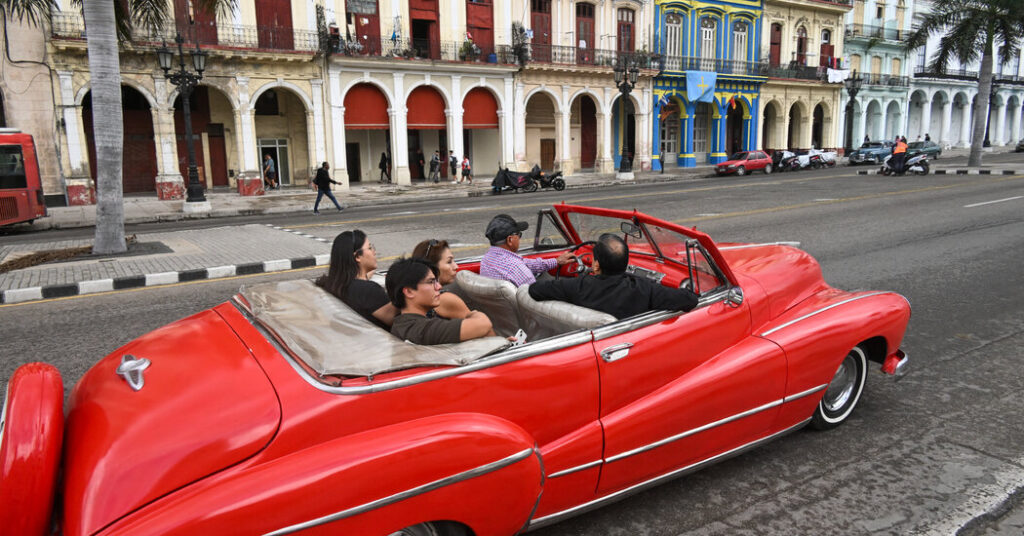
Cuba has relied on tourism, and on sun-starved Canadian visitors above all others, as a key pillar of its collapsing economy.
“The Cuban people love Canadians,” said Ms. Sutherland, 64, a behavioral therapist from Ontario. “They would say, ‘You know, we would die without Canada.’”
But President Trump’s travel restrictions and move to to block all foreign oil from Cuba has brought the industry — already weakened after the Covid-19 pandemic — to its knees and intensified an economic meltdown threatening the government’s survival.
Like many other travelers, Ms. Sutherland’s vacation was cut short last month as the country’s crippling energy crisis began paralyzing tourism.
With the government saying it was running out of jet fuel and with power outages worsening, Russian and Canadian airlines suspended flights to Cuba, a move that jeopardizes the livelihoods of hundreds of thousands of people.
Airlines sent empty jets to the island to take thousands of tourists back home, a stark sign of the volatile conditions in Cuba as the Trump administration’s campaign has created an increasingly desperate situation for Cuba and its people. Abandoned trucks, cars and motorbikes, apparently out of gas, littered the road to the airport, Ms. Sutherland said.
The Trump administration, in its quest to topple Cuba’s 67-year-old Communist government, has targeted the country’s main sources of foreign currency, including tourism, but also medical missions to other countries in exchange for payments to the Cuban government.
Even before Mr. Trump’s executive order in January threatening to impose tariffs on countries that provide oil to Cuba, his administration had been chipping away at Cuba’s tourism industry.
Mr. Trump limited Americans’ ability to travel to Cuba, stay at government hotels or travel there aboard a cruise ship. His decision to put Cuba on the list of state sponsors of terrorism meant that Europeans who went to Cuba lost their ability to travel to the United States without a visas.
Last year, Cuba had just 1.8 million international visitors, down from 4.7 million in 2018, said Paolo Spadoni, a social sciences professor at Augusta University in Georgia who recently published a book on Cuba’s tourism industry.
Even as their numbers have also decreased, Canadians have remained a cornerstone of tourism, accounting for roughly 40 percent of foreign visitors. Cuba has actively courted Canadians, who can enter Cuba legally, and like to spend money on winter getaways and are reliable return visitors.
But as international headlines focus on nationwide blackouts, the spread of mosquito-borne illnesses and the growing piles of garbage in the streets, many European and Canadian tourists are choosing other destinations. Some tour operators have removed Cuba from their list of offerings.
Even Cubans living in the United States are staying away, Mr. Spadoni said.
As a result, Cuba’s tourism industry is likely to suffer a year comparable only to the pandemic, when travel around the world largely shut down, experts say.
It was not long ago that Cuba enjoyed a brief tourism boom after President Barack Obama’s decision in 2014 to restore diplomatic relations with Cuba.
He also relaxed prohibitions against Americans traveling there, even allowing cruise ship sailings. Cuba had long been a forbidden destination for Americans, so the numbers of them visiting Cuba suddenly soared.
The loosening of restrictions was short-lived; Mr. Trump put tougher regulations back in place during his first term in office. The number of Americans visiting Cuba plummeted to 110,000 in 2025 from 638,000 in 2018, according to Cuban government statistics.
But even as the number of tourists heading to Cuba dwindled, Cuba doubled down on its investment, pouring billions into new hotels.
The government added 22,000 new rooms from 2014 to 2025, with some 70 new hotels, Mr. Spadoni said. Cuba has 85,000 hotel rooms nationwide, but an occupancy rate of only about 20 percent, he added.
Cuba’s state-run hotels are managed by Gaviota, a subsidiary of the military-run conglomerate GAESA, which controls the Cuban economy. That means Cuba’s best hotels and prime real estate are in the hands of military officials, Mr. Spadoni said.
“One key misconception is: How can Cuba build so many hotels when the occupancy rate is so low?” Mr. Spadoni said. “One thing people miss is that to the Cuban military, these are real estate investments more than tourism.”
Military officials are likely taking the “long view” by wanting to be in control of valuable properties should the Communist government transition to democracy, he said.
Some new luxury hotels, like the iconic Torre K in Havana, are largely empty.
In the past 15 years, the Cuban government invested about $24 billion in hotels, said Emilio Morales, a Miami-based former marketing official for Cimex, Cuba’s retail conglomerate, who now studies Cuba’s tourism industry and is a harsh critic of its government.
“There were many hotels, and in two or three and a half years, everything shut down or kept deteriorating,” Mr. Morales said. “They didn’t invest in the other sectors that support tourism, such as the energy grid itself.”
The Cuban government did not respond to requests for comment.
In public statements, Cuban officials have denounced the Trump administration for trying to push it toward collapse.
“What does it mean to prevent a single drop of fuel from reaching a country?” President Miguel Díaz-Canel said recently. “It means affecting food transportation, food production, public transportation, the functioning of hospitals, institutions of all kinds, schools, economic output, and tourism.”
He added: “Surrender is not an option.”
The Cuban government last month abruptly closed more than a dozen hotels and transferred its guests to consolidate tourists and save on energy.
Some airlines have continued their flights, adding stops in the Dominican Republic for refueling, while some countries are warning against visiting Cuba.
Air Canada said it decided to suspend the flights because the added stops for fuel would disrupt schedules.
“More broadly, ongoing fuel supply challenges in Cuba, combined with instability in the power grid, have broader implications for customers,” said Christophe Hennebelle, a spokesman for Air Canada, which had 3,000 customers in Cuba on vacation packages.
Basic necessities like food and medical care were becoming scarce, he added. “We do not want to put the health, safety, and well-being of our passengers at risk.”
Lorne Berkun, an 80-year-old in Vancouver, British Columbia, who organizes coffee tour trips to Cuba, said he had received only one inquiry from a potential client this year, compared with the at least 15 he would have expected by now.
“There’s no way I would take anybody now,” he said.
Lucy Davies, a British tour operator who specializes in cycling trips, said that once countries like Canada and Britain elevated their travel advisories, her business was largely finished.
“The rest of our clients have canceled because once a government advises against all but essential travel to a destination, travel insurance won’t cover travelers to that destination,” she said. “We very much hope that Cuba and the U.S.A. can find a resolution soon — and before the country falls into total collapse.”
Drew Garneau, 42, who works at a car dealership in Nova Scotia, had planned to visit Cayo Cruz, an island just off Cuba’s coast, from Feb. 4 until the 18th.
Five days into his trip, Mr. Garneau had put down the microphone after performing a Bon Jovi hit during karaoke night at his hotel when a porter approached him in the lobby.
“He took me aside and said, ‘Hey, you two gotta pack. You’re leaving at 6 a.m.,” Mr. Garneau said.
Airlines, he learned, were taking tourists home. “I’ve never been kicked out of a country before,” he said.
Hannah Berkeley Cohen contributed reporting from Curaçao.
Frances Robles is a Times reporter covering Latin America and the Caribbean. She has reported on the region for more than 25 years.
The post With Fuel Running Out, Cuba’s Tourism Is Collapsing appeared first on New York Times.