J.B. Branch is the Big Tech accountability advocate in Public Citizen’s Congress Watch division. Allan E. Cameron is a retired U.S. Air Force major and independent scholar.
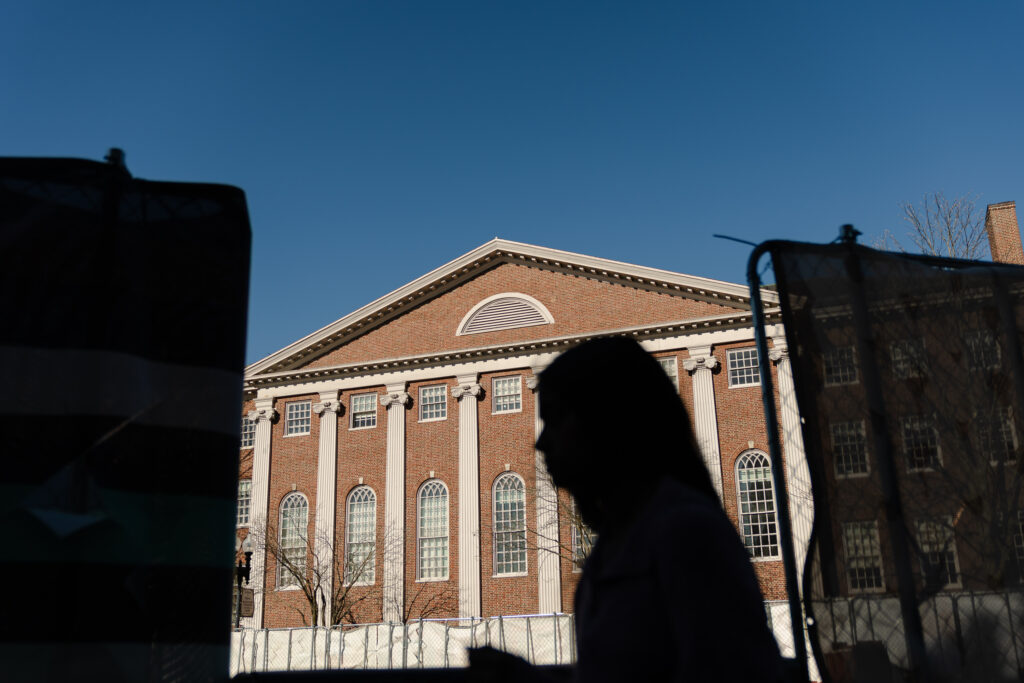
Defense Secretary Pete Hegseth’s effort to end the Pentagon’s academic partnership with Harvard and more than 20 other universities is being presented as a symbolic stand in the Trump administration’s wider campaign against higher education.
But this decision is far more consequential than partisan optics suggest. It directly affects how the United States cultivates technological advantage, educates its senior military leaders and prepares for long-term strategic competition.
At a time when the Pentagon warns about competition with China, voluntarily pulling U.S. military officers out of the world’s most important research and policy institutions is not a show of strength. It is a strategic retreat.
For nearly a century, U.S. military advantage has depended on partnerships between the armed forces and civilian research universities. The Manhattan Project relied on Columbia University, the University of Chicago and the University of California in Berkeley. The Defense Advanced Research Projects Agency institutionalized that model, seeding breakthroughs ranging from the internet to GPS to mRNA vaccines. At Harvard, between 2020 and 2024, roughly $300 million in Pentagon funding supported research critical to national security, including biological threat detection, emerging technologies and AI governance, all critical to modern warfare.
This civil-military-academic ecosystem is the foundation of American geopolitical power. When the Pentagon recently terminated a DARPA grant at Harvard, court filings revealed internal warnings that ending the program would pose “grave and immediate harm to national security.” That should give policymakers pause.
The timing is particularly troubling. The Defense Department has requested billions in new funding for trusted AI and autonomy research. Artificial intelligence is reshaping warfare. Harvard’s Belfer Center and Kennedy School have produced influential research on how AI will affect military bargaining and escalation dynamics — exactly the kinds of questions defense leaders must grapple with today.
Senior officers who spend a year in higher education do more than earn degrees. They build working relationships with researchers and technologists shaping the tools those officers may later be responsible for deploying or regulating. They learn to evaluate emerging technologies directly from the people building them. Removing officers from those networks risks weakening the military’s conceptual understanding and capabilities.
Strategic education is also at risk. Many officers are trained at War Colleges that are largely composed of military peers focused on joint actions and war planning. That structure has strengths but also limits. The 2018 National Defense Strategy acknowledged that professional military education had stagnated and emphasized the need for broader intellectual exposure. Civilian graduate programs were identified as part of the solution because of their high-quality education and diverse student bodies.
At traditional higher-ed institutions, officers sit alongside diplomats, technologists, journalists, entrepreneurs and public servants. They debate strategy with people who will go on to lead governments. For example, since 1970, the Harvard Kennedy School has graduated 20 heads of state. Those relationships create networks that develop into strategic assets.
In moments of diplomatic tension, friendships built years earlier can facilitate communication and trust that formal channels cannot. Research supports this belief. Studies from Rand Europe and analyses in professional military journals have found that diverse, cross-disciplinary environments improve decision-making, innovation and adaptability.
Finally, there is the issue of how this decision positions the United States relative to its adversaries. Hegseth has cited China’s past engagement with Harvard as justification for disengagement. Both researchers and Congress have documented thousands of AI-related contracts awarded by the People’s Liberation Army to universities in recent years. Chinese officials have long sought executive education and graduate training at elite American institutions, viewing exposure to those environments as strategically valuable.
If a rival government treats access to a particular institution as an asset, the rational response is not abandonment. It is engagement with oversight. Withdrawing U.S. officers from Harvard and other universities will not prevent foreign officials from attending. It will simply remove an American military presence from classrooms and networks that other nations value.
None of this requires ignoring legitimate concerns about foreign influence or research security. Vigilance and guardrails are essential. But dismantling long-standing partnerships in the name of a culture war risks eroding the very ecosystem that has sustained American defense innovation for generations.
The U.S. will not secure its military edge by narrowing access to world-class institutions or turning strategic education into a political litmus test. The most capable military in the world was built on rigorous research, open intellectual exchange and investment in excellence. The U.S. builds strength by investing in the best research, the best ideas and the best talent this country has to offer.
If strength is the goal, then engagement is the strategy. Invest in top institutions. Protect and fortify the innovation ecosystem. Put America’s officers where the best ideas are tested, refined and deployed. The academic-military partnership that secured U.S. national security for generations must transcend partisan divides.
The post Why U.S. military officers need to go to Harvard. And Columbia. And … appeared first on Washington Post.