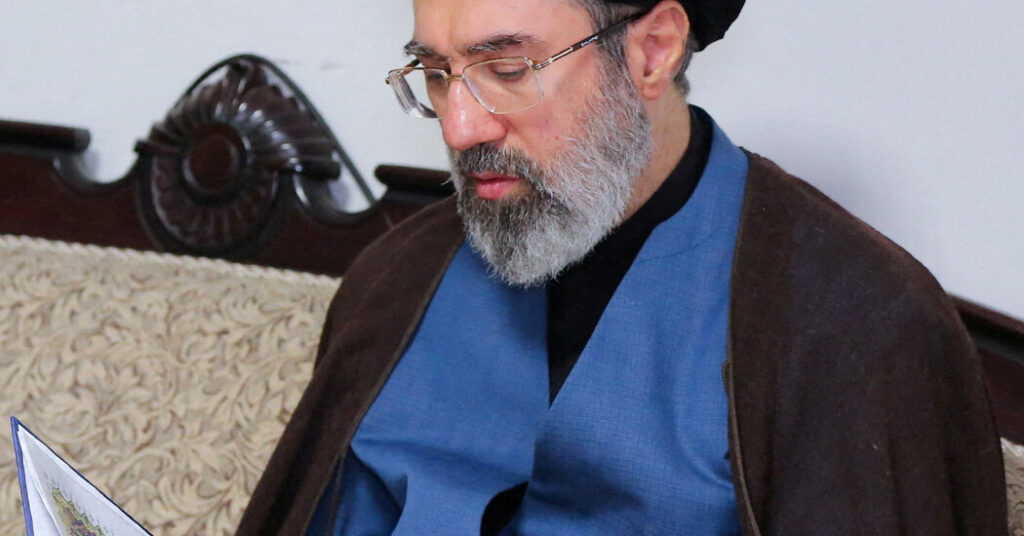
Mojtaba Khamenei, a son of Ayatollah Ali Khamenei, appears to be a front-runner to become his father’s successor.
The younger Mr. Khamenei, 56, is the second son of the ayatollah, the supreme leader who was killed on Saturday in a strike on his compound in Tehran. Mojtaba Khamenei was born in 1969 in Mashhad, an important religious center in Iran, about a decade before the Islamic Republic was established in 1979.
Known for having close ties to the Revolutionary Guards, Mr. Khamenei first joined the Islamic military corps around 1987 after finishing high school. He served during the latter period of Iran’s long war with Iraq from 1980 to ’88.
The next year, his father was named supreme leader, replacing the deceased Ayatollah Ruhollah Khomeini.
Mojtaba Khamenei went on to study with the country’s most esteemed clerics in Qom, and to teach in a religious seminary himself, forging connections with the religious leadership and gaining esteem in their eyes in part thanks to his father’s position.
But he was not a well-known figure and has operated mostly in the shadows, running the office of the supreme leader from behind the scenes, making headlines only occasionally in recent decades.
In 2005, after the conservative candidate Mahmoud Ahmadinejad was elected president, reformers accused Mojtaba Khamenei of working with religious leaders and the Revolutionary Guards to ensure the victory of the relatively unknown candidate they preferred.
Mehdi Karroubi, a reformer and one of Mr. Ahmadinejad’s competitors, had criticized Mojtaba Khamenei, accusing “a master’s son” of interfering with the elections. The supreme leader at the time defended his son, saying he “is a master himself, not a master’s son.”
In 2024, Iran’s Assembly of Experts met to plan the supreme leader’s succession. The Ayatollah Khamenei said at that time that his son should be excluded from consideration.
His selection could ruffle feathers in Iran because it rings familiar bells. The Islamic revolution in 1979 ousted the shah, Mohammad Reza Pahlavi, and, with him, it seemed, the dynastic passage of power, replacing it with the rule of clerics.
Installing the younger Khamenei in what was once his father’s role could anger Iranians who took to the streets in economic protests that morphed into a referendum on the regime earlier this year.
But selecting Mr. Khamenei would send a message, according to some analysts, that hard-liners tied to the Revolutionary Guards remain in charge, suggesting little would soon change.
Mojtaba Khamenei’s wife, Zahra Adel; his mother, Mansoureh Khojasteh Bagherzadeh, and a son were killed alongside his father in strikes on Saturday, the Iranian government said.
Farnaz Fassihi contributed reporting.
Ephrat Livni is a Times reporter covering breaking news around the world. She is based in Washington.
The post Who Is Mojtaba Khamenei, the Son and Possible Successor of Iran’s Supreme Leader? appeared first on New York Times.