When the A.I. video generation tool Seedance 2.0 debuted recently, with the ability to create impressively realistic clips of just about anything a user could imagine, it prompted two drastically different reactions on opposite sides of the world.
In the United States, many in the movie industry responded with fear. After a Seedance-generated video purporting to show a fight scene between Brad Pitt and Tom Cruise spread widely online, Hollywood filmmakers and writers said their jobs were fast becoming obsolete.
But in China, many reacted with pride and excitement. Stocks in short-video companies surged. One of China’s most famous directors, Jia Zhangke, shared a short film that he made using Seedance, in which his real self and an A.I. version discussed moviemaking.
“I’m not worried about technology replacing movies. From the very beginning, movies have coexisted with new technology,” Mr. Jia wrote on social media. “What really matters is how people use technology.”
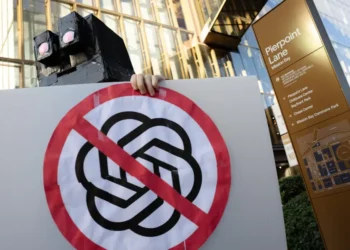
The contrasting reactions point to a broader split between China and much of the West on A.I.: Chinese people appear to be much more optimistic about it.
People in China are among the most excited in the world about A.I., according to a KPMG survey of 47 countries last year. While 69 percent of people in China said the technology’s benefits outweighed its risks, only 35 percent of Americans agreed. Other polls have shown similar disparities.
The question is, why?
The answer may be related to how the technology has been deployed in each country, as well as how the government and industry leaders have talked about it.
In China, A.I. Is Seemingly Everywhere
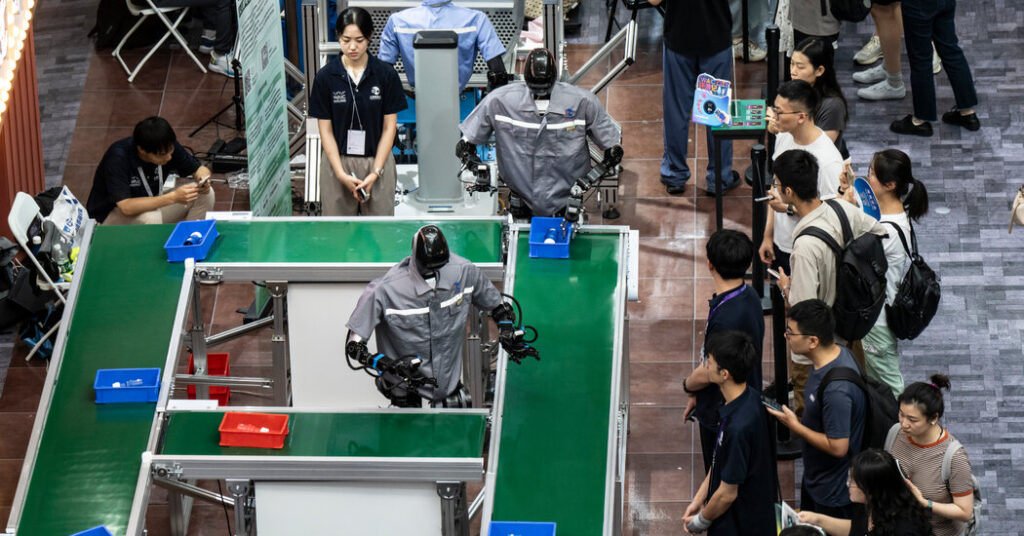
Driverless taxis roam more than a dozen Chinese cities, and service robots putter through hotels and restaurants. Chinese tech companies have rolled out medical chatbots to help users avoid long lines at hospitals. They’ve embedded A.I. assistants throughout popular apps, so users can ask A.I. in their mapping apps to help them decide where to eat, or in their shopping apps to help them choose between pairs of shoes.
That’s because Chinese tech companies have focused intensely on real-world applications for A.I. By contrast, many leading American tech companies have been focused on more abstract goals, like developing the most cutting-edge model, or achieving artificial general intelligence.
In addition, most of China’s leading A.I. models are free to use, unlike in the United States, where users have to pay for chatbots like ChatGPT to access all their features. (In fact, Chinese companies have been giving away money and luxury cars to entice people to download their apps.)
As a result, Chinese consumers are feeling the benefits of A.I., said Bai Guo, a professor who studies the digital economy at China Europe International Business School in Shanghai.
“A lot of things can already be helped by A.I., and people find that interesting, that’s useful, and so there are quite a lot of positive and active feelings toward it,” Professor Bai said. Potential dangers, such as unemployment or increased inequality, still feel remote.
Beijing Has Been a Big Champion
The focus on A.I. applications is a product of China’s hypercompetitive internet economy. Leading companies like Alibaba, ByteDance and the food delivery giant Meituan are locked in a perpetual battle for users, and A.I. is the latest tool.
The Chinese government has also encouraged this approach. Xi Jinping has said that China’s A.I. industry should “prioritize practical application.” Officials say that A.I. could help solve China’s thorniest problems, such as inequalities in health care, or an aging work force.
In August, the government laid out a plan, called A.I.+, for A.I. to penetrate more than 70 percent of Chinese society by 2027, and 90 percent by 2030. The plan said A.I. will “promote a revolutionary leap in productive ability” and “create higher-quality, beautiful lives.”
Because Chinese officials are promoting A.I. as an economic engine, they may also be silencing those who are more pessimistic about it. Crashes involving autonomous driving have attracted widespread attention online, only for posts to be censored. State media outlets have compared concerns about job loss for taxi drivers to the Luddite movement.
China also does not permit independent labor unions, which have been some of the most vocal critics of A.I. in the West.
The signaling by the state that A.I. is strictly managed has, for some Chinese, bolstered their confidence in the technology. In interviews, some parents have said that they are comfortable letting their children use A.I. toys or educational tools because they believe the government would not permit the models to produce anything harmful.
National Pride and Faith in Technology
Many Chinese scholars, investors and entrepreneurs cited a more abstract reason for the optimism: Simply put, China has modernized so quickly in recent decades that many Chinese are used to groundbreaking change. And technology has been key to that change.
Afra Wang, a technology writer from China, wrote in a recent newsletter about her grandmother, who once walked five hours to buy a clock so that her children could get to school on time. “Today her Xiaomi phone has given her an online shopping addiction, and delivery drones fly above her apartment,” Ms. Wang wrote. “A.I. simply looks like the next turn of a wheel that has only ever spun forward.”
For many Chinese, their country’s ability to compete with the United States on A.I. is a source of great pride, further proof of how far China has come. After Seedance 2.0 was released, the hashtag “Seedance 2.0 has been praised to the skies overseas” was a top trend on Chinese social media.
“Technology still firmly occupies a particular place in the Chinese imagination: It is still seen as a channel for upward mobility,” Ms. Wang wrote.
Concerns About A.I. Are Growing
Still, there are signs of increased caution, by both the government and the general public.
Some Chinese content creators have expressed unease about Seedance 2.0’s prowess.
Feng Ji, the founder of a leading Chinese video game developer, wrote online that intellectual property laws would face “unprecedented challenges.” Disney and the Motion Picture Association, which represents major Hollywood studios, have already accused ByteDance, the Chinese company that made Seedance, of copyright infringement. (Not long after the release, ByteDance announced that it would temporarily restrict the creation of videos featuring real people.)
Users have also raised concerns about how easily the government’s restrictions can be bypassed. A Chinese feminist group recently highlighted tutorials for making sexually explicit deepfakes that circulate openly on Chinese social media. Attempts to report the images were unsuccessful, the group said.
The Chinese government has also begun more directly addressing the technology’s potential for disrupting jobs, mental health or the Communist Party’s grip on power.
The state news agency reported in January that the government would soon release an action plan to address A.I.’s effect on employment, as automation threatens to displace workers in some industries.
The government has also ordered A.I. companies to impose a wide range of guardrails, from blocking politically sensitive content to preventing users from becoming dependent on their A.I. companions.
For all of its potential, China must not let A.I. “spiral out of control,” Mr. Xi warned during a recent meeting of the leaders of the Communist Party.
Siyi Zhao contributed research.
Vivian Wang is a China correspondent based in Beijing, where she writes about how the country’s global rise and ambitions are shaping the daily lives of its people.
The post Where are China’s A.I. Doomers? appeared first on New York Times.