Since the U.S. and Israel jointly began attacking Iran on Saturday, destroying Iran’s ballistic missile capabilities has emerged as a top objective for President Trump despite the unlikelihood that it can be accomplished without ground troops.
With no modern air force, Iran has long looked to ballistic missiles to project power outside its borders. Its most capable ballistic missile is the Shahab-3, which can hit targets more than 1,200 miles away. Most of those missiles, as well as the facilities that produce them, are thought to be located underground.
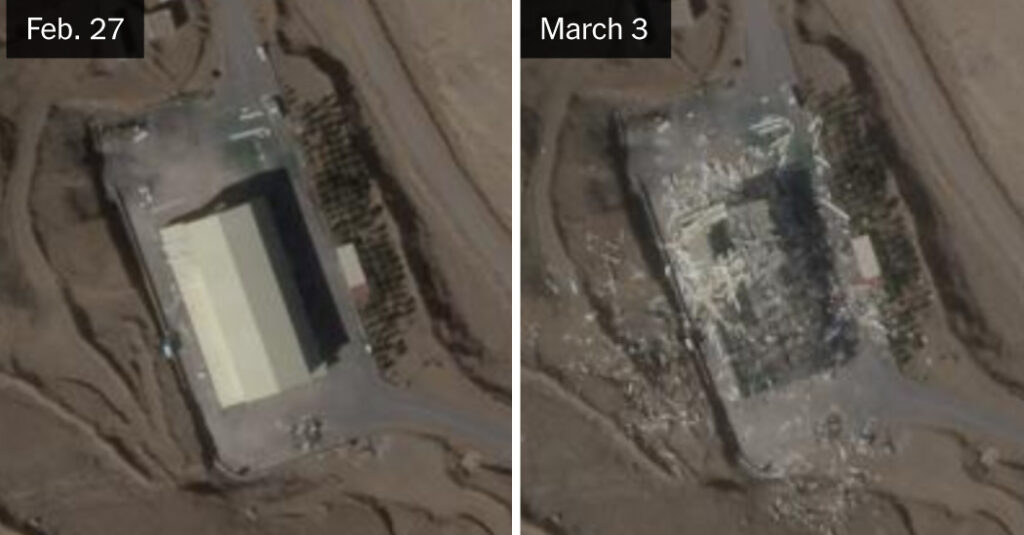
A New York Times analysis of satellite imagery shows how these sites have been targeted since the Pentagon’s most recent air campaign against Iran began on February 28.
Here is a look at some of the key sites that have been hit, and what it says about the U.S. and Israel’s strategy :
Underground facilities are a top target — and tough to take out
U.S. Central Command said in a social media post on Sunday that it had used B-2 stealth bombers to attack “hardened ballistic missile facilities” with 2,000-pound penetrator bombs. Gen. Dan Caine, the chairman of the Joint Chiefs of Staff, acknowledged on Monday that such specialized weaponry was needed as the sites were underground.
Those bombs were likely based on the BLU-109, a thick-cased warhead designed to punch through rock or reinforced concrete before detonating. They are fitted with either a GPS- or laser-guidance kit, depending on the accuracy required for the mission.
Unlike an aerial attack on a target above ground, where a bomb’s explosive power can transmit through the surrounding air and create damage at a distance, placing a munition on-target as precisely as possible is even more important when assaulting underground sites, as the surrounding rock will absorb more of the bomb’s power.
These one-ton penetrator bombs cited by General Caine would be used for underground facilities that are closer to the surface than the two deeply buried nuclear sites at Fordo and Natanz that the United States attacked last June. The facilities were attacked with special 30,000-pound penetrator bombs that can be dropped only by B-2 stealth bombers.
Using the BLU-109 or a similar 2,000-pound penetrator warhead to attack sites closer to the surface greatly expands the types of aircraft that can carry and employ those munitions.
The U.S. military has noted that Iran’s land mass is slightly larger than Alaska, which makes the already difficult task of locating the entrances to underground facilities even more challenging.
Destruction at some aboveground ballistic missile facilities is extensive
The Times’s analysis found evidence of damage at some of Iran’s aboveground ballistic missile facilities, and at a few facilities the damage was extensive.
For instance, at one missile facility near Kermanshah, multiple buildings were destroyed.
And at a missile facility in Garmdareh, just outside Tehran, satellite imagery shows at least nine buildings were struck in two separate strikes since Feb. 28.
At this stage, the Times has not been able to verify satellite imagery that shows missile production sites struck. Sam Lair, a research associate at the James Martin Center for Nonproliferation Studies in Monterey, Calif., suggested that this could be a strategic move by the U.S. and Israel. “It could happen at a later stage of the conflict once the missile bases have been suppressed,” Mr. Lair said.
Missile sites struck last year are targets once again
Last June, the Isfahan nuclear complex was heavily bombarded with cruise missiles, but so far it has been spared during the four days of bombing by the United States and Israel. Missile facilities near the city, however, have been targeted, including ones that have been rebuilt since the U.S.-Israeli strikes in June.
In the case of the ballistic missile facility at Isfahan, which was rebuilt following the U.S. attack last June, recent satellite imagery shows it has been severely damaged since February 28.
As of Tuesday, U.S. Central Command, which oversees all U.S. military operations in the region, has acknowledged attacking more than 1,700 targets inside Iran.
Additional reporting by Christoph Koettl.
Daniel Wood is a Times graphics editor focusing on cartography and data visualization.
The post What Satellite Images Show on Efforts to Destroy Iran’s Ballistic Missiles appeared first on New York Times.