This article is part of a Women and Leadership special report highlighting leaders in women’s rights, health, business and much more.
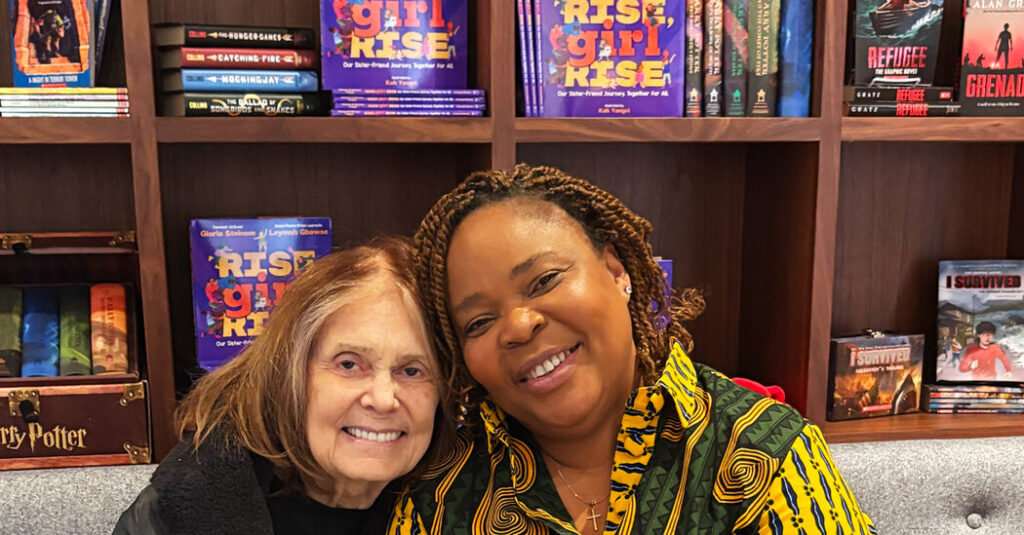
On a recent Monday evening, the American activist and author Gloria Steinem and the Liberian Nobel Peace laureate Leymah Gbowee spoke at 92NY in New York City about their new children’s book, “Rise, Girl, Rise.” Colorful, lighthearted illustrations tell a story of happy childhoods from the perspective of two girls who grew up in different parts of the world.
But the narrative, rooted in the personal experiences of its authors, also depicts their discovery of inequality. “As I grew, our travels showed me the unfairness women and girls face,” said the character based on the young Ms. Steinem, who accompanied her antiques-dealer father on trips to roadside auctions. “In every state. Of every race. And place. The doors closed on women’s dreams,” the character continued. “Even as a child, I knew this was not right.”
Supportive parents nurtured a sense of self, the authors said, but also the importance of community, equality, collective action and inclusion, lessons they carried into adulthood.
“Diversity is a gift, because we learn from diversity way more than we learn from sameness,” Ms. Steinem, 91, said during the event at 92NY. “We need a word like feminism. It’s about our shared humanity.”
The book was written to inspire younger generations, said Ms. Gbowee, 54, a peace activist and women’s rights advocate who led a nonviolent movement that helped end the 14 year civil war in Liberia in 2003. “There will always be children and they will always be looking for a light,” she said at the event. “Some people will try to shut you down, but the more they try, the more you walk louder and louder and louder.”
An audience member asked the speakers: At a time when there is a rollback of women’s rights in one of the most developed nations in the world, and children’s rights abuses are prevalent in many countries, where do we go from here?
Both women said they remained hopeful. “We try to create our little area of democracy,” Ms. Steinem said. Personal responsibility and small-scale actions, like decisions about having children, sharing housework and child care, and insisting on equal pay, “will have a huge influence,” she said.
Ms. Gbowee recounted how the chief imam of Liberia, Sheikh Ali Krayee, who had been working to end child marriage, asked for her help, through her foundation, to get four young girls who were about to be married access to an education. He knew they had potential, she said.
“He may not end child marriage immediately,” but he helped some men who previously supported child marriage understand the value of education, Ms. Gbowee added. Seven years later the imam has helped 36 Muslim girls enter her program. Those first four girls? “We have two doctors, one engineer and one accountant,” she said.
Other women involved in the women’s rights movement — from a scholar of feminist history to a proprietor of a feminist bookstore — were asked for their views on the state of feminism today:
Estelle B. Freedman
78, emerita professor at Stanford University specializing in women’s history and feminist studies
“There’s a long history both of struggle within and resistance to feminism,” said Dr. Freedman in a phone interview. “But despite major setbacks over the century and a half of feminist activism, the long story is one of enormous social and political change.”
The decades-long suffrage movement in the United States resulted in American women’s right to vote after 1920, which laid the groundwork for future equal rights policies, like Title IX, the 1972 law prohibiting sex-based discrimination in federally funded education. Today, many organizations work locally, nationally and globally to combat gender-based violence and achieve full political representation, organizations “that did not exist during the American feminist movement of the 1960s and 1970s,” said Dr. Freedman, who has a Ph.D. in history and is a co-founder of Stanford’s program in feminist, gender, and sexuality studies.
Another huge difference between the movement then and the movement now, she said, is the internationalization of feminism outside “the first world, industrialized superpowers.”
“Look at the changes that have been made because diverse groups of people kept mobilizing and organizing,” Dr. Freedman said, building on what earlier activists did, “reframing feminism for the era we live in.” But the recent rollback in reproductive rights in the United States, which included defunding global women’s health programs, she added, “is a stark reminder that we’ve got plenty of work to do to actually achieve gender equality.”
Jennifer Baumgardner
55, founder and publisher of Dottir Press, which produces feminist works, and editor in chief of LIBER: A Feminist Review
While there had been progress in issues like coeducation and how gender is understood, “a lot of the same big things we’re always fighting for in a sexist world have remained,” Ms. Baumgardner said. Control over one’s body, the ability to care for oneself and one’s children, freedom from violence and the exploitation of women’s labor in the home are ongoing challenges, she said.
“I think there’s a disconnect there between how we think things should be versus what we’ve actually done to build that into civil society,” Ms. Baumgardner, who is currently a writer in residence at Smith College, said by phone. She said students in her class on feminist public writing were fascinated by the history of feminism, and a 1995 piece they read about sexual assault shocked them with its relevance to today. “There’s knowledge in this movement that they can draw from,” she said. “They see that while some things have changed, there are these central questions.”
At the same time, new harmful challenges have emerged from technology, like deep fakes, cyberbullying, and “opportunities” like OnlyFans and sugar daddy sites, she added. Social media, too, can impede progress.
“It’s community building without the actual community. It’s not conversation, it’s not discussion,” she said. “There’s something very profound about meeting in real time, in real space,” like in the earlier days of the feminist movement. “I definitely think the way we did it in the past is the way forward,” Ms. Baumgardner said.
Sara Luce Look
56, co-owner of Charis Books & More in Decatur, Ga.
As an owner of Charis, one of the first independent feminist bookstores in the United States (established in 1974) and one of the few remaining from that period, Ms. Look agreed that in-person gatherings created deeper, sustained encounters and can support activism.
“What we’re seeing with our younger staff and our customers is the amount of real life programming they want,” she said in a phone interview. Many of the store’s 200 to 300 events hosted annually are in person.
“I think of all the people who are traumatized over and over again in the current political climate,” Ms. Look said. “There’s a lot of outrage happening, and we need outrage.” But, she said, the resurgence of feminist and other mission-driven bookstores is a source of hope.
When she started working full time at the store in 1994, she said, “It was at the height of feminist bookstores. There were over 200 in North America. By 2013, there were less than 15. Now, we’re back on the rise.” She estimates that there are at least 50 social justice mission-driven bookstores that include feminist work in North America today.
Lynne Segal
82, professor emerita of gender and psychosocial studies at Birkbeck, University of London
“When feminism burst onto the scene at the close of the 1960s,” said Dr. Segal over email, “it did so with amazing energy and spirit — hopes could hardly have been higher.” But decades later, attaining the goals feminists fought for remains mixed.
“Women have a stronger voice, with many more choices today,” said Dr. Segal, who has a doctorate in psychology and is the author of many books, including “Why Feminism? Gender, Psychology, Politics.” “Women can no longer be so easily ignored; more workplaces flourish with women in them. Yet sexism remains; women can still be seen primarily in terms of their bodies.”
More women are living in poverty, and there is widespread ageism, which impacts “women first and foremost,” she said. “Everything is to be gained by recognizing women’s rich diversity, alongside men’s, and working together for a peaceful, fairer, greener world,” she said.
Sima Bahous
United Nations under-secretary-general and executive director of U.N. Women
There has been much progress globally in the last three decades, Ms. Bahous said. “Today we see more than double the number of women in national parliaments,” she wrote over email, “more girls than ever before completing secondary education; maternal mortality dramatically reduced over the past decades; improved laws, policies and investments.”
Still, the world’s women have only 64 percent of the legal rights of men, and there was an 87 percent increase in conflict-related sexual violence from 2022 to 2024, she said. “When women are excluded, economies underperform. When women are silenced, democracies weaken. When women’s rights are negotiable, instability follows.”
“What has been won can be lost if we fail to grasp it and protect it,” Ms. Bahous said. “The future of gender equality is not guaranteed. But it is still possible, and it will be shaped by the choices we make now.”
The post ‘What Has Been Won Can Be Lost’: A Look at the Past and Future of Feminism appeared first on New York Times.