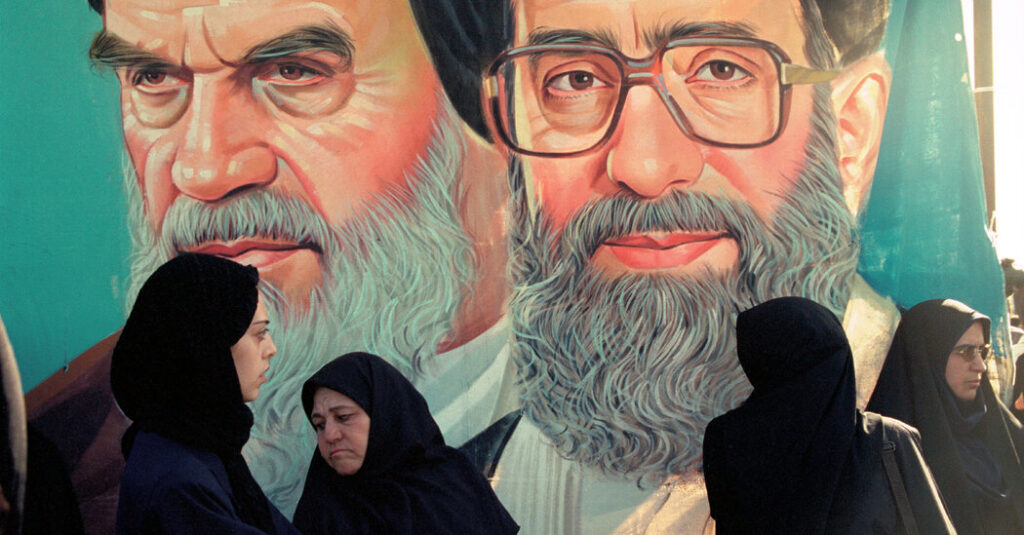
The face of Ayatollah Ali Khamenei has loomed over every significant milestone of my life — of everyone’s life — in Iran. The requisite photo of him that was hung in every public space, where people learned, worked, lunched, transacted, watched theater, saw art and visited the doctor, altered over the years. In my youth, in his middle age, his image was toothy and callow. As the years passed, his expression grew truculent, his beard gray. But he was always there, always watching.
You get the face you deserve, said Henri Cartier-Bresson. Ayatollah Khamenei never developed the fleshy, decayed look of Muammar el-Qaddafi or the hooded rage of Saddam Hussein. Age turned his image haughty and domineering, rather than mad and ravaged. Yet he outlived them, our seemingly immortal dictator, resisting every effort to oppose and resist him — at the ballot box, through elite maneuvering, through sly satire, through years of protests, first by varying segments of society and then increasingly most of them at the same time.
The permanence of his image signified the control of the regime. His baleful gaze insisted on its preservation at any cost, with a brutality that created thousands of other images framed and placed in Iranian homes: remembrances of the citizens who protested and defied the system over the years and were killed by his coercive apparatus.
Now he is dead, killed by the American and Israeli military campaign underway. Will another face replace his and carry on a version of the same story, collapsing what is true and what is false? Will the regime elite reshuffle itself, dispense with the business of having a symbolic face at all and recalibrate in order to survive? This is the dreaded scenario, a riff on the outcome in Venezuela, in which a pragmatic regime figure assumes power and brokers a cease-fire with the United States, meeting Washington’s surrender demands in return for allowing the regime to carry on in some zombie form, its fundamental nature intact. Surviving at any cost was always worth it to the supreme leader, and this outcome would be his vindication.
The ayatollah peered over us during our most banal and our most intimate moments. He was on the wall when I married in a notary office and when I checked into the hospital to have my son. He was on the wall of the office where I received my first press card to report my first story in Iran.
It was July 1999, a decade into his supreme leadership. In the middle of a summer night, plainclothes police officers and militiamen raided a dormitory at the University of Tehran. Students earlier that day protested the closure of a reformist newspaper, and for that they were punished. The militiamen broke into their rooms, set their beds and belongings on fire and threw several of the students out of windows. Four were killed, and hundreds were wounded or detained.
Tehran erupted in protests; the streets smelled of burning tires. Ayatollah Khamenei pretended the violence had nothing to do with him. With his trademark faux magnanimity, he said the students must be dealt with patiently — even “if they set my picture on fire or tear it.” No one used to do that back then, but it was almost as if he anticipated that defacing his image or tearing it up would one day become commonplace.
One family of a student who died in that raid tried to bring his killers to justice. A judge considered the case and threw it out. The supreme leader’s face was on the wall of the courtroom.
His face stared at us from the walls of Iran during so many moments of dark injustice that his face became inseparable from the immorality of the regime. In the fall of 2021, after tens of thousands of Iranians had died of Covid, I accompanied an elderly relative to a vaccination center in Tehran to get a shot. At the start of the year Ayatollah Khamenei banned vaccines made in America and Britain, calling them “untrustworthy.” In the summer he posed for photographers at the same center supposedly receiving a locally made vaccine, unevidenced and produced by a conglomerate controlled by him. Some Western vaccines were eventually allowed in and reserved for the elderly. A nurse that fall at the vaccination center nodded at the ayatollah’s face on the wall and, shaking her head, told me she thought he had really gotten AstraZeneca’s shot.
Those who challenged him often died in mysterious and awful ways. Dissidents were hacked to death by assailants with machetes. In June 2009 his great political rival and fellow revolutionary Ali Akbar Hashemi Rafsanjani warned the supreme leader in a personal letter that he must accept change or “volcanoes fueled from burning hearts will emerge in society.” Mr. Rafsanjani quoted the 13th-century Persian poet Saadi at the letter’s end: “A stream of water can be diverted with a small shovel, but once it grows, even an elephant cannot stop its flow.”
The same month, believing the result of the presidential election to be fraudulent, a million Iranians poured into the streets. Many young protesters were arrested and taken to a detention center south of Tehran called Kahrizak, where many were tortured and some allegedly raped. Less than 10 years later, Mr. Rafsanjani was found floating in a pool, said to have suffered a heart attack while swimming. His bodyguards had apparently been away, and security cameras had been turned off.
His most despised adversaries — intellectuals and political rivals — bore his specific, spiteful rage. But thousands of people were killed in protests or imprisoned over the years, and just last month he oversaw the fastest, largest mass slaughter in modern Iranian history.
On Saturday, when I first saw the words “Ali Khamenei has been killed” flash on a television screen, I felt choked. The distance between that possibility and all the years of being gripped by fear of him could not be crossed. There was no relief in that first moment, just a flood of grief for all the suffering and the bleak inheritance he had left us. Then came an hour of uncertainty and frantic messaging: Are we sure? How can we be sure? What if it’s a feint? The hopeful among us saw confirmation in the pale, nervous stuttering of an Iranian government spokesman refusing to confirm the dictator was alive; the pessimists, wishing to avoid disappointment, held out until President Trump announced the death.
Released from the grip of life under Ayatollah Khamenei, tens of millions of Iranians — inside the country and out — will grasp at whole new ways to contemplate the future. The possibilities are precarious and depend, in part, on how the days ahead unfold. But for the first time in 47 years, there will be possibilities: for Iranians to consider how they want to be governed, as opposed to just thinking about what they don’t want; about how to articulate a new Iranian identity; and about how to relate to one another outside the logic of repression.
Even if the war carries on for weeks, even if Iran returns to talks after inflicting what damage it can on U.S. targets, its Arab neighbors and Israel, Iran’s fundamental crises remain: the economy on the brink of collapse and the state at open war with its citizenry. Any new dispensation will have to resolve people’s need to eat and survive and to reconcile their dreams of secular, accountable government.
There is a dignity in this pause and the chance to envision the path to a different kind of rule — whether it might wind through a transitional return to constitutional monarchy, a steppingstone to whatever system comes next, all prefaced by the need for gozaar, or moving beyond, from the failed Islamic model.
In the hours after news of the supreme leader’s death, satellite images of the blackened, bombed-out crater of his official residential and administrative compound surfaced. It was a sorrow to see, because it was the family residence of my close relatives many years ago. That district of the city has been the seat of Iran’s rulers since the Qajar dynasty, which ruled from 1789 to 1925 — and a scene of caprice, lawlessness and confiscation for over a century. Reza Shah Pahlavi, the first Pahlavi monarch, expelled Qajar families from the quarter in the 1920s and expropriated their property, and the Islamic republic expelled and expropriated both the Pahlavi elites and what remained of the Qajar elites after the revolution in 1979.
Many Iranians today yearn for an idealized Iran of the past — an inclusive, less authoritarian, culturally flourishing Iran, wreathed in nostalgia for the glory of monarchy, with its imperial pomp and mirror mosaic palaces. It may be compelling to conjure the aesthetics of the distant past, of royal families who lived in graceful palaces, feted the world’s dignitaries and outperformed the whole region by every measure. The present is a time of corruption and impoverishment, with the currency effectively collapsed and millions of people unable to afford enough to eat. Recalling when it wasn’t that way is part of survival.
While many yearn for this idealized past, others, far fewer, are grieving what just ended and the patronage it secured them. With time, new divisions and contestations will emerge, as they always have in this large and diverse land, but they will take forms we cannot yet anticipate.
The reality of Iran’s past is the triumph of one dictatorship over another, forced secular authoritarianism, followed by forced Islamism. That is the destructive cycle that needs to be broken, the cycle of land grabbing and score settling, in which leaders are more concerned with erasing their predecessors than improving the lives of their citizens.
No one doubts that Iranians wish to build a better future. Doing that requires reconciling with the past, with each era’s follies, and refusing to repeat them.
Azadeh Moaveni is an associate professor of journalism at New York University. Her forthcoming book is “The East Wing.”
The Times is committed to publishing a diversity of letters to the editor. We’d like to hear what you think about this or any of our articles. Here are some tips. And here’s our email: [email protected].
Follow the New York Times Opinion section on Facebook, Instagram, TikTok, Bluesky, WhatsApp and Threads.
The post We Are Finally Free From Khamenei’s Suffocating Gaze appeared first on New York Times.