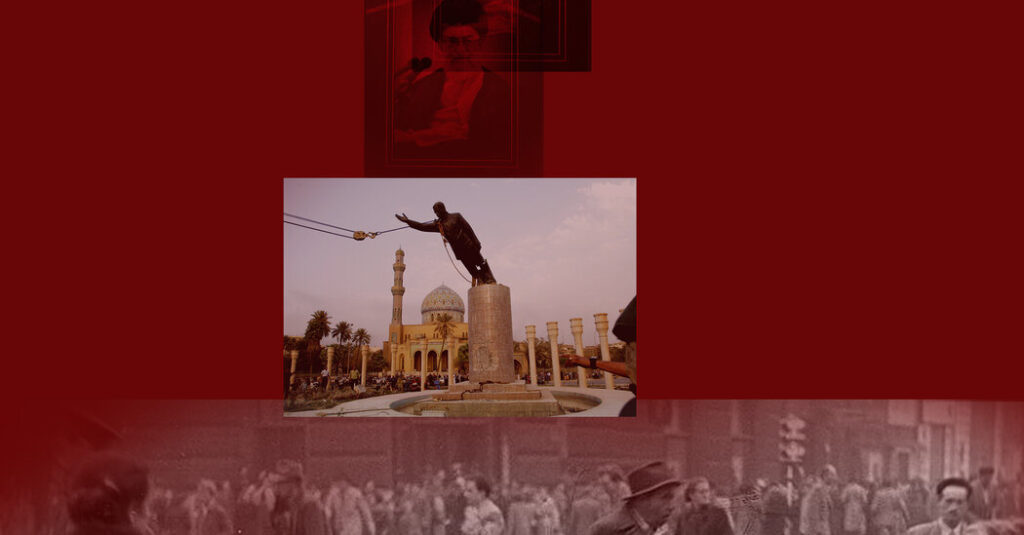
“Take over your government,” President Trump urged Iranians as bombs began raining down this past weekend. “It will be yours to take. This will be, probably, your only chance for generations.” It was a stirring call, drawing on the dream of democracy and the promise of liberation. The United States has issued it to other nations many times in the past, and it tends to end in disaster.
During the Cold War, Radio Free Europe broadcasts encouraged the people of Hungary — my parents among them — to rise up, offering guidance on tactics and strategies and leading many listeners to believe they would receive U.S. military assistance. On Oct. 23, 1956, Hungarians took to the streets, publicly lynching officers of the Communist secret police. A new government formed, under Imre Nagy, and announced that Hungary would leave the Warsaw Pact.
Western help never came. Russian tanks rolled in. My parents watched soldiers open fire on a busy square. Between 2,500 and 3,000 Hungarians were killed during the Soviet crackdown. Tens of thousands were arrested, including Nagy, who was later executed.
Something similar played out in 1961, as Cuban exiles prepared to invade their homeland and overthrow Fidel Castro, with the promise of U.S. air cover. The military support failed to materialize. More than 100 rebel combatants were killed at the Bay of Pigs, more than 1,000 were captured, and Castro emerged stronger — emboldened in ways that set the stage for the Cuban missile crisis 18 months later.
We saw it again in the 1980s, when the United States funded and armed Afghan mujahedeen in their war against Soviet occupation. This time American support of revolutionaries did initially succeed. The Soviets withdrew in 1989 — but so did American support. What followed was a civil war, the rise of the Taliban, the radicalization of mujahedeen like Osama bin Laden and eventually 20 years of American war.
In 1991, after Operation Desert Storm drove Saddam Hussein’s forces out of Kuwait, President George H.W. Bush called on Iraqis to “take matters into their own hands — to force Saddam Hussein, the dictator, to step aside.” Iraq’s Shiite majority rose up in rebellion, driving Baathist forces out of the holy cities of Najaf and Karbala. Within days, Saddam’s Republican Guard regained the upper hand. Army forces rounded up rebels, torturing, raping and murdering them in Shiite mosques, or using helicopters to pour kerosene on them and set them on fire. Washington decided not to intervene. Tens of thousands died.
In all of these instances, the body count tells only part of the story. A bitter sense of betrayal lasts for generations. In 2003, two decades after Washington abandoned those Shiite rebels in Iraq, my “60 Minutes” colleague Bob Simon and I sat down with Muqtada al-Sadr, then a young Shiite cleric, in Najaf, which was at the heart of Saddam’s 1991 crackdown. We asked him whether he was thankful that the United States had at last toppled Iraqi Shiites’ oppressor. With the first gulf war still fresh in his mind, he replied, “The little serpent has left, and the great serpent has come.”
Authoritarian regimes rarely just collapse. With everything on the line, they fight back, often brutally. That’s why real regime change takes more than just the removal of an individual leader. It takes weapons, logistics and intelligence. It takes time and money and American lives. Too often, presidents talk a big game at the outset but reassess their priorities when the costs become clear.
What gets left out of that reassessment are the people who believed the promises. The Hungarians who took to the streets of Budapest. The Iraqi Shiites who seized control of their cities. The Cuban exiles who waded ashore.
In the case of Iran today, the obstacles are especially daunting. While the majority of Iranians oppose their nation’s ruling regime, there is no clear, organized movement with recognized leadership to lead them out of it. The Islamic Revolutionary Guards Corps is large, powerful and brutal, More than 6,800 civilians died during the recent protests against the regime, according to a U.S.-based human rights group. Some estimates are many times higher.
Numerous military analysts say that without the arrival of weapons or ground troops, Iran’s rebels have little hope of success. In addition, many Iranians are skeptical of America’s intentions, and mindful of the last time this country effected regime change in Iran — in 1953, when the C.I.A. helped to overthrow a democratically elected leader and returned the shah to power.
If a popular uprising did succeed, internal divisions could cause the nation to fracture, creating the kind of power vacuum that has derailed U.S. interests before in places such as Baghdad and Kabul — this time with a country potentially on the brink of developing nuclear weapons.
Watching the violent crackdown on protesters in Tehran reminded me of scenes that my parents described in Budapest in 1956. Without overt U.S. intervention, it took more than three decades for Soviet control to end there. Will the United States stick around now to support the Iranians it is goading into a dangerous uprising? Or will it achieve its military goals and move on?
The rhetoric of liberation is cheap, whereas the cost of actually delivering on it is not. The people who believe the promises are the ones who bear the price. That has been true across nearly a century of American foreign policy. Before Iranians bet their lives on the United States’ commitment, they deserve to know the odds.
Source photographs by Amr Alfiky/Reuters, Mirrorpix/Getty Images and Universal Images Group, via Getty Images.
Peter W. Klein is an Emmy Award-winning investigative reporter and filmmaker. He is a founder of the Global Reporting Centre at the University of British Columbia, where he is a professor of journalism.
The Times is committed to publishing a diversity of letters to the editor. We’d like to hear what you think about this or any of our articles. Here are some tips. And here’s our email: [email protected].
Follow the New York Times Opinion section on Facebook, Instagram, TikTok, Bluesky, WhatsApp and Threads.
The post Trump Wants the Iranians to Rise Up. But Will He Have Their Backs? appeared first on New York Times.