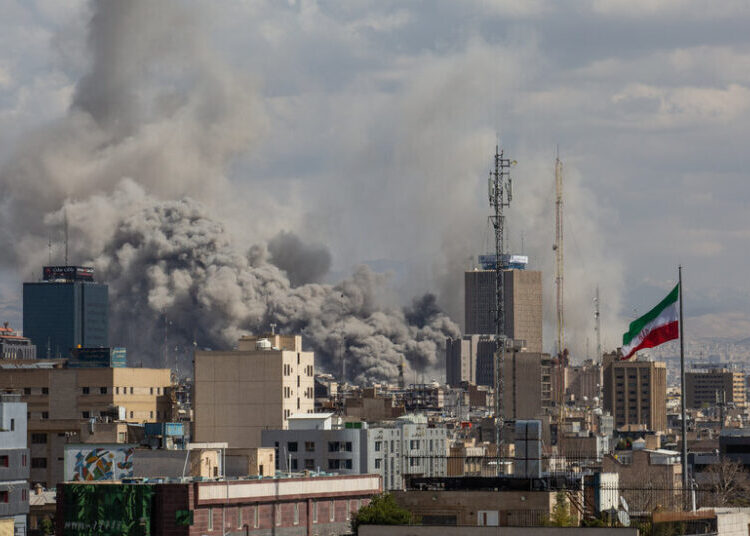
President Donald Trump acknowledged for the first time on Tuesday the economic toll for Americans of his assault on Iran, saying that oil prices were likely to spike as a result of the fighting in the Persian Gulf but insisting they would eventually dip.
It was a measure of the political consequences of the war as the White House reinforced its effort to justify the surprise attack that started Saturday. The conflict — the largest U.S. military action since the invasion of Iraq in 2003 — is pushing oil prices higher and weighing down the stock market as midterm elections loom later this year.
The president and his allies have offered shifting justifications for the decision to launch the joint attack with Israel, and they have also declared a range of goals for the outcome.
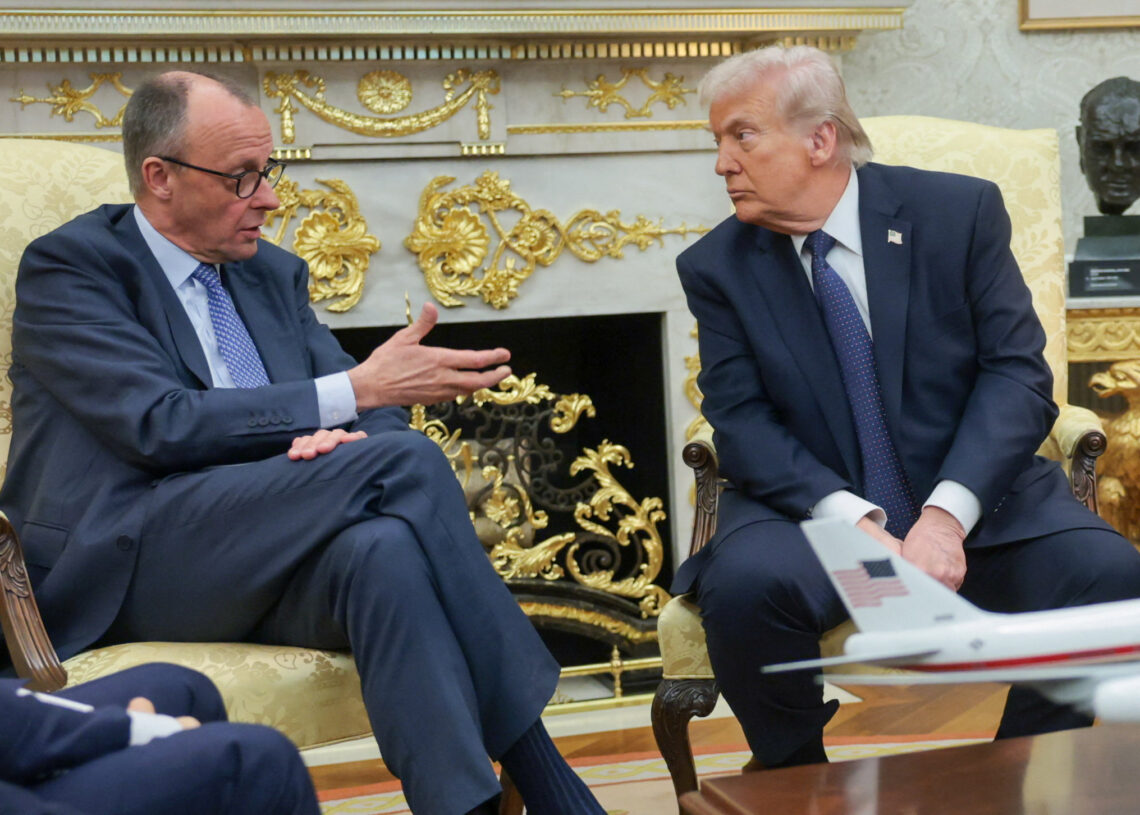
“So if we have a little high oil prices for a little while, but as soon as this ends, those prices are going to drop, I believe, lower than even before,” Trump told reporters in an Oval Office appearance alongside German Chancellor Friedrich Merz, after a reporter asked both leaders how worried they were about the rising prices of oil and gas.
Merz offered a more sober assessment of the war’s impact, saying that “this is of course damaging our economies. This is true for the oil prices, and this is true for the gas prices as well. So that’s the reason why we all hope that this war will come to an end as soon as possible.”
Later in the day, Trump ordered the U.S. International Development Finance Corporation to offer government-backed insurance and guarantees to ships traversing the Persian Gulf, a bid to make it more attractive for oil tankers to risk passing through what is now a war zone. Trump also said that the U.S. Navy would escort oil tankers through the Strait of Hormuz if necessary.
Prices for crude oil and gasoline have jumped in the last two days, with the price of a gallon of regular gas increasing $0.11 on Tuesday, to $3.11 on average across the United States, according to AAA — the highest since mid-October. West Texas Intermediate crude oil futures are up 10 percent since Friday.
Those rising prices marked a shift from the last several months, when declining energy prices helped moderate inflation in the United States.
Trump and his lieutenants have offered multiple reasons for their decision to strike Iran now, rather than continue to engage in diplomacy or push Tehran in ways other than air bombardment.
On Tuesday, senior administration officials said they thought Iranian negotiators in recent weeks weren’t serious about giving up the stockpile of enriched uranium that they said offered Tehran a potentially quick path to a nuclear weapon.
One senior official said it could have been possible to strike some sort of nuclear deal reminiscent of the one President Barack Obama reached with Iran in 2015. Trump opposed that agreement, saying it failed to end Iran’s nuclear program once and for all, and pulled out of it in his first term as president. Obama and other backers of the deal said at the time that it was a superior alternative to war.
“We came back to the president, we said, ‘Look, if you want us to make a deal like an Obama kind of deal, maybe it would be an Obama-plus deal, we could probably get one done,’” a senior administration official said, briefing reporters on the condition of anonymity to speak frankly about the closed-door meetings. Such an agreement might have included strict limits on Iran’s enriched uranium.
A deal “would take months,” the official said. “These guys definitely were not looking to make a quick deal. And if you’re asking us at the end of the day, if we’re going to look at you and say we’ve actually solved the issue … they weren’t willing to make the type of deal that President Trump would have been satisfied with.”
The focus on Iran’s nuclear capabilities was especially notable given that Trump had declared in June, after U.S. and Israeli airstrikes, that the United States had “obliterated” Tehran’s nuclear program.
With U.S. troops dead and thousands of Americans trapped in the Middle East or seeking to flee the expanding regional conflict, the pressure is rising on Trump to explain why he decided there was an urgent need to launch an attack on Iran when the United States had not been attacked.
Administration officials’ explanations have varied.
Trump on Tuesday undercut the justification offered the previous day by Secretary of State Marco Rubio, who had said that Washington believed that Israel was about to attack Iran and that officials decided to join the operation rather than allowing U.S. troops to be targeted in the Iranian retaliation.
That wasn’t the case, Trump said Tuesday when asked about it in the Oval Office.
“We were having negotiations with these lunatics, and it was my opinion that they were going to attack first,” Trump said, referring to Iran. “If anything, I might have forced Israel’s hand. But Israel was ready, and we were ready,” he said, in response to a question about whether Israel had forced his hand to attack Tehran.
Rubio, too, changed his explanation Tuesday. “The president had already made a decision to act,” he told reporters before briefing lawmakers on the Hill. “The president acted on the timing that gave us the highest chance of success.”
Trump said he had taken at least some inspiration for the Iran attack from the January raid on Venezuelan President Nicolás Maduro, a pinpoint operation that captured a longtime foe of Washington but left the rest of the Venezuelan regime in place, preserving stability although not answering some Venezuelans’ call for a democratically elected leader.
“Venezuela was so incredible, because we did the attack, and we kept government totally intact,” Trump said, contrasting that with the effort two decades ago to oust Iraqi President Saddam Hussein, in which Iraq’s existing military and administration were dissolved following the 2003 U.S. invasion.
“We don’t believe in that, so we’ll see what happens,” Trump said, referring to the events in Iraq, though he said the situation in Iran was evolving differently from what happened in Venezuela.
“Most of the people we had in mind” to run the country “are dead,” Trump said. “We had some in mind from that group that is dead, and now we have another group. They may be dead also, based on reports. So I guess you have a third wave coming, and pretty soon we’re not going to know anybody.”
Merz, whose visit to Washington was planned long before the attack on Iran, told German reporters after the meeting with Trump that “to my knowledge, there is currently no fully developed strategy for the future civilian leadership of Iran.”
He said he did not support the idea Trump seemed to float of finding new leaders within the current ranks of Iran’s government, as the United States did in Venezuela.
“It would make no sense to carry out such a military operation only to be confronted five or 10 years from now with the same regime in a different personnel configuration,” Merz said.
Adding to pressure on the Trump administration, the State Department scrambled to evacuate U.S. citizens from the Middle East on Tuesday, after issuing a warning late Monday that Americans should leave 14 countries because they faced “serious safety risks.” Democratic lawmakers questioned why the warning was issued more than 48 hours after the attack on Iran started.
The State Department was chartering flights and urging Americans to contact it for assistance. Over 9,000 American citizens have returned from the Middle East in recent days, the department said, including more than 300 from Israel.
Adam Taylor contributed to this report.
The post Trump concedes Iran conflict may push up oil prices for Americans appeared first on Washington Post.