Last week, President Donald Trump announced his plan to offer the 54 million American workers who do not have employer-sponsored retirement plans the same retirement savings plan given to federal workers that would match workers’ contributions up to $1,000 a year. The policy is just one of many on the president’s new affordability agenda and has the potential to be far-reaching and deeply impactful for low-income Americans.
The plan is the perhaps unlikely brainchild of National Economic Council chief Kevin Hassett and a progressive economist, The New School professor Teresa Ghilarducci.
While they may seem like an odd pairing, both Hassett and Ghilarducci share a passion for and deep concern about the future of retirement, she told Fortune. Americans are not saving enough for a comfortable retirement, and some are returning to work because they can’t afford not to.
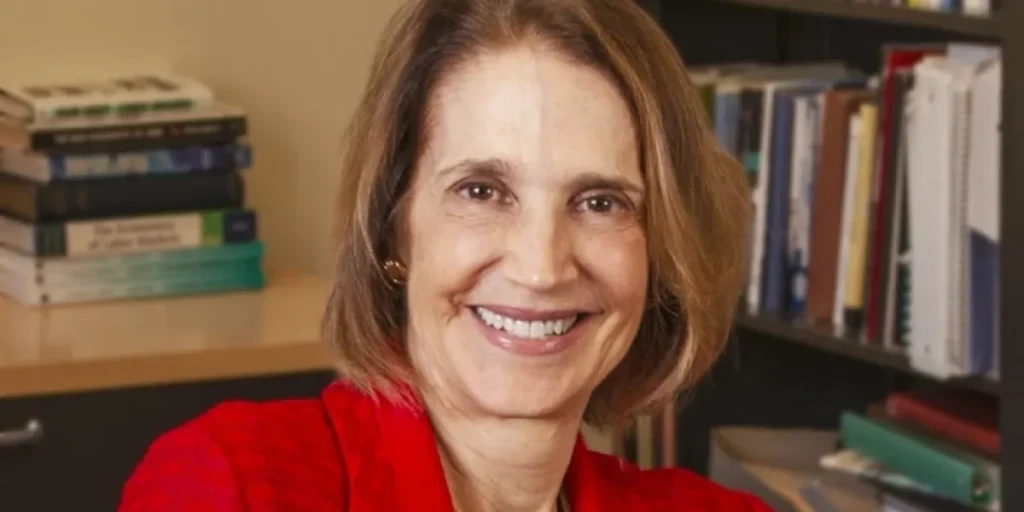
A self-described “retirement nerd” and advocate for social democratic policies, the 68-year-old Ghilarducci told Fortune about how she came to partner with Hassett, saying it’s a natural outgrowth of her 42-year career studying retirement security. At The New School, she directs a think tank and a specialized lab that studies how to promote economic security for aging Americans and she believes now is the time for major changes in how the U.S. approaches retirement, especially for low-income workers.
Her work is in keeping with the New School’s identity as a protest university, of sorts. It was founded in 1919 by a group of progressive intellectuals who thought Ivy League Columbia University was too conservative, as it had censored their criticism of U.S. participation in World War I. It stresses a “more relevant model of education, one in which faculty and students would be free to honestly and directly address the problems facing societies,” which Ghilarducci interprets to include retirement.
Hassett, who has worked for both Trump administrations and has a PhD in economics, reached out to Ghilarducci in between White House stints, to ask about feedback on a paper he was writing about retirement security in 2021. “I gave him all sorts of comments, and he wrote back, and he said, ‘You know, you should be a co-author of this paper,’” she said. That paper became the basis of the administration plan for universal 401(k)s, which the president announced at the State of the Union.
The White House did not respond to Fortune’s requests for comment or questions about Hassett’s work on retirement issues.
Right place, right time
The last 15 years has created a perfect storm for major change to come to retirement policy, Ghilarducci explained. As 76 million baby boomers have retired and Gen X’s retirement is on the horizon, people have been disappointed in how their assets or 401(k)s have grown, she said.
A recent BlackRock survey found that people think they need about $2.1 million to retire comfortably. The average balance of 401(k) was $144,400 in Q3 of 2025, according to Fidelity Investments, or less than 7% of what people believe they need.
“[Baby boomers are] uncertain about how much money they’re going to have and how long it’s going to last. That’s 50 million people that did not have this concern 20 years ago,” Ghilarducci said, explaining that many retirees “have been disappointed” by how their 401(k)s and assets have appreciated.
As millions retire, there has been a simultaneous increase in awareness about growing wealth inequality in the U.S., pointing to the Occupy Wall Street and Black Lives Matters movements that focus on wealth distribution.
The third and most important factor was “a quirky, bold leader,” she said, and the U.S. has found that in Trump. “Retirement security is a worker issue, and therefore a populist politician, like Donald Trump, has reasons to take it up.”
She said her concern for the depth of the retirement crisis has pushed her to move beyond politics. “I’ll work with anybody who says that workers need more security for all their life,” she said. “I think if I was younger, I would have these ideological, righteous concerns, but over time, the problem has just got too big for my righteous concerns.”
Mutual concern, mutual commitment
Due to her expertise, Ghilarducci is often invited to events and meetings with financial managers and economists on the right, she said. She is also a trustee for two pension funds for United Auto Workers retirees at General, Ford, and Chrysler, and steelworkers at Goodyear. “I’m very comfortable there,” she said. “I’m usually there to give another point of view.”
While it comes to retirement security, she said Hassett is just as “passionate” as she is, describing him as an “empathetic, emotional guy.” She said they bonded over being “PhD nerds” and their mutual commitment to making retirement better for more Americans. “There’s this empathy we have for old people, because we’re human and we’re going to get old.”
Details are yet to be released
Specific details of the president’s plan for universal 401(k)s and how workers can enroll have not yet been released. Economists have estimated that a plan like Trump’s would help the poorest 25% of Americans save between $138,000 and $610,000 for their retirement.
“This plan has been thoroughly studied by hundreds of experts and professors for many years, and this is surely an idea whose time has come,” Ghilarducci said. “It should have happened earlier, before half of baby boomers retired. It would have really helped them.”
She said she believes that low-income workers need a bigger match than $1,000 each year and she hopes Congress will pass a more generous match for workers.
“This is an architecture, a design, where they have the best chance of putting some money in their accounts early in their life, keep it there and then,” she said. “When you do that, you take advantage of the magic of math, because compound interest kind of takes over for the workers’ contribution.”
The post This ‘retirement nerd’ at the uber-liberal New School teamed with Trump’s economy guru to reinvent the 401(k) appeared first on Fortune.