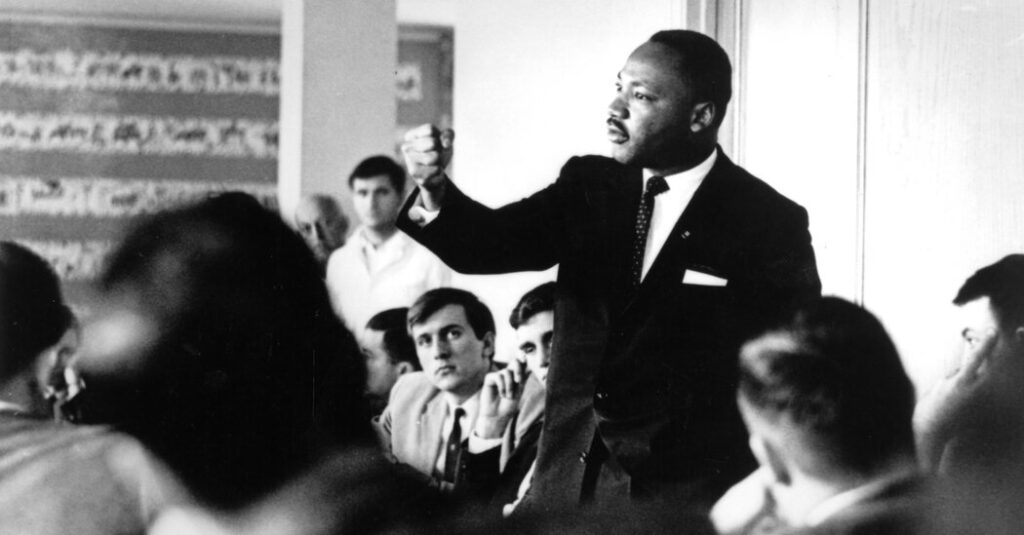
Between 1962 and 1966, Martin Luther King Jr. visited Wesleyan University four times to talk with students and teachers about the struggle for civil rights and nonviolent activism. It was a dark time in this country, but Dr. King told his audience that moral ends could yet be achieved through moral means, and that “we can move through the darkness of the hour to the brightness of a new day.”
Some undergraduates heeded that call, and were inspired to join the many others around the country traveling to Mississippi, where voting rights were under attack. Freedom Summer, as that unforgettable season in 1964 was called, involved dangerous work. Many participants were beaten or arrested. A few were murdered. But they shook the conscience of a nation, and their efforts eventually led to the passage of the Voting Rights Act.
American voting rights are once again endangered, this time by the White House. The threat of violence isn’t nearly as immediate as it was in 1964, but from demanding Minnesota’s voter rolls to reinvestigating the 2020 election to making remarks about nationalizing elections, the Trump administration’s actions should leave no doubt as to what the nation is up against. Now is the time for everyone — Republicans, Democrats and independents — to come together and defend our foundational democratic right. And higher education has a unique role to play.
Inspired by those volunteers seven decades ago, Wesleyan University and a network of hundreds of schools and allied organizations are uniting for Democracy Summer, a nationwide program to educate citizens and protect our elections in the coming year.
This isn’t some passing fad: American colleges and universities have been educating people to participate in public life since the founding of the Republic. Thomas Jefferson and George Washington regarded civic education as a fundamental component of liberty. Throughout the 1800s, colleges considered this work — training people to fulfill their duty as citizens — to be central to their mission, because they knew, as Frederick Douglass put it, that learning was “the direct pathway from slavery to freedom.”
The brave volunteers of Freedom Summer knew it, too, and put it into action with Freedom Schools, which taught basic math and reading skills while also helping students explore their role in a functioning democracy.
That is the resolve that we now all must muster to secure our most fundamental right, our most fundamental freedom. Doing so won’t just strengthen our republic; it will also directly enhance the education of students who participate, empowering them to build a better future. And what better way this summer to celebrate our nation’s 250th birthday?
The Democracy Summer network includes research-intensive universities like Yale and Duke, big state schools such as Michigan and Texas and small religious institutions such as Goshen College and Trinity Washington University, as well as interest groups from the American Association of Colleges and Universities to Interfaith America. Civic engagement centers at more than 400 colleges and universities have joined the effort, and more are expected.
How these schools interpret the mandate to protect our democracy is up to them. Many will work with organizations such as Campus Compact and Civic Nation to encourage voting. Others are focused on promoting free speech and civil dialogue on their campuses. They might work on local issues by canvassing and organizing in communities, or focus on national obstacles to voting such as poor access to polling places, misinformation and administrative constraints. Many will offer internships that enable students to join campaigns from Alaska to Texas, or hold workshops on how to register voters and help them get to the polls. And by the end of the summer, as midterm elections come into view, the network of schools will dispatch thousands of students for meaningful work, under the guidance of election administrators and civic organizations, to recruit poll workers and monitor voting as it’s underway. Many different ways to ensure one simple promise: that every eligible voter has the chance to cast a ballot, and that all ballots are accurately counted.
The Trump administration has taken steps to limit how colleges and universities distribute voter registration materials. But Democracy Summer is not a partisan effort: We are drawing students from conservative-leaning civics centers and older progressive organizations alike, and they will work side by side, in districts where they feel politically at home as well as those where they are outliers. Nor is this a one-time effort. The elections of 2026 are crucial, but we are building democratic muscles in young people that should endure well beyond the current election cycle.
Leonard Edwards, who met Dr. King during one of his visits to Wesleyan, was asked about why he joined Freedom Summer. It was “the fastest decision I could make,” he said. “This was my chance to make a difference on an issue that had bothered me my entire life.” Mr. Edwards went on to be a distinguished superior court judge in California, an expert on juvenile justice. Looking back, he concluded: “I couldn’t have chosen a better foundation than doing the work in Mississippi.”
College students may not be an exact demographic match for the country as a whole, but they are a diverse lot, and the work of Democracy Summer will offer all of them the same strong foundation that Mr. Edwards described. It will bring students out of their campus bubbles, providing young people with an extraordinary opportunity during our semiquincentennial to learn about the broad array of problems, opportunities and aspirations in America, and to learn how to listen to and communicate with people who don’t share their own convictions or life experiences.
Higher education has thrived in the ecosystem of freedoms provided by our democracy. Today that ecosystem is under enormous strain, and as teachers and students we must now rise to its defense. We can, as Dr. King said, “move through the darkness of the hour to the brightness of a new day.”
Michael S. Roth, the president of Wesleyan University, is the author of “The Student: A Short History” and “Safe Enough Spaces: A Pragmatist’s Approach to Inclusion, Free Speech and Political Correctness on College Campuses.”
The Times is committed to publishing a diversity of letters to the editor. We’d like to hear what you think about this or any of our articles. Here are some tips. And here’s our email: [email protected].
Follow the New York Times Opinion section on Facebook, Instagram, TikTok, Bluesky, WhatsApp and Threads.
The post The Nation Faces a Crisis. Colleges Have a Unique Role to Play. appeared first on New York Times.