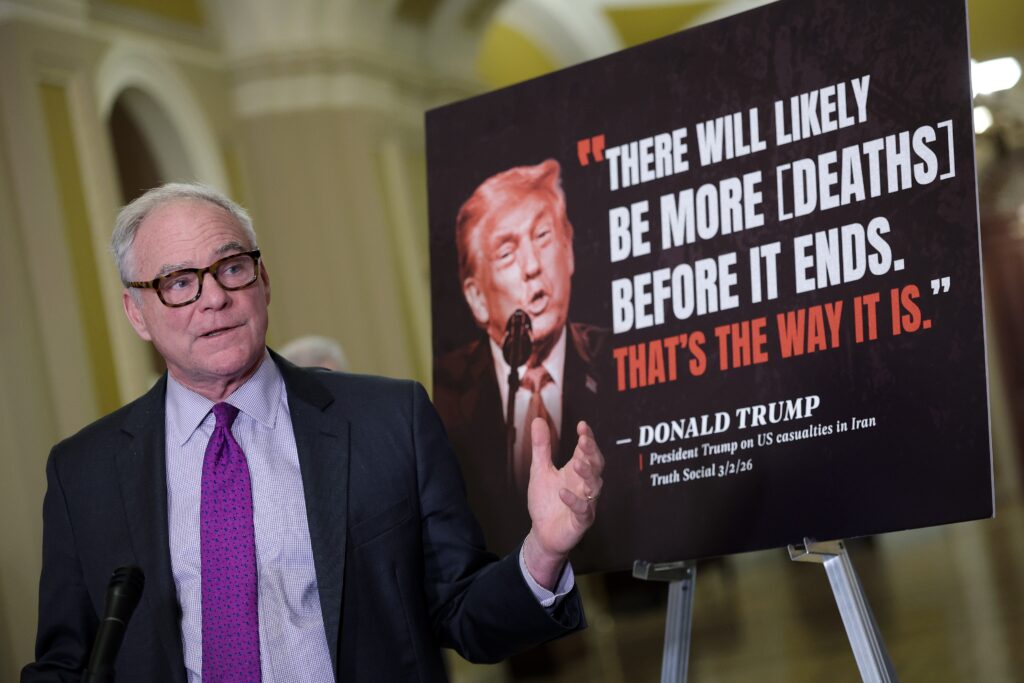
The Senate is scheduled to take an initial vote Wednesday on blocking President Donald Trump from ordering further strikes on Iran, offering the first test of Congress’s support for a campaign that Trump launched without its consent.
Democrats — along with Sen. Rand Paul (R-Kentucky) — are forcing a vote on a war powers resolution over the opposition of most Republicans, who control the Senate. Democrats are imploring a handful of Republicans to break with their party to end the conflict and reassert Congress’s control over declaring war.
“I pray so hard for my colleagues to exercise the judgment that this is not the right time for more war,” Sen. Tim Kaine (D-Virginia) said Monday on the Senate floor.
But the resolution faces tough odds.
Congress has voted on seven other war powers resolutions since June, all of which failed. Most Republicans support the U.S. and Israeli air campaign that started Saturday, which has killed Ayatollah Ali Khamenei and other top Iranian leaders, and they are working to defeat the resolution.
“We should let him finish the job,” Sen. Lindsey Graham (R-South Carolina) told reporters, referring to Trump. “We should cheer him on, in my view.”
The House is set to vote Thursday on a similar war powers resolution, which Speaker Mike Johnson (R-Louisiana) said he believes he has the votes to defeat.
“The idea that we would take the ability of our commander in chief … to finish this job is a frightening prospect to me,” Johnson told reporters. “It’s dangerous, and I am certainly hopeful — and I believe we do — have the votes to put it down.”
In the Senate, at least four Republicans besides Paul would need to support the resolution for it to pass if every senator is voting. One Democrat, Sen. John Fetterman (Pennsylvania), has said he will oppose it.
Even if the resolution passes the Senate and the House, Trump could veto it. Overriding Trump’s veto would require a two-thirds majority in both chambers. No war powers resolution has ever overcome a veto.
The Senate vote Wednesday is an initial procedural vote to advance the resolution, and any Republicans who support it could still oppose its final passage.
That’s what happened in January, when five Republicans — Sens. Lisa Murkowski (Alaska), Susan Collins (Maine), Josh Hawley (Missouri), Todd Young (Indiana) and Paul — voted with Democrats to advance the resolution blocking strikes on Venezuela. But Hawley and Young flipped days later after Trump wrote on social media that they “should never be elected to office again,” though they extracted some concessions.
Democrats wanted to force a vote on the Iran resolution before the strikes, which Kaine said last week would increase its odds of passing. But they did not do so, in part because negotiations between the Trump administration and Iran were still underway.
Some Democrats have compared Trump’s strikes on Iran to the Iraq War, although President George W. Bush sought and received authorization from Congress before the U.S. invasion in 2003. Trump has not asked for authorization to strike Iran.
“I pray that my colleagues will vote to end this dangerous and unnecessary war that has already resulted in the loss of six servicemembers and injured others,” Senate Minority Leader Charles E. Schumer (D-New York) said in as statement. “We owe it to those in uniform, their families, and all Americans to not make the same mistakes that we made in Iraq and Afghanistan.”
The U.S. invaded Afghanistan in the aftermath of the Sept. 11, 2001, attacks and occupied the country for nearly 20 years. While U.S. forces succeeded in killing Osama bin Laden, the architect of the attacks, in Pakistan in 2011, they never defeated the Taliban, which had sheltered bin Laden. The Taliban overthrew the American-supported Afghan government weeks before U.S. forces withdrew and remains in power.
The War Powers Resolution, which Congress passed in 1973 in response to the Vietnam War, allows a single lawmaker to force a vote to withdraw U.S. forces from a conflict or to block strikes when hostilities are imminent. It also requires the president to withdraw forces after 60 days — or 90 days if the president seeks an extension — unless Congress declares war or authorizes the use of military force.
Senate Majority Leader John Thune (R-South Dakota) said Tuesday that he does not believe the Trump administration needed to seek authorization to continue the Iran campaign even if it lasts for longer than 90 days.
“I think the president has the authority that he needs to conduct the activities, the operations that are currently underway there,” Thune told reporters.
Secretary of State Marco Rubio, Defense Secretary Pete Hegseth and other administration officials held briefings for lawmakers Tuesday, which Sen. Chris Murphy (D-Connecticut) said convinced him that the campaign could last a long time.
“I think they have contempt for Congress,” Murphy told reporters. “They have no plans to come to Congress for any authorization, even if they were to insert ground forces.”
Liz Goodwin, Noah Robertson and Marianna Sotomayor contributed to this report.
The post Senate to vote on forcing Trump to end Iran strikes appeared first on Washington Post.