In Nick Shirley’s mega-viral YouTube videos alleging social-services fraud in Minnesota, the important piece of evidence was — in a literal sense — the absence of evidence. Shirley and his crew drove around Minneapolis pulling up to Somali-American-owned day cares that had received state funds and knocked to request entry. Notionally, they were trying to see if there were legit child care businesses inside. They were denied entry; what day care, after all, would let a camera-brandishing crew of YouTubers inside?
Once a door was shut in their face, all they could film was the building’s facade. Brick. Covered windows. And crucially, no children: a fact they latched onto with great energy. “Where are the kids?” they asked. “The children are missing!” They took what could easily be viewed as banal — a nondescript business — and transfigured it into evidence of something nefarious. At one point, Shirley even pointed to a lack of footprints in the snow outside a day care as evidence that something was off.
As Shirley’s footage became an online sensation, helped along by posts on X by JD Vance and others, it spawned a wave of imitations: copycat influencers nationwide started filming their own “investigations” of social services. Much of the footage they produced was like Shirley’s, with the everydayness of business exteriors presented as a potential sign of wrongdoing, often underlined by some variation on the same observation: Something’s wrong here; something’s missing.
Whether imitating Shirley or not, Mehmet Oz, Administrator for the Centers for Medicare & Medicaid Services, made a similar contribution, posting a video in which he drove around a Los Angeles neighborhood that has a high density of Armenian-American-owned hospice care agencies. Gazing skeptically at their storefronts, he suggested that the lack of visible activity was a sign of possible fraud. “I don’t know how many patients are getting care,” he said. “There are either a lot of people dying here or you’ve got a lot of fraudulent activity.”
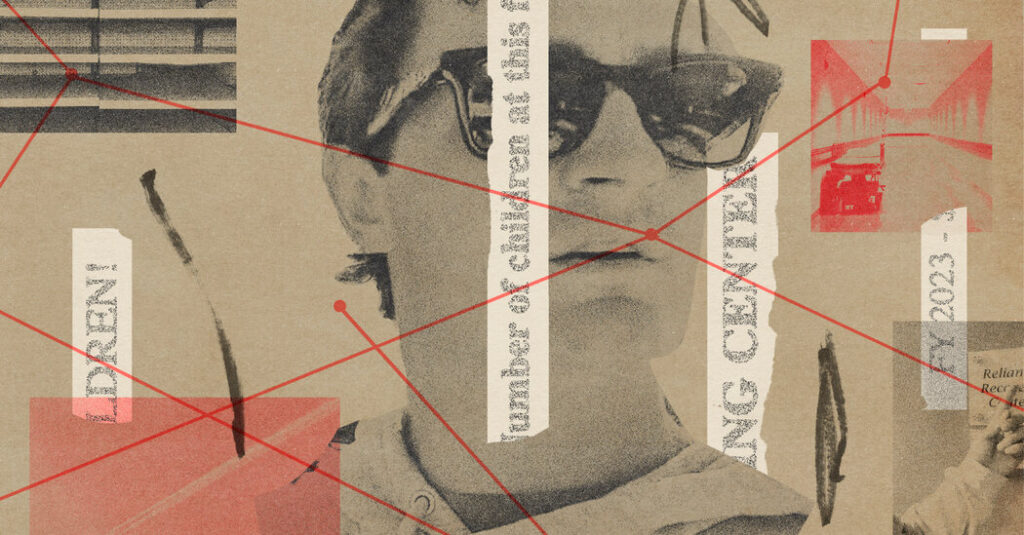
We’re long familiar with a mode of conspiracy theory that depends, in its way, on substance: elaborate stories about what’s really happening and how it’s been hidden, trumpeted by people who insist that they have the facts and analytic acumen to prove it. We might call this mode “baroque conspiracy.” Its practitioners offer up piles of evidence, notecards connected by strands of red string and narratives about how it all adds up. Conspiracy theories tend to simplify the world: It’s not complicated, it’s the Jews; it’s not complicated, it’s the World Economic Forum; it’s not complicated, it’s the lizard people. But this doesn’t mean they can’t also be baroque. Intricacy and elaborateness can be their own currency.
These new videos by Shirley and others operate in a distinctly different mode. The underlying account of what’s happening passes quickly and can almost be taken for granted. This is the case even when there’s very real evidence of very real malfeasance on hand. While The Minnesota Star Tribune found no evidence of fraud at the day cares that Shirley visited, social-services fraud in the state is a real phenomenon, widely documented by government indictments, prosecutions and journalistic investigations. But these creators aren’t always following up on this work. Instead they think that something (kids, hospice work) should be visible. They think that this something is missing. The blank space is the smoking gun.
We can see this new mode of theorizing afoot in online reactions to the Epstein files. These are the raw material of a baroque conspiracist’s dream: zillions of documents, direct mention of all manner of global elites, granular insight into the private lives of power. But instead of digging into this rich soil, today’s online conspiracists are talking about pizza.
Epstein’s emails contain hundreds of mentions of pizza: One possible explanation being that the sex trafficker and his friends, like most Americans, loved pizza; another explanation, one that circulated online, is that for Epstein, “pizza” was code for “sex” or “sex with underage girls.” This same theory was a central component of Pizzagate, the D.C. sex-trafficking theory that eventually grew into QAnon. When shoehorned into our new online style, this fixation becomes the whole story. Some videos simply point to the sheer number of “pizza” mentions in Epstein, as if they speak for themselves. Others repurpose old clips of celebrities talking about pizza (or more menacingly still, “pizza parties”), raising the possibility that they, too, were part of Epstein’s evil cabal.
Instead of engaging with what all the emails actually show, the new conspiracists stay focused on their bread and butter: nothing. In the world as they describe it, truth is made visible by the meaningful absences on the surface of the everyday: the blank outside of the day care, the empty grocery shelf, the ciphered references in the tranche of documents. In the world they help create, even when the truth starts coming out, it gets buried in an avalanche of slop.
This new aesthetic seems to have come of age in the hothouse conditions of the Covid pandemic. As the virus spread worldwide, skeptics who didn’t believe that it was actually having the effects claimed by journalists and public health officials began sharing footage of empty hospital parking lots and waiting rooms, often tagging the posts with #FilmYourHospital. If things were really so bad, these videos suggested, then where were all the patients? Rather than elaborate a grand theory of the deceiving parties and their motives, these videos simply let the eerily quiet footage speak for itself.
In retrospect, #FilmYourHospital feels like the progenitor of the still-mutating genre of videos in which an image of a bare shelf in a grocery store is presented as straightforward evidence of, well, whatever you want to see: the dire effects of Covid-era policies on food-supply chains; the foolishness of Trump’s tariffs; an imminent economic collapse coordinated by global elites. Since Covid, videos of cargo ships at sea — apparently sitting still — have been posted as evidence of coordinated supply-chain shenanigans. The clips ask: Why? What explains the absence of motion? Who is keeping the ship still? During a recent government shutdown, chemtrail theorists posted pictures of empty skies, as if they proved that chemtrails were, in fact, a government op.
The political scientists Russel Muirhead and Nancy Rosenblum have a neat term for this mode: “conspiracy without the theory”: conspiratorial content that traffics less in spiraling explanations and more in vague assertion and coy insinuation about what, exactly, is being argued by whom (“a lot of people are saying”). This new mode dovetails neatly with the incentives of the online video economy: assembling an elaborate account of how the Illuminati actually control the world takes work — you have to write out your argument. Posting, say, an empty grocery store shelf captioned by a raised-eyebrows emoji or a simple semi-assertion — “more fraud?” — takes just a couple of minutes, and gives the viewer the satisfaction of having something mind-bogglingly complex reduced to a single potent image that appears to say it all. Much easier to hit your weekly upload quota and stay on schedule. “Nothing” — a blank facade, an empty street — is easier to track down than anything resembling actual evidence; nothing is everywhere, and fits perfectly into short clips.
Each of these scenes’ emphasis on absence (Where are the children? Where are the patients? Where are the groceries? Where are the chemtrails?) creates a void into which every scrolling viewer can instantly project whatever suspicion they’re already disposed to. The baroque conspiracy theorist assumes he has to talk you into something, to do the hard labor of helping the scales fall from your eyes. Shirley and Co. seem to know that the scales are primed to fall; instead of sketching elaborate counter stories, they seem to assume you already have some at your disposal, waiting to be deployed. They’re just trying to give you the pleasure of doing so — of flooding the blank image with meaning based on what you already know to be true.
Peter C. Baker is a writer in Evanston, Ill., and the author of the novel “Planes.”
Source for illustration above: Screenshots from YouTube.
The post In Today’s Conspiracy Theories, the Lack of Evidence Is the Evidence appeared first on New York Times.