Seth Cropsey is president of the Yorktown Institute. Joseph Epstein is a senior fellow at the Yorktown Institute and director of its Turan Research Center.
With the Iranian regime decapitated by a joint U.S.-Israeli strike that killed Supreme Leader Ali Khamenei and several top commanders, and with a resurgent Sunni extremist axis led by Turkey and Qatar gaining ground, the United States faces a pivotal choice in the Middle East. It should proceed by building a coalition of moderates — anchored by Israel, Azerbaijan and the United Arab Emirates — that is capable of countering both Iranian aggression and the rising tide of Sunni radicalism.
That emerging extremist Sunni axis, fueled by Muslim Brotherhood ideology, Turkish military ambition and Qatari money, is pulling in cautious allies such as Saudi Arabia — nations whose recent surges in anti-Jewish rhetoric signal an ideological drift that should alarm Washington.
Israeli Prime Minister Benjamin Netanyahu’s answer is essentially a revival of the “Periphery Doctrine” that aimed to counter hostile Arab nationalism through clandestine alliances with non-Arab states and minority groups in the Middle East. Netanyahyu has proposed a counterweight coalition, mentioning India, Greece and Cyprus. But the key to any alliance fighting extremist Islam is Muslim countries that can put forward a contrasting and appealing vision.
In a potential post-Islamic Republic era — now closer than ever after the elimination of Khamenei and the ongoing destruction of Iran’s military and nuclear infrastructure — moderate, tolerant Islam will be pitted against radical intolerance. If the Turkey-Qatar axis is allowed to fill that vacuum, the result will be a wave of extremism that pits American allies against each other and fuels global terrorism.
This is where the Israel-Azerbaijan-UAE coalition becomes indispensable. These three nations share more than bilateral goodwill. The UAE anchors the Abraham Accords, while Azerbaijan is one of Israel’s closest allies after the United States. Baku and Abu Dhabi recently conducted joint military exercises in “Peace Shield 2026.” All three nations are committed to combating terrorism and have embraced models of tolerance and coexistence.
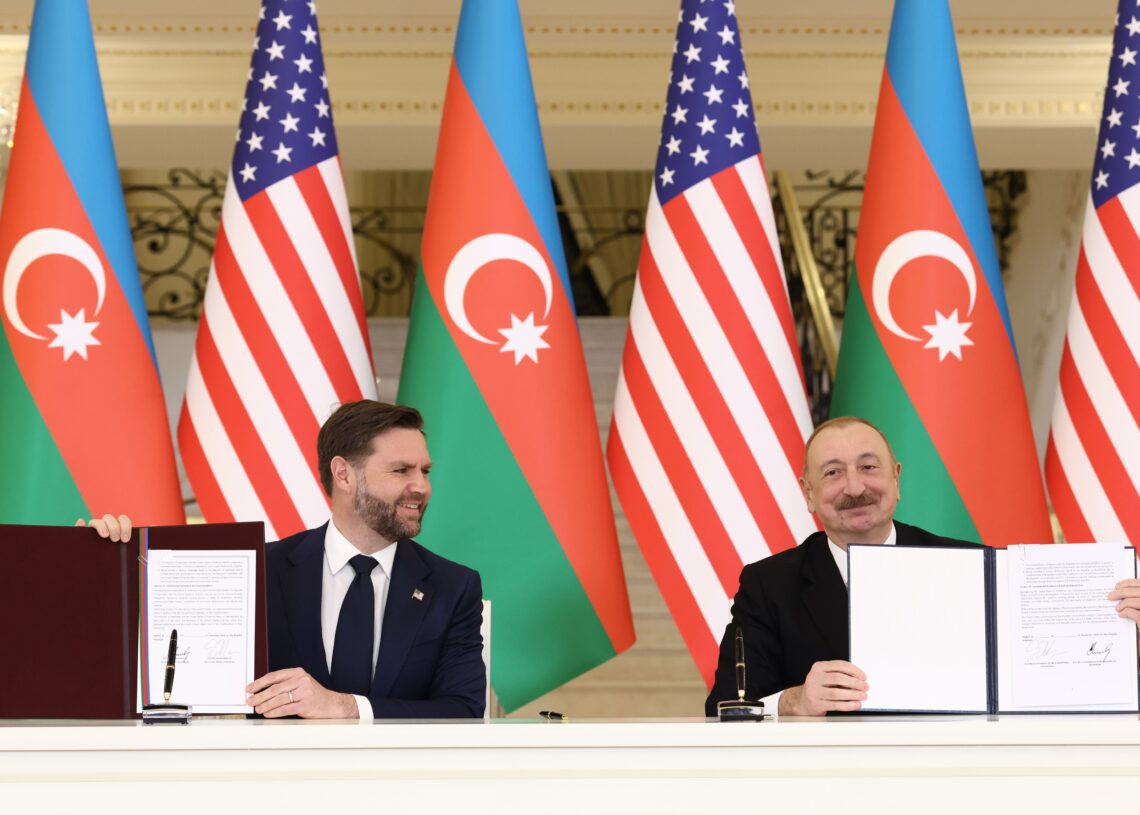
Washington already recognizes Azerbaijan’s value as a defense partner. On Feb. 10, Vice President JD Vance and that nation’s president, Ilham Aliyev, signed the U.S.-Azerbaijan Charter on Strategic Partnership, elevating the relationship with an emphasis on security cooperation, counterterrorism and energy development. Aliyev signaled his eagerness for deeper ties, declaring after the signing, “For us, it’s a great honor to be a strategic partner of the most powerful country in the world.” That openness should be welcomed with effective policy.
When Iran launched Operation True Promise 4 in retaliation for the U.S.-Israeli strikes, it fired a scatter of missiles and drones across the region — more than 165 ballistic missiles and more than 540 drones at the UAE alone. Saudi Arabia was hit in Riyadh and its Eastern Province. Kuwait, Bahrain, Qatar and Jordan all came under fire. Iran’s indiscriminate barrage transformed a theoretical argument about coalition defense into operational reality.
The intelligence dividends from a moderate coalition are significant. Mossad’s capabilities, UAE surveillance networks and Azerbaijan’s unique insights into Iran’s ethnic minorities — particularly the many millions of Azerbaijanis inside Iran — would create a complete intelligence picture. Joint exercises among the three nations would build the interoperability necessary to deter Iranian aggression and, if deterrence fails, to act decisively.
The Feb. 28 strikes already demonstrated what coalition coordination looks like in practice. UAE bases supported American operations. Israeli precision-strike capability stretched Iranian defenses across multiple fronts, enabling the elimination of Khamenei and numerous senior commanders of the Islamic Revolutionary Guard Corps. The net effect was fewer American casualties and a faster, more decisive outcome.
This coalition is not directed against Turkey or Qatar. Both remain important American partners, and the goal is not to isolate them but to reshape the regional incentive structure. A credible bloc of moderate, pro-American states would raise the cost of flirting with extremism and reward constructive behavior. Ankara and Doha, both deeply dependent on their relationship with Washington, would have every reason to gravitate toward moderation rather than risk being sidelined.
Furthermore, this coalition delegates regional responsibility to capable allies, reducing the need for direct American military involvement. This burden-sharing is especially necessary as Washington pivots to Asia.
The path forward requires concrete steps. First, Washington should incorporate Azerbaijan and the UAE into discussions with Israel on countering Iran. Second, Congress should repeal or permanently waive Section 907 of the Freedom Support Act, an anachronistic restriction on aid to Azerbaijan that hamstrings full partnership. Third, Washington should promote joint military exercises, intelligence sharing and counterterrorism coordination among all three nations, along with economic and energy initiatives that strengthen the coalition’s material base.
Finally, the United States should champion this coalition’s moderate ethos as the ideological alternative to both Iranian theocracy and Sunni radicalism. In the contest for hearts and minds that will define the post-Islamic Republic order, this alliance offers a credible vision of tolerance, prosperity and coexistence. It could even lay the groundwork for integrating a free Iran into the regional architecture.
As the Sunni axis consolidates and the Iranian regime fights for survival, ideology will determine the Middle East’s trajectory — and, with it, the United States’ security for decades to come. Washington should act now to back the coalition that aligns with both American values and American interests.
The post How to defeat a dangerous ideological drift in the Middle East appeared first on Washington Post.