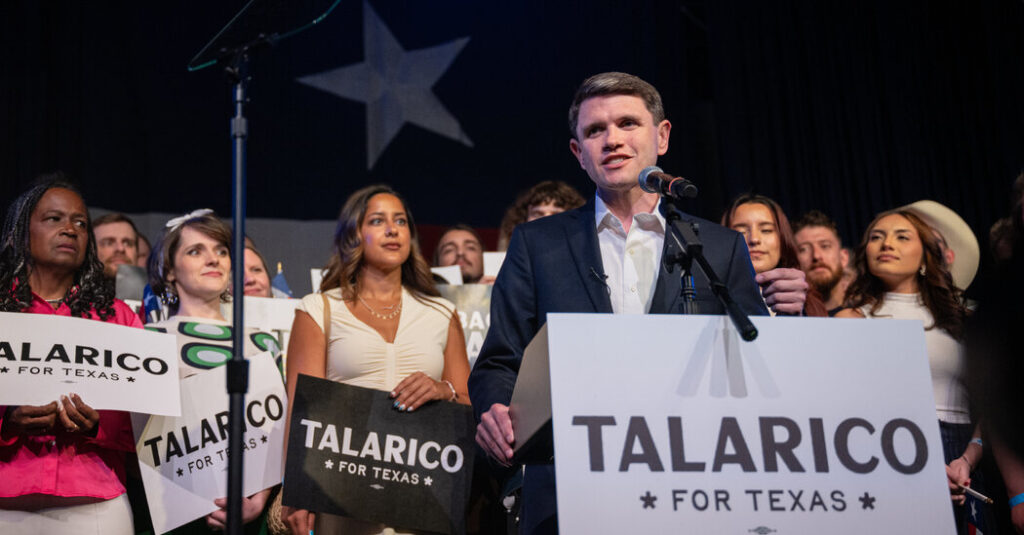
The first primary of the season is in the books, and for all the attention on the Texas Senate Democratic race, there’s a case that the Republican primary was the most significant result of the night.
After all, James Talarico was a modest favorite in the Democratic race before his win over Jasmine Crockett, even if the outcome was still uncertain heading into Election Day. John Cornyn, the Republican incumbent, was not a favorite at all. He trailed in the polls, and the betting markets gave his main opponent, Ken Paxton, around an 80 percent chance to eventually win the nomination, with an outside chance that Mr. Paxton could reach the 50 percent of the vote necessary to avoid a runoff.
But as of this hour, not only are we headed to a runoff, but Mr. Cornyn actually won more votes.
Mr. Cornyn’s strength is pretty consequential. Most obviously, it makes him seem more competitive in the runoff. It might also increase the chance of an endorsement from President Trump. And if Mr. Cornyn ultimately prevails, he will be a much stronger candidate in the general election than Mr. Paxton, who brings a lot of personal and political liabilities.
Mr. Talarico’s chances of winning Texas in November don’t necessarily depend on a Paxton victory. But if one stipulates that Democrats wanted a perfect storm to help turn Texas blue, with a strong nominee, a weak Republican opponent and a favorable Democratic political environment, a Cornyn nomination would spoil one of those conditions.
Here are a few other observations on the results from Tuesday night:
Not what was billed
For months, the two Texas Senate primaries were cast as referendums on each party’s deepest divides. For Democrats, many perceived it as a fight between the party’s progressive left and its moderates. For Republicans, it was ostensibly a contest between MAGA and the Republican establishment. Neither race ever quite fit the billing, as the results confirm.
Usually in a Republican primary, the MAGA candidate wins by overwhelming margins in rural areas, while the establishment one wins the most affluent and highly educated enclaves. That’s not what happened. In the end, Mr. Paxton won by only four points in rural areas. There were wide swaths of central Texas that went Mr. Cornyn’s way. Perhaps it shouldn’t have been a surprise. President Trump didn’t endorse Mr. Paxton, while Mr. Cornyn is a well-known incumbent with a huge financial advantage.
On the Democratic side, the perceived “moderate” candidate, Mr. Talarico, won the state’s usual progressive strongholds. He carried nearly all of the counties won by Bernie Sanders in the Democratic presidential primary against Joe Biden in 2020. He won college campuses and gentrifying neighborhoods, but he also won the leafy gated communities that usually line up against those more progressive strongholds.
In other words, if the New York mayoral race pit the wealthy Upper East Side against the younger Bushwick, Mr. Talarico basically won Texas’ equivalents of both — usually with overwhelming margins. It’s a strong indication that this election wasn’t really about the Democratic Party’s usual divides, despite the prevailing framing of the race.
A racially polarized primary
What was an enormous factor in the contest? Race.
Ms. Crockett dominated majority Black areas. She routinely won more than 90 percent of the vote in majority Black precincts in metropolitan and eastern Texas.
Mr. Talarico, on the other hand, essentially swept areas where Black voters represented a below-average share of the population. White, Hispanic and (in a very small and potentially unrepresentative sample) Asian precincts appeared to support him by a wide margin.
In highly educated and liberal white areas, Mr. Talarico ran up the score. He won more than 80 percent or even 90 percent of the vote in the relatively white and affluent communities west of Houston and Austin or north of Dallas.
Hispanic voters backed Mr. Talarico by a comfortable margin. He won about two-thirds of the vote in the South Texas counties along the border, for example, and he appeared to fare similarly well in the majority Hispanic precincts in the state’s major metropolitan areas.
Missing Democratic Hispanic voters
While the turnout was high and Mr. Talarico did well among Hispanic voters, there were lingering signs of dissent among the state’s Hispanic voters — especially along the Rio Grande. Many there didn’t cast ballots in the Senate race — or voted for Ahmad Hassan, who won about 1 percent of the vote statewide.
Take Starr County, a heavily Hispanic county along the Rio Grande. It was ground zero for the Trump surge among Hispanic voters: He won the county by 16 points in 2024; Hillary Clinton won it, 79 to 19, just eight years earlier. The turnout was enormous, leading some to highlight the surge as a sign of a Democratic rebound. Well, about half of Democratic primary voters left their ballots blank in the Senate race — and left their ballots blank for most races, other than the county judge election. And among those who did vote in the Senate race, 8 percent voted for Mr. Hassan.
This doesn’t mean Democrats won’t do much better among Hispanic voters in Texas in November, but at the very least it’s a reminder that primary participation is an imperfect measure of someone’s current political allegiances.
Democratic turnout was huge
Whatever the limitations of primary turnout, the fact remains that the turnout in the Democratic primary was exceptional. That’s true even if we limit ourselves to the ballots cast in the Senate race.
With nearly all of the votes counted, about 51 percent of Texas Senate primary votes were cast in the Democratic race, compared with 49 percent in the Republican Senate contest.
This is extraordinary. Usually, Republican primary voters outnumber Democrats by around 20 percentage points in Texas. Democratic primary voters did outnumber Republicans by a similar margin in 2020, but that was a year with a competitive Democratic presidential primary and no marquee Republican race. This time, Republicans had a high-profile matchup of their own — one that would ordinarily decide the next U.S. senator from the state — but more people decided to vote in the Democratic race anyway (and no, those who voted in the Democratic primary can’t vote in the Republican runoff in May).
The same story held in North Carolina, where neither statewide race was especially competitive. There, 57 percent of voters cast ballots in the Democratic primary, to just 43 percent on the Republican side.
On its own, primary turnout doesn’t necessarily mean much for the general election. But Tuesday’s numbers are part of a broader pattern of high Democratic turnout, including in special elections and last year’s general elections in New Jersey and Virginia. It follows a longer-term trend of the party out of power faring well in off-year elections, especially when the president is unpopular. And it’s yet another sign, if a modest one, that this year’s midterm is shaping up to be a strong one for Democrats.
Nate Cohn is The Times’s chief political analyst. He covers elections, public opinion, demographics and polling.
The post High Turnout, Unusual Coalitions: Lessons From the Texas Primary appeared first on New York Times.