BEIRUT — The killing of Iranian Supreme Leader Ayatollah Ali Khamenei in U.S.-Israeli strikes over the weekend did not just shake Iran. It has reverberated across the Shiite Muslim world, raising the specter of a broader backlash in the Middle East and beyond.
For the Muslim world’s Shiite minority, 86-year-old Khamenei was more than just Iran’s theocratic ruler since 1989. He was also one of their most prominent religious and political figures. His death at the hands of a joint U.S.-Israeli operation has stoked fury across the Shiite world.
“There is reason to be concerned about how Shia minorities across the Middle East, and in particular … the Shia majority in Iraq might respond to this,” said Burcu Ozcelik, senior research fellow for Middle East security at the Royal United Services Institute, or RUSI, a U.K.-based defense and security think tank.
Shiite Muslims make up around 10% to 15% of the world’s Muslim population, concentrated mainly in Iran, Iraq, Bahrain and Azerbaijan. There are also significant communities in Pakistan, Lebanon and Yemen.
For Mamoona Shirazi, a Shiite activist in Pakistan’s Punjab province, Khamenei “was not only our leader but a leader for all. He raised his voice against oppression. He never bowed to anyone; he spoke the truth and was like a father to us.”
Protests erupt
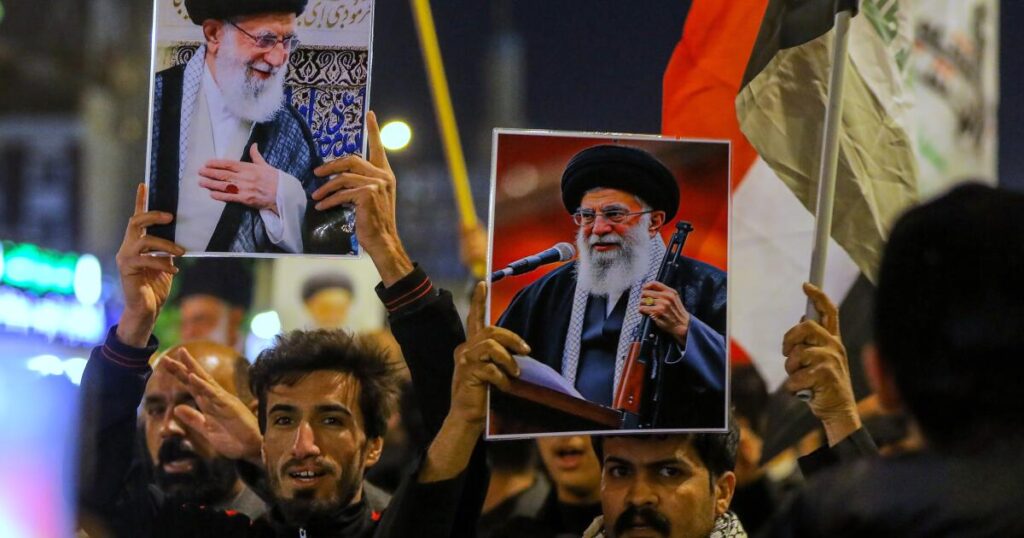
Within hours of Khamenei’s death, thousands of infuriated protesters took to the streets in Pakistan. They tried to storm the U.S. Consulate in the southern city of Karachi and clashed with police outside the diplomatic enclave in Islamabad where the U.S. Embassy is located, while also attacking United Nations offices in northern cities. At least 34 people were killed in clashes with security forces. More than 120 were injured.
“If the United States and Israel are not stopped, the entire world will turn into ruins. Peace-loving people must awaken,” said Hussain Muqaddasi, head of the Pakistani Shiite political party Tehreek-e-Nifaz-e-Fiqh-e-Jafariya.
In Iraq, demonstrators clashed with police near the U.S. Embassy, while in Lebanon, the Iran-affiliated Hezbollah group fired missiles toward Israel for the first time in over a year. Hezbollah’s missile attack triggered intense Israeli airstrikes on the country that killed dozens of people. Tens of thousands of people fled their homes in the predominantly Shiite areas of southern and eastern Lebanon as Israel threatened more strikes, called up 100,000 reservists and sent troops into southern Lebanon.
“I think there’s a psychological, emotional aspect to the killing of Khamenei and we are very much in the early days of trying to make sense of what that might look like,” said Ozcelik of the U.K.-based think tank.
Frustration at Iran’s meddling in other countries
Still, Ozcelik noted the potentially violent backlash could be tempered by growing frustration, even among Shiite populations, at Iran’s meddling in other countries’ affairs.
Over the last five to 10 years, the young generation in Iraq in particular, she said, has shown resistance to Iran’s “overwhelming penetration” of Iraqi domestic affairs, including its security services, judiciary, politics and economy.
Involvement in countries with a significant Shiite population has been a defining feature of Iran’s foreign policy for decades. Tehran adopted a strategy of building alliances not only with states, but also with armed groups — the Houthis in Yemen and Hezbollah in Lebanon being just two, as well as armed groups in Iraq and Syria.
Its interventions, generally presented as seeking to protect Shiites’ interests, often drew criticism of undermining countries’ sovereignty and fostering instability. One of the Trump administration’s key demands of Iran ahead of this conflict had been that it sever support to proxy groups in Lebanon, Iraq and Yemen — a demand Iran rejected.
Given this frustration, Ozcelik suggested there is unlikely to be the “sharp, violent sectarianism that we saw after 2003,” when Iraq descended into a bloody, prolonged period of violence between the formerly dominant Sunni minority and Shiite majority in the wake of the U.S. invasion and overthrow of Saddam Hussein, a Sunni Muslim. The violence spilled across other countries in the region, most notably into the Syrian civil war.
Since then, “the Middle East in many ways has moved on. I think there is a strong urge and desire for de-escalation at this point, particularly in the gulf,” Ozcelik said.
Previous prominent targets
Over the last years, the U.S. and Israel have assassinated some of the most prominent figures in the Iran-led regional alliance, including Shiite clerics. The slayings began with the 2020 U.S. airstrike in Baghdad that killed Iran’s Gen. Qassem Soleimani, commander of the Revolutionary Guard’s elite Quds Force, along with veteran Iraqi militant Abu Mahdi al-Muhandis.
In September 2024, Hezbollah’s leader Hassan Nasrallah, the de facto head of an Iranian alliance spread across Iraq, Yemen, Syria and Lebanon, was killed in a massive Israeli airstrike south of Beirut.
But Khamenei was by far the biggest blow.
“After the assassination of Ayatollah Khamenei, Iran says it has no red lines left,” said Trita Parsi, co-founder and executive vice president of American foreign policy think tank Quincy Institute for Responsible Statecraft.
A region in turmoil
Tehran’s backlash has brought turmoil across the region.
Hundreds of missiles and drones have flown across the Middle East and as far afield as Cyprus. Usually prosperous and peaceful countries like the United Arab Emirates and Qatar scrambled to shoot down Iranian weaponry as they shut their airspace, grounding commercial flights and stranding hundreds of thousands of passengers.
Many Shiites perceive the strikes against Iran and Khamenei’s killing as aimed against their entire community.
“There is targeting of Muslims in general, but the targeting is specifically directed at Shiites,” said Nasser Khazal, whose building was destroyed in an Israeli airstrike Tuesday in a suburb of the Lebanese capital, Beirut.
Lebanese political analyst Qassim Qassir said Iran’s vehement retaliation is seen as a fight for Shiite survival against the U.S. and Israeli vision for the region.
“There is targeting of the Shiite community and its political and religious leaders, and today it is an existential war, whether in Iran, Lebanon or Iraq,” said Qassir, author of a book about Hezbollah. “The United States and Israel want to impose their project on the region.”
Associated Press writers Becatoros and Mroue reported from Athens and Beirut, respectively. Munir Ahmed in Islamabad, Pakistan, contributed to this report.
The post From Karachi to Beirut, Khamenei’s death sends shockwaves across the Shiite world appeared first on Los Angeles Times.