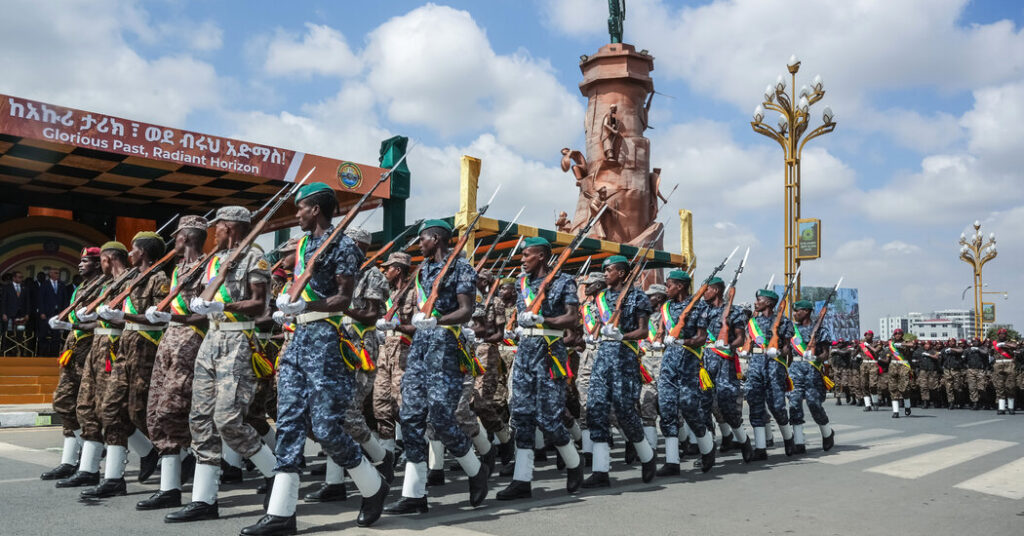
Last weekend, Ethiopia’s military staged a parade before a cheering crowd. Tanks rolled. Fighter jets roared and special forces troops marched in procession.
At the heart of the display was a message emblazoned for all to see: It featured a picture of the prime minister, Abiy Ahmed, a crude image of a soldier breaking down a door and the words, in Amharic, “Whether they like it or not, we will not be landlocked.”
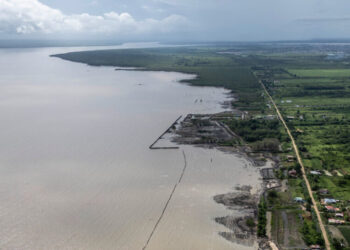
Ethiopia wants a port, by any means. The nearest one is in the city of Assab, just 40 miles away and across the border with Eritrea. Tension between the two nations has escalated in recent weeks, in part over the port issue. Many analysts say a conflict could be on the horizon.
Both sides have moved troops toward their shared border and Ethiopia warned Eritrea in a letter last month that its forces had occupied part of Ethiopian territory. The letter was sent by Foreign Minister Gedion Timothewos to his Eritrean counterpart. Mr. Gedion said the so-called incursions were “acts of outright aggression” and demanded that Eritrea withdraw.
Eritrea has denied the accusations. The country’s president, Isaias Afwerki, in January dismissed any talk of war as absurd and sounded a note of defiance. “Should war be unleashed on us, we know how to deal with it,” Mr. Isaias said in an interview.
By population, Ethiopia is the world’s largest landlocked country. Access to the Red Sea is viewed as crucial to facilitate trade, to ensure security and as a home for the country’s navy. It is also a matter of national pride.
Last year, Mr. Abiy told Ethiopia’s Parliament that sea access was an “existential” issue and on Monday, at celebrations to commemorate Ethiopia’s victory over Italian troops at the Battle of Adwa in 1896, the country’s president, Taye Atske Selassie, went further.
“Ethiopia’s renaissance will be attained when geography no longer curtails the destiny of its 120 million people and they are unshackled from being denied access to the sea,” he said.
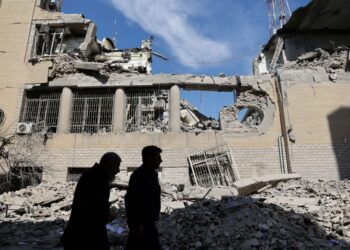
The toll of any conflict with Eritrea would be devastating, given the quantity and sophistication of the weaponry available to both countries and the size of their respective armies. At least 80,000 people died in the 1998-2000 border war that was fought by soldiers dug into trenches and armed with artillery.
This time drones would be a significant additional factor.
A conflict would also further destabilize the Horn of Africa and likely make Ethiopia and Eritrea another theater for rivalry between two powerful Gulf States, Saudi Arabia and the United Arab Emirates, analysts said. The U.A.E. has close ties with Mr. Abiy’s government, while Mr. Isaias visited Saudi Arabia in December.
Mr. Isaias and Mr. Abiy have not always been enemies. In 2018, Mr. Isaias welcomed Mr. Abiy into his home in the Eritrean capital, Asmara. The gesture signaled a thaw in relations two decades after the start of their initial conflict. Video at the time showed one of Mr. Isaias’ grandchildren perched on Mr. Abiy’s knee as the two men shared coffee. Mr. Abiy beamed.
A year later, Mr. Abiy was awarded the Nobel Peace Prize.
In 2020, Mr. Abiy and Mr. Isaias were allies in a war against the Tigray People’s Liberation Front in Ethiopia’s northern province. The Front had dominated Ethiopian politics in the region for decades under Meles Zenawi, who took power in 1991 when his rebel forces defeated the country’s Communist dictatorship.
Mr. Abiy sidelined the group from power after he took office in 2018. The war in Tigray that began in 2020 led to accusations of atrocities and massacres. Hundreds of thousands of people were killed and millions were displaced.
A peace deal signed in the South Africa capital, Pretoria, ended the fighting, but a failure to implement its terms, including fixing the status of Tigray within the federal republic, is a factor in the current instability, according to analysts.
A recent report by the Pan African Agenda Institute think tank described the situation as a “negative peace.” Now, no side appears happy with the 2022 deal. The Tigrayan leadership has fractured and new rebellions have sprung up in Ethiopia involving militias from neighboring Amhara province.
Ethiopia has accused Eritrea of collaborating with these new rebel groups and militias, an allegation Asmara has denied. (Western Tigray is currently under the control of the Amhara militias.)
Ethiopia currently trades through Djibouti and the prime minister has explored a deal with Somaliland to use its port at Berbera, though few believe it is his preferred solution. In his speech at the military parade, he played down the prospect of war and said that Ethiopia’s intention was to “ensure peace throughout Africa.”
But, he added, “Ethiopia has built a force that finishes missions in a short period of time.”
Matthew Mpoke Bigg is a London-based reporter on the Live team at The Times, which covers breaking and developing news.
The post Ethiopia’s Demand for Red Sea Access Drives Fears of New War With Eritrea appeared first on New York Times.